Activity
Mon
Wed
Fri
Sun
May
Jun
Jul
Aug
Sep
Oct
Nov
Dec
Jan
Feb
Mar
What is this?
Less
More
Owned by Marek
Community for creators, freelancers, and coaches who want to turn ideas into real offers and funnels — without chaos, hype, or guesswork.
InnerAscender is a path to light, where each person rises from within – toward their own strength, wisdom, and limitless possibilities.
Memberships
Skoolers
191.8k members • Free
Selling Online / Prime Mover
36.6k members • Free
OfferLab
9.5k members • Free
Affiliate Skool
348 members • Free
Fulltime Freedom
6.3k members • Free
Scale It Up
50 members • Free
HEALTHY BLOOD, HEALTHY LIFE
76 members • Free
The Unbroken Hub
17 members • Free
FunnelHub Community
2.2k members • Free
392 contributions to Selling Online / Prime Mover

2d •
The Invisible Layer Underneath Every Funnel That Nobody Talks About
Launching a funnel is already one of the most overwhelming things you'll do as an online business owner. Design. Copy. Graphics. Offer. Traffic temperature. Hooks. Follow-up sequences. VSL. Thank you page. Upsells. Downsells. And that's just the stuff you can see. Every one of those elements gets attention because you can see it. You can tweak the headline. You can adjust the button color. You can rewrite the hook. The visible layer of a funnel gets obsessed over because it's right there in front of you. But underneath every funnel is a second layer that most operators never look at. Not because they don't care. Because nobody told them it existed. The invisible layer looks like this.. Your SEO title and meta description -- the text Google and AI search engines use to understand and display your page. Most funnel pages have the platform default sitting there untouched. Your page speed -- visitors are leaving before your headline loads. Silently. Without a bounce notification. Without any indication in your analytics that speed is the problem. Your JSON schema -- the structured data that tells search engines and AI crawlers exactly what your page is and who it's for. Almost nobody in the funnel world has this configured. Your indexability -- whether Google is actually allowed to find your page. One accidental noindex tag and your page is invisible to search entirely. Permanently. Until someone checks. Your checkout flow -- not whether the page loads, but whether a real human on a real device can actually complete a purchase right now. These two things are not the same. Your SSL certificate -- a single expired certificate puts a security warning between your prospect and your page before they read a single word. Your email confirmation -- whether the automation actually fires after someone opts in or buys. Not whether it's set up. Whether it fired. Here's the painful part.. None of these show up in your funnel builder. None of them appear in your analytics. None of them send you an alert when something goes wrong.


🔥
1 like • 11h
This is gold! Most people optimize what they SEE in a funnel. But the real leaks happen in what they don’t. And today that “invisible layer” = whether AI and search can even understand the page. No structure → no visibility. No visibility → no sales. Not just funnels anymore. It’s about building answers. Appreciate this value bomb @James Curran 🔥
🔥
11h •
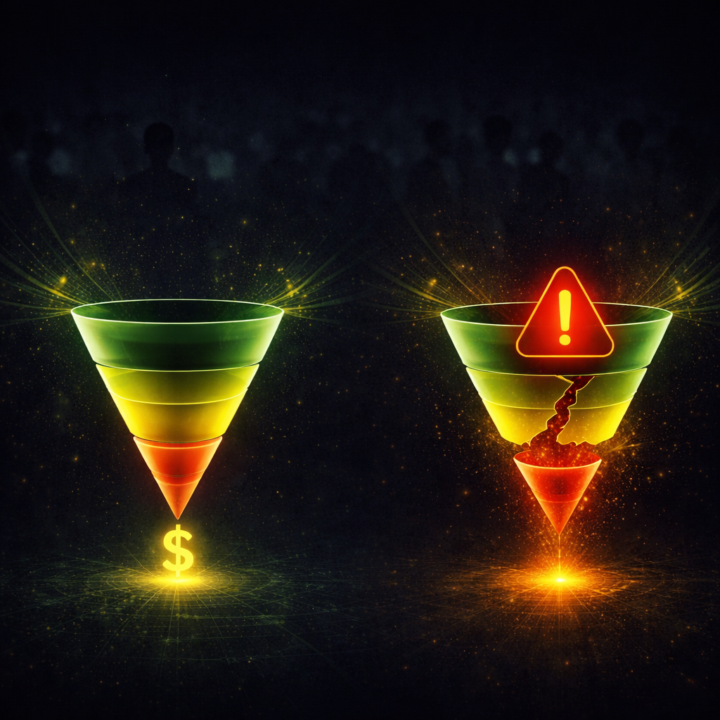
Most funnels don’t fail everywhere.
They fail in one exact place. And people keep fixing the wrong thing. They redesign pages… rewrite copy… change tools… While the real problem stays untouched. Until that one bottleneck is fixed… nothing moves. 👉 Which part of your funnel currently feels the weakest?
3
0
🔥
1d •
Your funnel has too many choices.
That’s why nobody chooses. People say: “give users options” No. Options create hesitation. Hesitation kills action. High-converting funnels do one thing: they remove decisions. One path. One action. One next step. Everything else is noise. 👉 Does your funnel have one obvious next step — or multiple?

🔥
1 like • 11h
... this is what real progress looks like @DrBetsy Meshbesher I appreciate this more than you think. What you did here matters. You didn’t rush to “build a funnel”… you did the deeper work first: clarity, structure, alignment. That’s why you’re moving now. 37+ years of experience was never the issue.Translating it into one clear path was. And you did that. Most people here are still stacking tactics on top of confusion. You chose discipline instead. Now it gets simple: One entry point. One promise. One next step. Thank you for trusting the process and for actually executing it. That’s rare.
🔥
1 like • 11h
@DrBetsy Meshbesher Love that Dr. Betsy. That’s exactly how this works, not just understanding it, but keeping it visible while you build. Because the moment things get complex… this is the anchor: one path, one action. Stay locked on that: ... everything else is distraction.

Jan 3 •
Why I just told a CEO her AI strategy is a "hallucination." 🍄
I was just diving into a thread on LinkedIn about the "AI Context Gap," and it hit me: We are still trying to put Ferrari engines (AI) into golf carts (messy data). Most GTM teams are obsessed with the "Magic Wand" of AI, but they’re ignoring the LOGIC LAYER. Back at NUTRABOLICS, we saw this play out in real-time. If the plumbing isn't architected for scale—specifically the LEAD-TO-INVENTORY SYNC—the most "intelligent" system in the world will still hallucinate growth and hit a wall. I’m currently in my SALESFORCE PLAYGROUND mapping out the guardrails to fix this. 🤺 ARCHITECT-TO-ARCHITECT: Where are the 'Revenue Leaks' actually happening? Top-of-funnel, or is the BACK-END FULFILLMENT LOGIC just a house of cards? I’m betting it’s the latter. 🫳🎤
🔥
1 like • 2d
@DrBetsy Meshbesher Yes it is...Right now I am spending over 80% my pc time with AI


🔥
1 like • 2d
@DrBetsy Meshbesher thank you for reminder
1-10 of 392

🔥
@marekrabcan
Founder @ FunnelAscender™
I help creators move from messy ideas to structured offers, working funnels, and revenue.
Active 10h ago
Joined Jun 23, 2025
INTJ
North Slovakia
Powered by