Activity
Mon
Wed
Fri
Sun
Nov
Dec
Jan
Feb
Mar
Apr
May
Jun
Jul
Aug
Sep
Oct
What is this?
Less
More
Automatable Free
25.5k
Free
Independent Wrench Jobs
201
Free
Technician Find Community
590
Free
The AI Advantage
130.1k
Free
Academy of Advertising
2.8k
Free
THE SKOOL HUB
5.6k
5.0
$10/m
Skool Course
36.6k
1.0
$29/m
Automotive Collective
139
Free
Champion University
29
Free
52 contributions to Technician Find Community

1d •
Stop asking techs to “tell me about yourself”
“They feel like you really studied my resume.” That’s @Brett Beachler, talking about the techs he interviews. Brett owns Beachlers Tire & Automotive Center in Peoria, Illinois. A family shop, open since 1951. He shared this on our last EasyBench call. The reason has nothing to do with his job ad. It’s what he does in the few minutes before an interview. I think it's brilliant and he gave me permission to share it here in the community. Brett had four tech interviews on the calendar. Before every one, he did the same thing. He dropped the candidate’s resume into an AI tool built to think like a technician. Told it what position he was hiring for. It handed him a full interview guide built around that one guy. Where he’s worked. What he’s done. How he’d fit at Beachlers. Brett’s problem with the standard interview sheet? “It’s not molded and fit to the guy that’s coming in.” This one is. Here’s why it works on the tech. Most shops ask him the same three things. Tell me about yourself. Why are you looking? Where do you see yourself in five years? Brett asks about him. How you interview a tech tells him what kind of boss you’ll be. Generic prep says generic boss. Here’s why it works. “Tell me about yourself” gets the answer he already gave the last three shops. It’s polished. It’s rehearsed. It tells you almost nothing. Ask something like “Why’d you leave the Ford store after 14 months?” and you get the real story. He hasn’t practiced that one. Custom questions don’t just impress him. They tell you who you’re actually hiring. Here’s a test for every question on your sheet, with AI or without it. Could I ask the next guy this, word for word? If yes, it’s a screening question. Keep two or three of those so you can compare candidates. Everything else should only make sense for him. Now, Brett will tell you he’s “not a very creative individual.” He even wonders if ChatGPT is dumbing him down a little. Here’s how I see it.


1 like • 1d
@Chris Lawson THIS. IS. AWESOME. 💪🏻⚡️🤟🏼
Jul 30 •
"Police instantly disperse teen takeover by firing job applications into crowd"
Community member @Paul C sent this to me today. I can't stop laughing🤣

0 likes • Jul 30
[attachment]
Jul 27 •
Brian's tech takes the same month off every year.
Same month. Every year. And every year he worked around it. Not this year. A Vo-Tech instructor is covering the month. Fully master certified. He teaches all year and gets three months off every summer. Brian didn't advertise to replace his vacationing tech. He runs a route. Quick lubes in his area. Donuts. Pizza. He's been doing it for years. They send him the work they can't handle. He isn't asking them for favors. He's useful to them first. And every one of them knows he's looking. One of them mentioned the instructor. The instructor is already in the shop a couple of days a week, learning their systems. He'll be up to speed before the month starts. He picks up summer work. Brian solves a problem he's had every year. And it lines up again next summer. The tech's month off doesn't move. Neither does the school calendar. Brian didn't get lucky. He built a route, made himself useful, and told everybody what he needed. Quick lubes. Parts stores. Tool truck. Anybody who sees technicians all day and isn't competing for them. You already have a route. You've never told anybody on it what you're looking for. And if you've asked and nothing came back, you asked too early. Nobody hands you a lead because you asked. The donuts and pizza got him known. Taking care of their customers made them look good for knowing him.
0 likes • Jul 28
@Brian Nerger is the GOAT! ⚡️
Jul 8 •
You Don't Have an Applicant Quality Problem
There, I said it! The applicants aren't usually the problem. I know that isn't what you want to hear. But nearly every time an owner tells me the candidates are garbage, we find out nobody ever opened them or at least never reviewed and processed them correctly. I've written about this before. I'm writing about it again because I watched it happen twice in the last two weeks. Two shops, both ready to blow up a campaign that was working fine. This one keeps costing people hires. So we're going to cover it again. Here's how it sounds when it starts. "Nobody qualified is applying." "No one wants to do this kind of work anymore." "I've exhausted all other options and I don't know what else to do." So the ad gets changed. Then changed again. Then the pay goes up. Then the town takes the blame. Sit with this one for a second. "Nobody good is applying" is a check engine light. It is not a diagnosis. You would never quote a customer a repair based on how he described the noise over the phone. You'd get hands on the vehicle. You'd pull codes. You'd watch live data. You'd verify before you replaced a part. Hiring is the one system in your building where you accept the phone call description and start throwing parts at it. WHERE IT ACTUALLY BREAKS Most owners are judging applicant quality from email notifications. The automatic ones. A name. Maybe a resume snippet. Often nothing you could make a decision from. The notification is a window. The account is the shop floor. You are standing in the parking lot deciding whether the bay is clean. Last month an owner told me his campaign was dead. Nothing coming in. Ready to pull it. @Christi Warren on my team got on a screen share and opened the account with him on the phone. Twenty-two applications he had never opened. Three he would have hired. Now here is the part that stings, and it's the reason I keep writing about this. The owner usually isn't the one reviewing. He handed it to a manager. A service advisor. His wife. Somebody who has forty other things on the list.

1 like • Jul 9
Great post, @Chris Lawson .
Jun 17 •
So I just ate it on the stairs at the beach in Oceanside.
Not a little stumble. A full send. Went down hard enough that my phone left my hand, cleared two steps, and kept going. I watched it bounce away like even it didn't want to be associated with me. Hand torn up. Leg torn up. And the first clear thought in my head, before any of the pain registered, was not "am I hurt." It was "how many people just saw that." The answer was a lot. The beach was packed. And the stretch right in front of me happened to be a row of very attractive women in bikinis, because of course it was. That's just how the math works when you're bleeding and trying to locate your phone. I'm not gonna lie to you. The version of me from a few years ago grabs the phone, does the fake "I'm fine, totally meant to do that" wave, and speed-limps straight to the car. Workout canceled. We don't talk about this again. But I'm standing there doing the math on the slink-away, and it just hit me that walking off bleeding would somehow be more embarrassing than what already happened. Like the fall was an accident. Quitting would've been a decision. So I got up. Wiped the blood on my shorts. And finished the run. In front of everybody. Looking exactly as graceful as you'd imagine. Anyway. We've all got a moment like this. Fell flat, whole world watching. What's yours? Tell me I'm not the only one. P.S. Phone lived. My dignity did not. Pics below after I got home and swabbed the wounds with iodine, you're welcome.
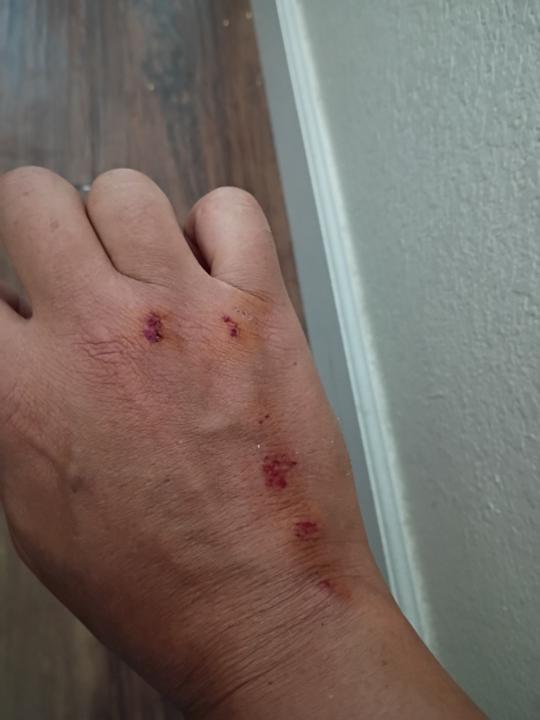
2 likes • Jun 18
First of all, I am glad you and the phone both survived. 😂 Second, “how many people saw that?” being the first thought is way too real. Pain can wait. Public embarrassment clocks in immediately. And honestly, finishing the run after that deserves respect. Bleeding, humbled, and still moving forward is basically the most accurate life metaphor ever. My version was tripping in a parking lot, trying to play it cool, then realizing I had dropped everything I was carrying like a yard sale with legs. No injuries, just instant emotional damage. Glad your phone lived. RIP dignity. 😂
1 like • Jun 20
@Eddie Lawrence I. Am. Giggling. 🤭
1-10 of 52
@christi-warren-7376
Client Success Manager | Building relationships and providing ongoing support to ensure client satisfaction.
Active 1d ago
Joined Oct 21, 2025
Texas
Powered by