Activity
Mon
Wed
Fri
Sun
Aug
Sep
Oct
Nov
Dec
Jan
Feb
Mar
Apr
May
Jun
Jul
What is this?
Less
More
Memberships
Faceless Tuber School
1.3k members • $7/month
GoHighLevel w/ Robb Bailey
13.2k members • Free
James University Community
918 members • Free
Find, Fund & Flip it Challenge
982 members • Free
GOOSIFY: Skool Made Fun
13.1k members • Free
The Game of Influence
374 members • Free
$30k/mo in 30 days Fun Auction
215 members • Free
Acquisition Mojo (FREE)
2.1k members • Free
PiggyBANKING Brand Creators
111 members • Free
7 contributions to Daily Email House

26d •
High percentage of failures
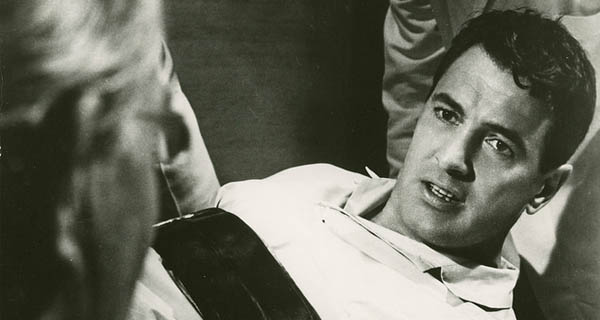
I recently rewatched an old movie called Seconds. Uncomfortable, but also very interesting. I won't give away the plot here, in case you ever want to go see it yourself. I'll just share a quote I wrote down, because it was relevant to what we all do: "You know son, when I began this business, I was a young man with an idea. I wasn't aiming to make a lot of money. Helping others, help them to find a little happiness. Oh heck, not just the rich. You see, I got tremendous comfort in the thought that in my small way I was waging a battle against human misery. And I was, too! Except we do have a high percentage of failures. I guess that's to be expected, but it hurts me." If you are in the information selling business... I reckon you got into it at least in part to wage a battle against human misery, in your own small way. I also reckon that you have a high percentage of failures. Regardless of how good your information is. Regardless of how accessible you try to make it. Regardless of how hard you try to motivate people. People just don't get the results that you know are possible, or any results at all. Does this hurt you? Do you just shrug it off and say, "That's to be expected"? I'm curious about your experiences, what you think about this, and what if anything you do about it. Let me know. And if you like I can share what my experiences are and what I think and do.

7 likes • 26d
Unless you're selling upcoming "winning lotto" numbers, or some other sure shot outcome, trying to sell information alone is no longer high perceived value, imo. Just today I wrote about how I saw at least 4 "gurus" that used to sell their high ticket info courses... they've made them free. Now the value is in the execution and outcomes. - Removal of: Acute Pain (High intensity) → Frustration (Mid) → Annoyances (Low) - FOMO: Events, Window of Opportunity, Loss of preferred option with no alternatives - Fear of Loss: Status (Good lord this is powerful), Asset (No one likes to lose good things they have), Life (basic survival) - Transportation: Bring you → it, it → you (Pair this with pleasure and you've got luxury tier stuff) - Transformation - But like someone else said, easier to sell this once they have some momentum - keeps you going. Away from pain gets you off your ass → towards pleasure keeps momentum going. Tools, Vehicles and Externalities are infinitely easier to sell, always have been, but now... With AI and rampant IP being given away and / or mass pirated... info itself is no longer highly valued. Not sure I went off on a tangent, but yeah.... leverage - bots, tools, power, speed and networks (distribution and intimate connection) towards outcomes are where the value seem to be. I dunno.
1 like • 26d
@John Bejakovic Yeah.. not everyone is Travis... fo sho, lol
Apr 24 •
Unwritten rules
This morning I watched a video about unwritten rules in baseball. (Bear with me if you know nothing about baseball or care nothing for baseball.) I had no idea, but baseball has had, for 100+ years, dozens of unwritten rules about player conduct, for example: - You cannot flip your bat after you hit a home run - You cannot have a beard (all teams, once upon a time, New York Yankees still today) - You cannot score from second base on a single if your team if the game is a blowout and your team is winning Now here's what got me: These unwritten rules are enforced BY THE PLAYERS THEMSELVES ON THE PLAYERS THEMSELVES... often by members of your own team! If you break one of these unwritten rules, odds are great that you will be beaten up, ostracized, or sometimes worse (eg. have a 100mph baseball launched at your face on purpose). Here's what else got me: - If you're a big star and you break a rule in a big moment, exceptions are made - If you're young or inexperienced, then you will be consistently and brutally punished by other players for breaking a rule I remember reading in, I believe, Robert Cialdini's Influence about the importance of hazing rituals to form a sense of in-group identity. That's what this reminds me of. Seemingly arbitrary rules, enforced by group members, as a way of reinforcing the importance of the group and of recommitting their loyalty to that group. Now I've really never belonged to any group, unless that group is the group of outsiders who don't really belong to any groups. But without getting too weird about it... I'm curious: What seemingly arbitrary rules have you experienced or seen in real-life groups you've been a part of? And in online groups you've been a part of?
5 likes • Apr 24
Show up early or at least on time. Punctuality is a filter. Ghosting is a filter. Courtesy and politeness are filters. It's very subtle but it says so much. In the online age, folks don't realize how rude it is to book a call and not show up or show up 10 minutes late. DM ghosting is pretty rude, too, ESPECIALLY if you're in a working relationship already. Like I know it's difficult to have negatively emotionally charged conversations, but that's something I think society needs help with again. It's societal lube. I def got a lot of this from mentors, but thank goodness that includes some family role models, too.
0 likes • Apr 28
@Vernon Richards yeah, I think self awareness gets diminished and self entitlement gets enhanced somehow online. Def seems like an opportunity that some tribes have figured out for themselves. I guess it's culture development? What's allowed to happen happens. Becomes what's tolerated. What is enforced becomes policy. I feel like this is a huge reason United States is becoming so disconnected. We all don't have the same underlying cultural norms, beliefs, interests and such.
Apr 12 •
Sales calls vs. sales pages
I'm curious what you think: Why do sales calls typically convert at 20%-50%... ... while sales pages typically convert at 2%-5%? If you had to put it down to just one thing?
4 likes • Apr 12
If no past relationship (first time doing business)... Heightened faith. If successful already once (already seen some success "buying" from them already)... Heightened trust.
1 like • Apr 13
@John Bejakovic Faith precedes trust. It comes before doing a thing or realizing the outcome of something before it's happened. Belief it's doable (if you've never seen it done before) or belief you can do it (if you've seen others do it) Trust is reinforced once achieved. You've done it. Likely repeatable. Example: We once had faith we could one day go to the moon, but now we trust we can do it again because... we've done it already. Have faith it'll happen. Trust the process. Make sense?
Mar 29 •
[Marketing Battleship] How to sell "Heavy Metal Poontang"
Good news, everybody: Vinnie Vincent, formerly a guitarist for Kiss from 1982 to 1984, has just released a new album, Guitarmaggedon. Guitarmaggedon retails for $2M. Yes, two million dollars. $2,000,000, for a single copy. I haven't heard the album yet – you have to pay for that, and I don't have $2M in cash right now — but I know it features bangers like: - "Heavy Metal Poontang" - "Rocks On Fire" - "Ride The Serpent" - "Cockteazer" If you're not a big VV fan, you might wonder who or what would possibly pay $2M for a 10-track album by a washed-up, second-rate, 73-year-old rock star. I don't know. I also don't know if Vinnie will be able to sell even a single copy of this album. But he does have something working in his favor. For $2M, Vinnie is not just selling a single digital copy of Guitarmageddon... ... he's also selling the licensing rights. In other words... pay Vinnie $2M today, and you could be slinging Heavy Metal Poontang for the rest of your life, and keeping ALL THE MONEY. I bring this up because I have lately been thinking about the value of tying in an offer to money — whether it ties naturally to money or not — in order to make it feel like your prospect is effectively buying "money at a discount." This morning, I came up with 10 ideas for tying an offer into money [update: 11]. "Licensing" was #3 on my list. I would like to share my complete list with you... but I also want to hear if you have ideas I didn't come up with. So I propose a nice little round of Sunday-morning Marketing Battleship. Here's how that works: Tell me your idea for tying an offer into money. If I have that same idea on my list, I'll tell you so. If your idea is not on my list, you get a hit, and I'll share an item on my list that I haven't shared yet. You win when I'm completely sunk and out of ideas. Are you game? Then fire away below and tell me your idea, or two or three, for tying in an offer to money, and making your offer feel like "money at a discount."
![[Marketing Battleship] How to sell "Heavy Metal Poontang"](https://assets.skool.com/f/36cef888ad8643c981305ebe26be21fa/f9977a819e474c0eb33a27938a4b44508595ac2ccdb949af89510edd5f8b8396-md.png)
1 like • Mar 30
Exclusive bonus: Buy it from [this place] and I'll give you x, y, z or an exclusive bonus you either can't get anywhere else or would have to pay for separately (like you get it bundled in audio format, digital and/or an AI ready prompt / instruction for your GPT use)
Mar 21 •
There's a reason why old ads work...
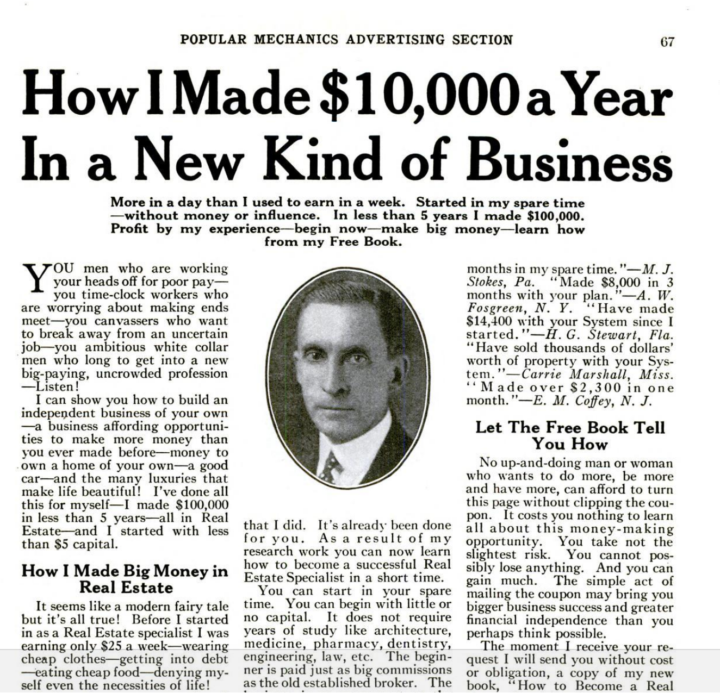
... and that reason is that they were tested infinitely. What you see in an old ad is the perfect combination of words, evolved over a long time, which can be hard or impossible to come up with in one sitting. Example: Yesterday I wrote an email to my list with the subject line: How an ex-copywriter makes $12k/month in a new kind of part-time job That subject line (and the entire email) are modeled on this ad: How I made $10,000 a Year In a New Kind of Business And when I say "modeled," I mean I used a bunch of the same words, same arguments, same structure. Results so far: 55 replies, many from people who are surprisingly qualified and serious about the offer. Would I have gotten the same kinds of results had I simply used my own copywriting brain to write this email? Maybe.... but my personal guess is no. I've had this experience before when I modeled old ads. Completely outsized response to what I normally get. I know it's familiar advice but it's worth repeating. Study old ads. And don't just study them. Apply them. Model them. Even word for word. Old ads are a treasure chest waiting to be opened, and the fact that the treasure chest has been sitting in an attic for the past 100 years doesn't change that.
2 likes • Mar 21
Dude, that Google Books ads trick is dope. Thank you. On a side note, if I may context matters a ton, too. A lot of folks think they can just swipe willy nilly and magically their "modeled" new ad will just work.
1-7 of 7
@carlos-rosario-7299
Weapons grade sales strategist Have an audience? Proven offers? Need more sales? Let's chat. Check me out here → https://sleekbio.com/focusedlife
Active 2d ago
Joined Dec 2, 2025
ENFP
Linden, NJ
Powered by