Activity
Mon
Wed
Fri
Sun
Jun
Jul
Aug
Sep
Oct
Nov
Dec
Jan
Feb
Mar
Apr
What is this?
Less
More
Memberships
Dissertation Help Community
3.6k members • Free
Project Biohacked
11.9k members • Free
Grappling Study Hub
112 members • Free
RB
Research Beyond Borders
26 members • Free
shribe! research lab
64 members • Free
Evidence to Practice
46 members • Free
Skool of Finance
594 members • Free
Scholar Career Network
380 members • Free
Career Operating System
91 members • Free
17 contributions to The Energy Data Scientist

2d •
The Business of Electrification
Download a report from Iberdrola about electrification. Interesting read. The report is global, not Spain-specific. It's based on a survey of 1200+ executives.
2 likes • 2d
3 key points: - Mainstream but not mature: Most firms are piloting electrification, but few have fully embedded it and many are falling behind targets. - Three dominant barriers: Capital costs, infrastructure and grid bottlenecks, and skills shortages are slowing electrification progress globally. - What businesses need: Financial incentives and policy stability are the key levers to unlock decarbonisation and cost-saving gains.
2 likes • 2d
Electrification is the process of replacing fossil-fuel-based technologies ( like internal combustion engines and gas boilers ) with electrically powered alternatives such as EVs and heat pumps. When paired with renewable generation, it's the most direct and scalable lever for cutting emissions across the economy while also improving energy efficiency and reducing dependence on volatile fuel markets.

23d •
Battery Arbitrage Project
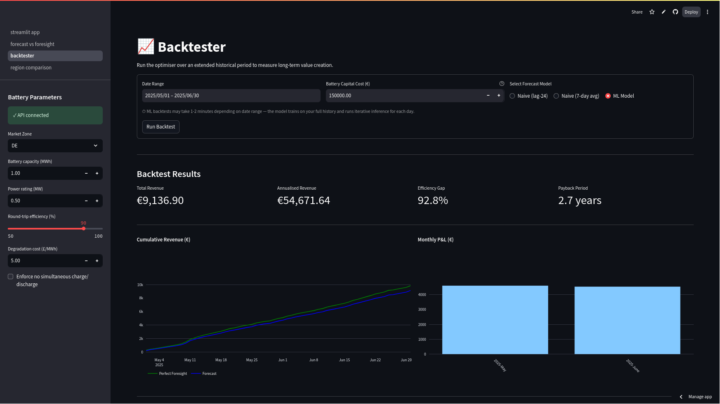
Hi everyone! I've been exploring the battery arbitrage space for the past few months and wanted to share my most recent project: I built a battery arbitrage backtester that finds the optimal charging schedule using LP, and tests it against three forecasting approaches(two rolling averages, one ML) and measures how much of the theoretically available market value was captured. I pooled data from different EU market zones to train a LightGBM model and trained a separate one for Britain, which is why the rolling average model overtook the ML model in Germany's results, for example, which was an interesting result. Article and Streamlit dashboard to play around with here if anyone's curious: https://kilowatthours.substack.com/p/building-a-battery-arbitrage-backtester https://bessarbitragedemo.streamlit.app/ I'm currently working on multi-battery coordination and whether batteries "knowing" more about the grid's topology can improve dispatch results, and using a neural network for the congestion signal. Curious to hear your feedback, and if anyone's working on battery optimization or grid ML, would love to connect.
1 like • 22d
Very cool project. I worked on a smaller storage optimization prototype last year, and one of the biggest surprises for us was how often forecast error mattered more than the optimization formulation itself. Your comparison between LP with different forecast inputs really resonates with that. Would love to know which features ended up being most important in the LightGBM models.
30d •
2025 Energy Jobs Report: Key Highlights
I am sharing this energy job report. It says the U.S. energy sector employed 8.5 million workers in 2024, accounting for 5.4% of all U.S. jobs, and is showing that energy remains a major source of stable, high-paying work across the country. The report’s key points are that energy jobs exist in every state. The largest employment areas were: - Energy Efficiency (2.38 million) - Transmission, Distribution, and Storage (1.46 million), - Fuels (1.05 million), - Electric Power Generation (933,800); - Texas, California, and Michigan had the most energy jobs overall; and the 2025 edition newly adds more detailed data on wages, benefits, occupations, and state-level trends to give a fuller picture of the U.S. energy workforce.
1 like • 30d
Also: .In fuels, petroleum was the biggest subsector with 548,500 jobs, followed by natural gas with 252,600, and together petroleum and natural gas made up most fuels employment.
Mar 10 •
Uncomfortable truths for Workplace
I see many students who want to stay home and so they ask for remote work all the time. Also I see many who go to work and do not dress well. Here is the truth for the job: Truth1: Go 3-4 times every week to the office so others see you. Your presence is very important. Smile and be professional. This plays a role for your promotion. If you stay home most of the time, you will not be promoted and people will forget you. Truth2: Do not use AI a lot at workplace because every computer has trackers and gives your managers a distribution of time (with plots) of how much you used AI and for how long. There is a software (hidden) that summarises your activity on the computer at work. So be careful : if they see that you cannot write code, and all you do is copy-paste from Chat GPT the code, they will fire you sooner or later. Silently one day they will fire you and they will not tell you why most likely. Be careful. Also you can use it on your phone, but it is time consuming.. Ofcourse they have AI tools but you must write code yourself. Truth3: If you go to non-code positions, it is more stressful and more competitive than code positions. Often, you get lower salary also. Because people in energy are scared of coding, and do not like it. So you get an advantage if you can code , understand code etc. Not super . Just basic things. Eg understand Python . Understand ML. etc Truth4: Do not share personal stories with co-workers. They are competing with you for promotion so they want you to fail ... Be careful. Do not share sensitive things. Truth5: Becareful of your social media presence. Managers spy on you e.g. they have fake profiles and are your friends. They will find your second, third etc profiles. They can find your anonymous X profile where you troll people . They have the ability to find you because they have software tools that you do not know . Truth6: yes the online courses here are all you need. But please fix your CV. Align it with energy companies. Do not just design your CV yourself. Get feedback here. Most CVs look rubbish. Try work on your CV carefully.
0 likes • Mar 12
@Kim Min-jun Yes, you do paint the accurate picture.

Mar 3 •
Reminder: Global Energy Market & Job Search
Just a little reminder ! I was in an energy conference in Australia travelling, and it was about energy jobs. Here are some points from top recruiters (eg director of HR in Chevron, director of HR in Total etc): --> energy is a global marketplace. Companies in Australia/Europe/Asia/Africa/America hiring people from all over the world And they sponsor VISAs. And no lay offs! No AI threat. Energy is considered TOO critical and humans are needed. Also be careful with CVs!!! dont just send randomly ! Many people apply to 20, 50, even 100 jobs…And still get no response. Why? Because job application today is not about volume it’s about alignment. Are you: • Applying to roles that truly match your experience? • Reading the job description carefully? • Positioning yourself based on what the employer is actually asking for? • Following application instructions properly? One small mistake in your application can cost you an interview. So you must: • Apply strategically instead of randomly • Align your experience with job requirements • Structure strong application responses • Navigate remote, hybrid, and on-site roles confidently Job searching is competitive, but with the right approach, you can stand out. I strongly recommend you use the service of CV feedback here. Everytime you apply for a job! Don't just send a CV. Same for interview! And last: BELIEVE THAT YOU CAN GET THE JOB. Stop thinking negatively. Tell yourself "I DESERVE THIS JOB."
1 like • Mar 5
@Muriel Shum king Employers in the energy sector are primarily concerned about a major skills gap, meaning many applicants lack the specialized training needed. Thheir biggest hurdle is simply finding candidates who are fully suited for new technical roles.
1-10 of 17

@aless-romano-3254
Python Expert for Commodities markets - Enel @ Milan
Active 2d ago
Joined Oct 30, 2025
INTJ
Italy