
Write something

26d •
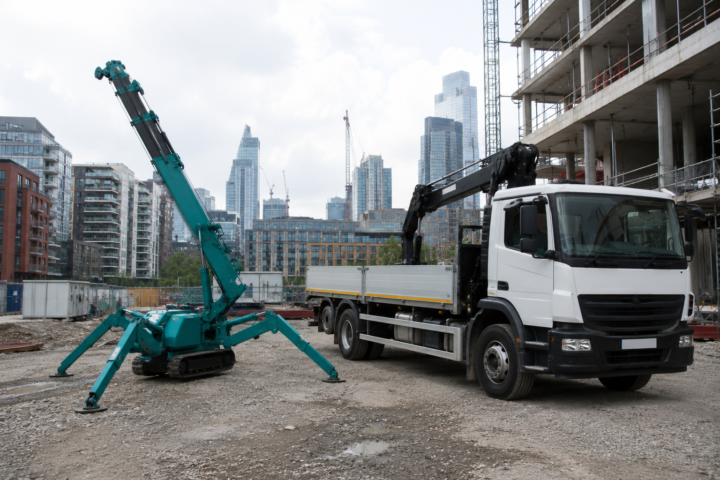
Spider Crane vs HIAB: Choosing the Right Crane for the Job
Incident Overview A site team needed to lift materials into a restricted internal courtyard with limited access, poor turning space, and sensitive ground conditions. The first suggestion was to use a HIAB / lorry-mounted crane because it was already delivering materials. This looked quicker and cheaper on paper. However, the lorry-mounted crane required vehicle access, enough outrigger space, and a stable set-up area. A spider crane would have been more suitable because it can access tighter spaces, work inside restricted areas, and set up closer to the lift point. Spider cranes are specifically used where larger cranes or vehicle-mounted cranes cannot easily access, including confined spaces and restricted routes. What Went Wrong Wrong crane type considered for the environment. HIAB selected because it was convenient, not because it was best. Access route and outrigger space were underestimated. Ground conditions were not fully assessed. Risk of collision with site structures increased. Risk of instability or overturning increased. The lift was treated as delivery work instead of a planned lifting operation. Key Lessons Learned Convenience is not crane selection. A HIAB is excellent for delivery/offload work, but it is not always the safest choice for restricted lifting. Spider cranes are better where access is tight, the lift point is internal, or the crane must get closer to the load. Lorry loaders still require proper stabiliser deployment and strict adherence to manufacturer instructions. HSE has also warned of serious crush risks around some lorry-loader stabilisers. A smaller crane can sometimes be the safer crane. https://www.hse.gov.uk/safetybulletins/lorry-loaders.htm Safety Recommendations Choose the crane based on the lift environment, not availability. Check access, ground bearing, outrigger positions, radius, and collision risks. Use a spider crane where access is restricted or the lift point is difficult to reach.
0
0
Jun 15 •
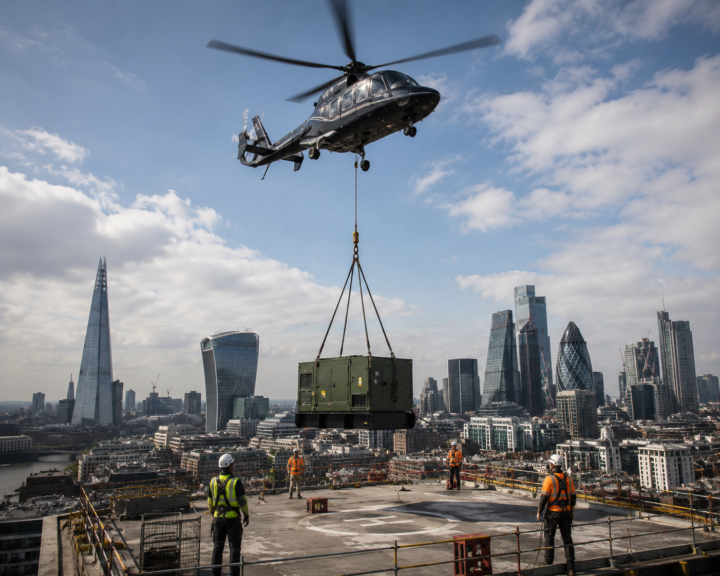
Helicopter Lift to Rooftop: Speed Should Never Replace Planning
Incident Overview A major London project required a large generator and mechanical plant to be installed on the roof of a high-rise building. Instead of using a conventional mobile crane, the contractor chose a helicopter lift to save time, reduce costs, and avoid lengthy road closures and council permits. The helicopter successfully delivered the load to the roof within minutes. Helicopter lifting is increasingly used in London because it can avoid major traffic disruption and long crane setups. However, the operation demonstrates an important lesson: Just because a helicopter can complete the lift quickly does not mean the planning can be quick. What Went Wrong Pressure to save time and money can reduce planning quality. The speed of helicopter operations leaves almost no margin for error. Load preparation, sling arrangement, landing area, and rooftop coordination must be perfect before the aircraft arrives. Unlike a mobile crane, there is little opportunity to "pause and adjust" once the helicopter is in position. Every second of delay increases operational risk and cost. Key Lessons Learned Fast lifting does not mean simple lifting. Helicopter lifts require even greater planning than conventional crane lifts. Ground crew and rooftop teams must work as one coordinated operation. Every load must be accurately weighed, prepared, and secured before take-off. The landing area must be completely clear and ready before the helicopter arrives. Safety Recommendations Carry out a full contract lift assessment before selecting a helicopter solution. Confirm accurate load weights and centre of gravity. Prepare and inspect all lifting accessories before the aircraft arrives. Establish exclusion zones on both the pick-up and landing areas. Ensure continuous communication between pilot, lifting supervisor, rooftop team, and ground crew. Never allow programme pressure or cost savings to compromise planning. Incident Source Helicopter lifting is increasingly used on UK construction projects to install rooftop generators, chillers, and HVAC plant where mobile cranes would require significant road closures or cannot access the site. Operations are completed in minutes but demand extensive planning and coordination.
0
0
May 13 •
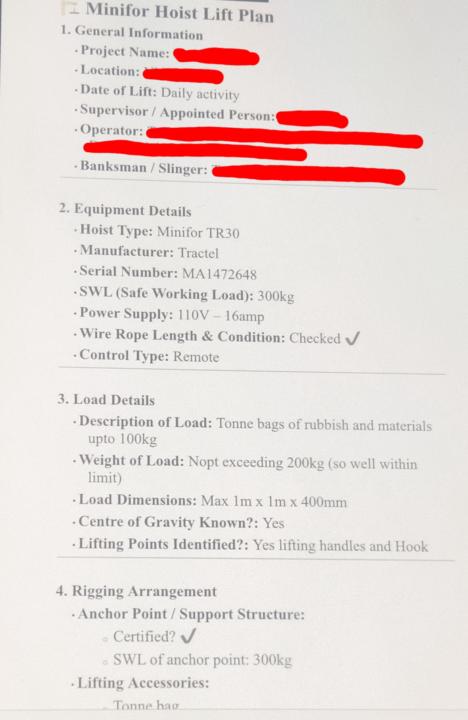
Insufficient Lift Plan. Not Fit for Validation
Incident Overview A Minifor hoist lift plan was presented on site for validation during lifting operations. The document appeared structured but lacked critical technical detail required for a safe and controlled lift. The plan included generic statements such as “inspect equipment,” “attach load,” and “proceed with lift,” but did not define how the load would be rigged, controlled, or safely executed in real conditions. No detailed drawings, rigging configurations, or load control methods were provided. Despite this, the plan was considered acceptable for use on site. What Went Wrong Lift plan relied on generic method statements, not specific methodology No rigging configuration or sling arrangement defined No drawings or visual references for the lift setup No load path or landing sequence described No defined exclusion zone layout or control measures Communication plan vague and incomplete No contingency planning for abnormal situations Plan not detailed enough to be validated or challenged Key Lessons Learned A lift plan must describe the exact lift, not a general process Generic statements do not control real risks If a method cannot be visualised, it cannot be executed safely Validation requires detail, not assumptions A poor lift plan creates unsafe decisions on site Safety Recommendations Ensure all lift plans include clear drawings and rigging configurations. Define exact lifting sequence, load path, and landing procedure. Specify lifting accessories and connection methods. Detail exclusion zones and communication systems. Include contingency plans for abnormal situations. Reject any lift plan that cannot be clearly understood and visualised. Incident Source Real site documentation. Minifor hoist lift plan reviewed on UK construction site (2026). Image evidence shows a generic, non-specific lift plan lacking technical detail. Regulatory Mapping ● LOLER Reg. 8 – Lifting operations must be properly planned. ● LOLER Reg. 9 – Planning must be carried out by a competent person.
0
0
Mar 23 •
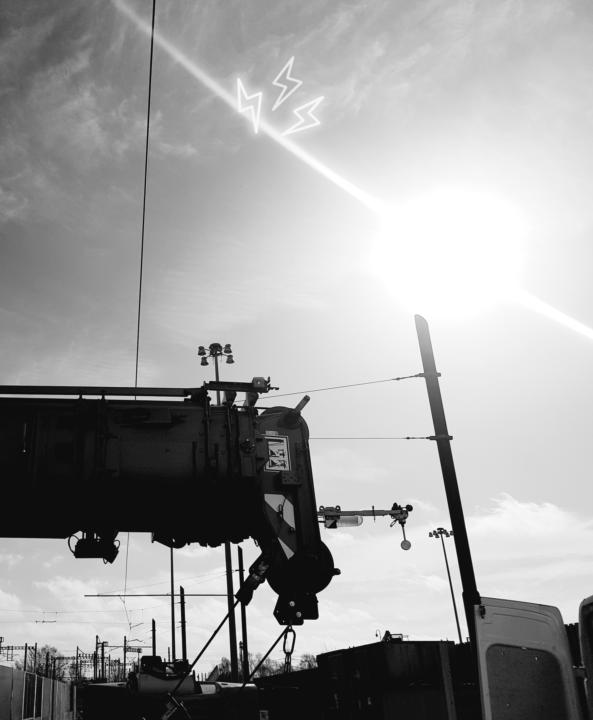
Lift Plan Mismatch & Unsafe Operation Near Power Lines
Incident Overview During a contract lift on a construction site, the lift supervisor identified that the lift plan drawings did not match the actual site conditions. A tram power line was shown as being approximately 4 metres away from the crane, but in reality it was positioned less than 3 metres away and directly above the crane setup area. When raised with the Appointed Person (AP), the proposed solution was to “find a sweet spot” by moving the crane with the boom raised — a method not included in the lift plan. Additional failures included lack of radios, missing exclusion zone barriers, no competency checks during induction, and unverified claims that the power lines were isolated. What Went Wrong Lift plan drawings were inaccurate and not site-verified Crane positioned within unsafe proximity to overhead power lines Unplanned crane movements introduced outside the lift plan No formal confirmation or proof of power line isolation Inadequate communication systems (insufficient radios) No exclusion zones established Competency and ID checks not carried out during induction Pressure and poor attitude from AP when safety concern raised Key Lessons Learned Lift plans must reflect real site conditions, not assumptions Any deviation from the lift plan requires stop and re-plan Working near power lines requires absolute verification, not trust Communication is a critical safety control, not optional Raising concerns is a duty, not a problem Safety Recommendations Stop the lift immediately if drawings do not match site conditions. Do not operate cranes near power lines without written isolation confirmation. Ensure full communication systems are in place for the entire lifting team. Install and enforce exclusion zones before any lifting activity. Verify competence of all personnel during site induction. Reject any “on-the-spot” method not covered in the lift plan. Incident Source Real site experience – Contract lift operation, UK construction site (2026). Regulatory Mapping
0
0
Jan 29 •
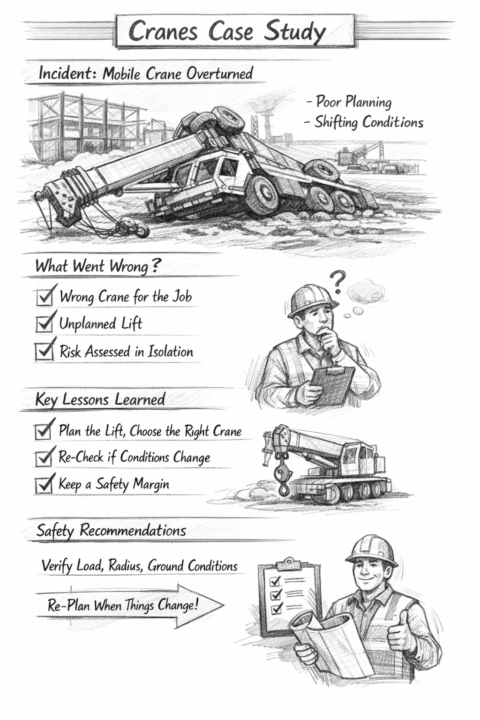
Wrong Crane Choice. Plan Changed, Capacity Margin Disappeared
Incident Overview A mobile crane overturned during an operation where planning and lift selection were not adequately controlled. The incident illustrates a common pattern: crane size/type selected for “expected” conditions, then conditions or configuration shift and capacity margin disappears. What Went Wrong Crane selection did not match real operating radius/ground conditions The lift became “unplanned” in execution Risk was assessed in isolation, not as a full system Key Lessons Learned Crane selection is part of lift planning, not procurement If the plan changes, the crane choice must be revalidated Margin is your safety buffer—don’t spend it Safety Recommendations Confirm crane selection using verified weight, radius, configuration, and ground strategy. Re-plan if site constraints change. Incident source UK mobile crane overturn prosecution linked to poor planning/unplanned lift. vertikal.net ●LOLER Reg. 8 – Lifts must be properly planned. ●LOLER Reg. 9 – Planning must be by a competent person. ●PUWER Reg. 4 – Equipment must be suitable for the task. ●BS 7121-1 – Crane selection must match load and site. Key point Margin is part of safety. Wolf Lifting Dynamics – Safe Lifting UK | Case Study 99
0
0
1-23 of 23
powered by
skool.com/wolf-lifting-dynamics-9548
This community shares real lifting case studies, consultancy insights, and site-proven lessons covering cranes, supervision, planning, and execution.
Suggested communities
Powered by