

1d •
Traced to a single date.
In English, the animal in the field often has one name, while the meat on your plate has another. - Cow becomes beef. - Pig becomes pork. - Sheep becomes mutton. - Calf becomes veal. - Deer becomes venison. No other major European language separates these words as consistently as English does. There is a reason for that, and it can be traced to a single date. October 14, 1066. The Battle of Hastings. When William the Conqueror sailed from Normandy and defeated the Anglo-Saxon King Harold, England came under the rule of a French-speaking Norman aristocracy. For the next three centuries, England effectively operated in two languages, one layered on top of the other. The peasants working the fields spoke Old English. The nobles living in the great houses spoke Norman French. The courts, the monarchy, and the legal system all functioned in French, while English survived primarily as the language of ordinary people. The animals remained in the fields, cared for by Anglo-Saxon farmers. They used Old English words like cow, pig, and sheep. Once those animals were prepared and served at a noble’s table, they became beef (boeuf), pork (porc), mutton (mouton), and veal (veau), all derived from Norman French. Two languages. Two sets of words. One animal. The difference reflected more than vocabulary. It reflected class. The people who raised the animals used one language. The people who ate them used another. The Saxon words stayed in the barn. The Norman words moved into the kitchen. That linguistic divide has never completely disappeared. In many ways, you can still read the social structure of medieval England from a menu. Venison evokes aristocratic hunting. Mutton carries its Norman heritage. Even Beef Wellington combines meat raised by Saxon farmers with a French-derived name served at an elite table. During the centuries following the Norman Conquest, roughly 10,000 French words entered the English language. Today, an estimated one-third of common English vocabulary has French origins.
1
0
25d •
By Rich Bradbury…A Grow Community Member
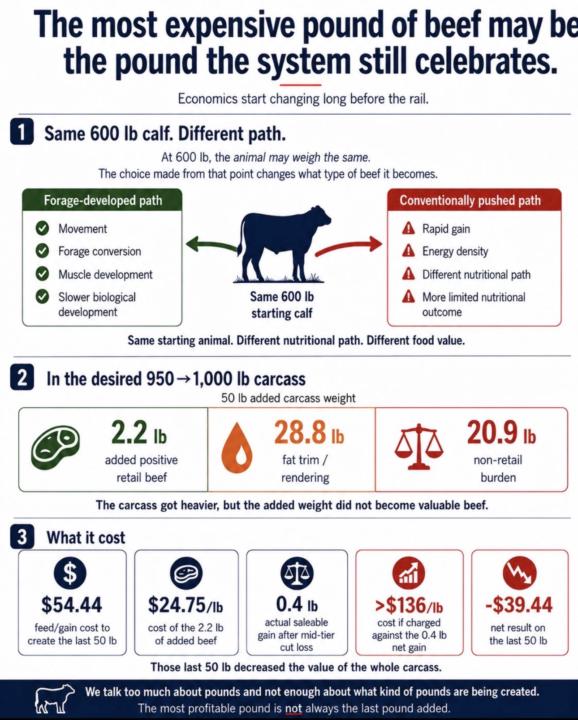
The most expensive pound of beef may be the pound the system still celebrates. We talk about carcass weight like every pound means the same thing. Those pounds are very different. A 600 lb forage-developed calf and a 600 lb conventionally pushed calf may weigh the same on the scale, but their nutritional paths are not the same, nor is their ultimate value to the food supply. One is being built around movement, forage conversion, muscle, and slower biological development. The other is being primed for rapid gain, energy density, and a more limited nutritional outcome. The game becomes about gross pounds—not animal wellbeing. Economics start changing long before the rail. In the desired 950→1,000 lb carcass, the animal added 50 lb of carcass weight. Only about 2.2 lb became added positive retail beef. About 28.8 lb became fat trim/rendering, and 20.9 lb became non-retail burden. That 2.2 lb of added beef cost $54.44 to create, or about $24.75/lb. Net out the mid-tier cut loss, and the actual saleable gain falls to about 0.4 lb, pushing the cost above $136/lb. The carcass got heavier, but those last 50 lb decreased the value of the whole carcass. Packers can avoid the loss by discounting heavy, fat, inefficient carcasses and pushing the burden upstream. They are not just mitigating the problem; they can profit from pounds that create little useful beef. We talk too much about pounds and not enough about what kind of pounds are being created. What rancher really thinks a 1,000 lb carcass is naturally healthy for a calf? We all know there is some evil space monkeys mastermind nonsense going on here— “but that is where the market is moving.” Blah, blah, blah. That is the same dull acceptance that allowed grocery shelves to become dominated by processed and ultra-processed foods. We are going that way with our whole muscle proteins. Garbage in, garbage out. The most profitable pound is not always the last pound added.

Apr 17 •
Asparagus Health Research - It's uber healthy!!!!
Did you know one of our Grow community members, Sandy Shore Farms, is a third-generation farmer and processor operating from an SQF-audited facility in Norfolk County, Ontario? Over the years, they have grown significantly and are now the largest grower and handler of asparagus in Canada, packing about 4,000,000 lbs annually. Check out these report on health benefits!
Mar 27 •
You’ve probably seen this before: POM Pomegranate Juice.
But did you know the full story? They are really owned by a massive conglomerate: The Wonderful Company. Who also own: • Fiji Water • Pistachios • Mandarins • Landmark Vineyards wine But the consolidation isn’t even the story, it’s how they produce these products. The latest data shows Wonderful Company was California's second-largest sprayer of paraquat, accounting for over 13% of the entire state's paraquat use. Paraquat is so acutely dangerous that the EPA itself warns "one sip can kill.” Just this week, a truck spilled Paraquat in Dorris, California. That led to a shelter-in-place of the ENTIRE city. All this to say, when it is produced on our food and drinks people don’t bat an eye. It’s not just ingredient labels for the Wonderful Company, this problem is a product of the entire industrial system. There is no fixing the grocery store. Everyone will be convinced of that the more we continue to uncover. Shopping from small farmers like you can do with the Localize - Farmers Market app will be the future of food. ~ Zephyr Zoidis

1-25 of 25
skool.com/thegrowskool
The Grow Renaissance unites agriculture, Web3, and stewardship to build a transparent, regenerative economy that nourishes people, animals and planet.
Leaderboard (30-day)
1

+19
2

+10
3

+8
4

+6
5

+6
Powered by