
Write something
Pinned

8h •
You failed. Now what?
You failed. Okay. Take a breath. First, let’s just acknowledge something. You were in the arena. You put something out there. You risked looking stupid. You risked it not working. That already puts you ahead of the majority of people who are still “thinking about it” or “getting ready.” Failure has a way of messing with your head. It makes you question yourself. It makes you wonder if maybe you’re not cut out for this. But almost every time, it’s not about who you are. It’s about what you did. There’s a big difference. When something doesn’t work, it’s usually a strategy issue, a clarity issue, a focus issue, or just not enough reps. It’s rarely an identity issue. But if you make it about your identity, you’ll shrink. If you make it about the approach, you’ll grow. So instead of asking, “What’s wrong with me?” ask, “What can I learn from this?” What broke? What did I assume that wasn’t true? Where did I hesitate? Where did I rush? If you paid the emotional price of the failure, at least get the lesson out of it. That’s where the value is. The only real danger isn’t failing. It’s quitting. It’s deciding that this one outcome defines you. It doesn’t. It defines a moment. And moments can be adjusted. Sometimes you don’t need more effort. You need a different angle. Sometimes you don’t need a new dream. You need more reps. Sometimes you just need to stay in the game longer than the discomfort. Failure isn’t the opposite of success. It’s the path to it. And once you stop being afraid of it, once you realize it can’t actually hurt you unless you let it stop you, you start playing differently. You start playing to win instead of playing not to lose. That’s the shift. So let me ask you this...What did your last setback teach you and what are you going to adjust because of it?
Pinned

9h •
🧠⏱️ Confidence Is a Time Strategy: How Doubt Creates Hidden Work
We usually treat confidence like a personality trait, something we either have or do not. In real teams, confidence is a system, and it shows up in one place first: our calendar. When we lack confidence, we buy certainty with time. We research longer than necessary, we rewrite instead of ship, and we delay decisions that could have moved work forward. AI does not magically give us confidence, but it can shorten the path to it. When we use AI to create fast options, fast explanations, and fast first drafts, we reduce the cost of taking the first step. That is how we earn time back, not by eliminating thinking, but by eliminating looping. ------------- The Time Leak Behind “Just Being Careful” ------------- Most of us can name obvious time leaks, like too many meetings, unclear priorities, and endless email threads. The harder leak to spot is doubt, because it disguises itself as diligence. It sounds like, “Let me check one more thing,” or “I do not want to send the wrong message,” or “I need to be more prepared before I bring this up.” Here is what that looks like on a typical day. A manager delays giving feedback because they want to get the wording perfect, so the issue lingers and grows. A project lead postpones a stakeholder update because they are unsure how it will land, so now the stakeholder asks for a meeting, and the cycle time expands. A team member keeps researching tools and approaches because they are afraid of choosing the wrong one, and the work stalls at the decision stage. Doubt also creates hidden coordination costs. When we are uncertain, we ask more people, we schedule more calls, and we add more reviewers. That feels responsible, but it inflates handoff latency and increases rework because feedback arrives late and inconsistent. The team loses time not because anyone is lazy, but because uncertainty spreads and multiplies. This is why confidence is a time strategy. It is the ability to move with “good enough clarity” early, so learning can happen faster than hesitation.

Pinned
7d •
The Best Free AI Got a MASSIVE Upgrade & More AI News You Can Use
This week, I break down some huge updates to Claude that, combined with the introduction of ads in ChatGPT, make Claude the best AI if you're on a free plan. Plus, I cover the barrage of OpenAI news and releases, discusses the evolution of the "OpenClaw" movement, and more. Enjoy!

1h •
Building a Production Ready AI Salon Receptionist With n8n
Today I am working on a production ready AI Salon Receptionist that handles real customer calls and real bookings The automation is powered by n8n as the main logic engine with Vapi handling the voice layer and Phorest managing clients and appointments When a caller asks for a service time the workflow checks real time availability in Phorest based on the service duration If the caller already exists the system continues smoothly If not a new client profile is created automatically Once availability is confirmed the appointment is written directly into the Phorest calendar Everything happens securely without human intervention Strong error handling is built in so if a slot is taken or the system is down the AI responds politely and guides the caller instead of breaking This is a good example of how n8n can be used to build serious production systems that go beyond simple automations

5h •
AI isn’t going to replace you (TLDR at bottom).
For all of human history, the way technology worked was man with tools vs man with tools, and as technology improved, it became man with tools vs man with better tools. Until AI hits the point of true "AGI" (at which point it will become man vs machine), it will always be this way. So I say it again: AI is not going to replace you - it is a tool. Does this mean ignore AI? No, absolutely not. This is because someone who uses AI might replace you, and even if you're aware of AI, someone else might use it better than you. The same thing happened in the early 2000s, when some people took advantage of the internet. The same thing happened in the early 2010s, when some people took advantage of social media. The same thing happened at the beginning of COVID, when some people took advantage of short form content. The same thing is happening now. As AI gets better and more available, you have this unique opportunity to be an early adopter. Of course, there are problems that come with being an early adopter. But when I think about what they actually are (probably that sales cycles are harder because most of the market isn't problem-aware), I'm way happier to deal with the upsides. Hopefully this helps combat another one of these "OpenClaw will erase all jobs" or "Claude Code will erase programmers" or "Nano banana will kill all design and creative jobs" posts. <TLDR> "You're not gonna lose your job to AI. You're gonna lose your job to someone who uses AI" - Jensen Huang, CEO of NVIDIA
1-30 of 11,648
skool.com/the-ai-advantage
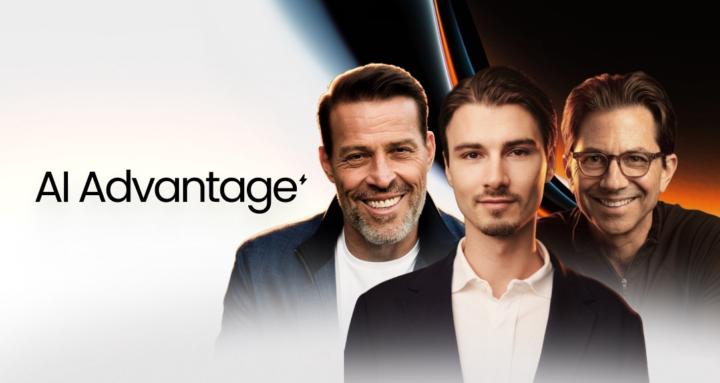
Founded by Tony Robbins, Dean Graziosi & Igor Pogany - AI Advantage is your go-to hub to simplify AI and confidently unlock real & repeatable results
Leaderboard (30-day)
1

+192
2

+149
3

+138
4

🔥
+136
5

+117
Powered by