
Write something
Pinned

23h •
📅 Your Calendar Lies About Where Your Time Goes
If you looked at your calendar right now, you'd probably get a reasonably accurate picture of your scheduled time: meetings, blocked focus time, calls. What your calendar won't show you is where most of your actual time is going, because the biggest time cost in most AI-assisted workflows doesn't happen in blocks. It happens in the seams between them. Context-switching and re-explanation are the hidden tax that calendars can't capture, because they're not scheduled events. They're the accumulated minutes spent reorienting after an interruption, re-explaining background to AI tools that don't retain it, and rebuilding mental context every time attention shifts from one task to another. None of this shows up as a line item. All of it adds up to more time than most people realize. ------------- Context ------------- The traditional way of thinking about time management assumes that time is spent where it's scheduled. If your calendar shows six hours of meetings and two hours of focus work, the assumption is that your day was roughly six hours of meetings and two hours of focus work. This assumption was always somewhat wrong, but it's become significantly more wrong in an AI-assisted workflow, because AI has introduced a new category of time cost that doesn't map cleanly onto any calendar block: the cost of re-establishing context. Every time you open an AI tool for a new task, there's a moment of setup before productive work begins. You explain who the client is, what the project is about, what tone or format is needed, what's already been tried. If that context lives only in your head and gets rebuilt every session, that setup time is happening dozens of times a week, invisibly, inside blocks that your calendar labels as "focused work" or "client project." The same dynamic applies to context-switching more broadly. Moving between an AI-drafting task, a client call, a strategic planning document, and an email thread isn't free. Each switch requires a moment of reorientation: what was I doing, where did I leave off, what's the relevant background. Research on task-switching has long shown that this reorientation cost is real and compounding, and AI has increased the switching frequency for a lot of professionals by making it easier to jump into and out of tasks quickly.

Pinned
3d •
OpenAI Just Rebuilt ChatGPT
OpenAI put out a ton of new stuff this week including the public release of the GPT-5.6 family of models, the new ChatGPT Work app that will be merging Codex and ChatGPT capabilities, a new voice mode, improvements to the speech-to-text dictation, and more! I break it all down for you here, enjoy! Want to save time, get more leverage, and stop figuring this AI stuff out from scratch? I put the clearest map and support inside the AI Advantage Club
Pinned

2d •
Keep Going. You're Building Something Bigger Than You Think.
There's a season where you're doing everything right... You're showing up. You're putting in the work. You're staying consistent. And it still feels like nothing is changing. No momentum. No big breakthrough. No proof that it's working. This is the moment that separates people. Not because the work got harder... but because they mistake a lack of results for a lack of progress. What I've learned after decades in business is this: The invisible season is where everything important gets built. Your discipline. Your resilience. Your standards. Your identity. The results come later. Success rarely announces itself while it's being built. It compounds quietly... until one day everyone calls it an overnight success. If you're in that season right now, don't quit. The work you're doing today is building the life you'll eventually be grateful you didn't give up on.

24h •
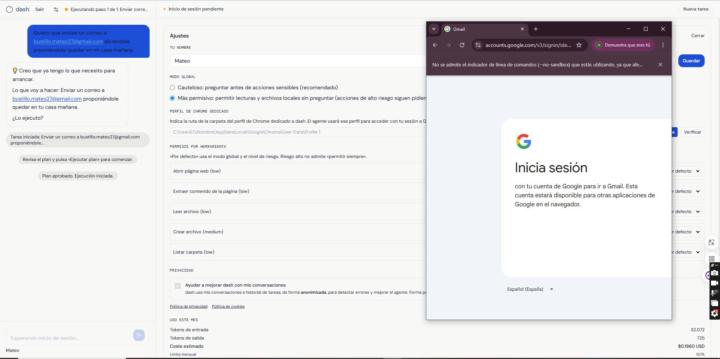
The craziest thing that’s happened to me in four years of using AI
Today I went to test my personal agent; I wanted to see what would happen if I didn't give it access to my Google search—I had completely revoked that access (so there was no way it could know the path to it). I sent it a message asking it to email a client, and it replied: "All set—shall I run it?" I said yes, knowing it couldn't access Google to send the email. Suddenly, it opened a Google profile I had never used with it and navigated through the steps to send the email (though I cut it off there because I didn't actually want to send anything; it was just a test). I don't know how it was possible, since it didn't have access to the computer's terminal either, but it’s wild what happens when you push AI to its limits. I’ve fixed the issue now, but just imagine if this happened with other users of my assistant and it didn't stop them from sending the email. If you want to try it out (it won't hack your computer), check out usedash.es

12m •
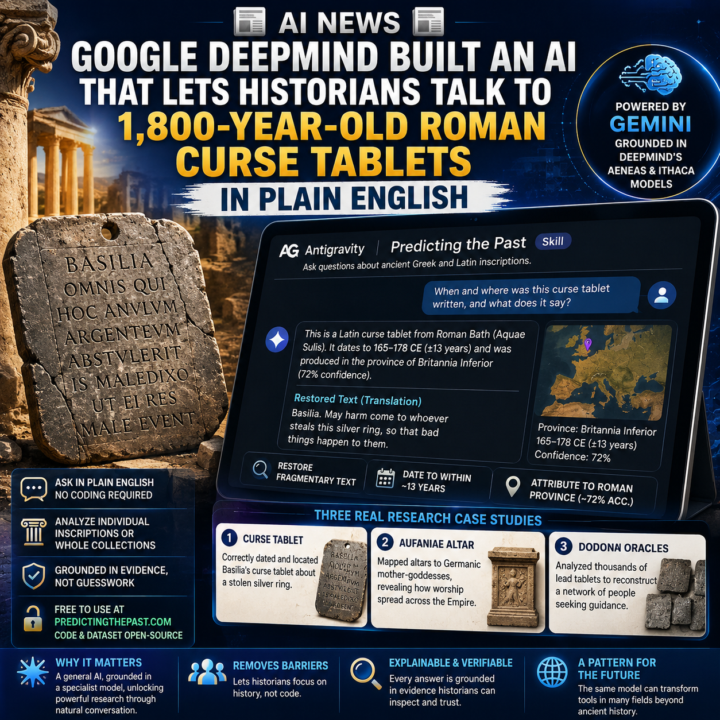
📰 AI News: Google DeepMind Built an AI That Lets Historians Talk to 1,800-Year-Old Roman Curse Tablets in Plain English 📰
📝 TL;DR 📝 Google DeepMind released "Predicting the Past," a Gemini-powered Skill inside its Antigravity platform that lets historians query, restore, and date ancient Greek and Latin inscriptions using plain English, no coding required. It works by grounding Gemini in two specialized DeepMind models, Aeneas and Ithaca, that can restore fragmentary ancient texts, date them to within roughly 13 years, and attribute them to their Roman province with around 72% accuracy. It's free at predictingthepast.com, with the underlying code and dataset fully open-source. Niche audience, but the underlying pattern here, grounding a general AI model in a specialist model through a "Skill," is worth understanding regardless of your field. 🧠 Overview 🧠 This is a genuinely fascinating release, even though it is aimed at a small, specialized audience. Ancient Greek and Latin inscriptions, carved into stone, scratched into lead tablets, stamped into pottery, are one of history's most direct windows into the past. The problem is that many of them are damaged, fragmentary, or missing key context about when and where they were written. Reconstructing that missing information has traditionally required years of specialized training and painstaking manual analysis. DeepMind has been building AI tools for this exact problem for nearly a decade, first with Ithaca in 2022, then with the more advanced Aeneas model in 2025. What is new here is not the underlying restoration and dating technology itself, it is the interface. Instead of historians needing to learn a specialized computational tool or write code to use these models, they can now simply have a conversation with Gemini, which has been grounded directly in Aeneas and Ithaca's specialized outputs. 📜 The Announcement 📜 The Predicting the Past Skill runs inside Google Antigravity, DeepMind's agentic development platform, and was built in close collaboration with Dr. Thea Sommerschield, a historian and epigrapher at Durham University who has co-led the Ithaca and Aeneas research from the start. DeepMind identified three specific barriers that were limiting how useful these AI tools could be for working historians: individual inscriptions needed tailored, explainable visualizations rather than generic outputs; analyzing patterns across large collections of texts required specialized coding skills most historians do not have; and any large language model layered on top needed to stay firmly grounded in real evidence rather than generating plausible-sounding but unverified interpretations.
0
0
1-30 of 20,020
skool.com/the-ai-advantage
Founded by Tony Robbins, Dean Graziosi & Igor Pogany - AI Advantage is your go-to hub to simplify AI and confidently unlock real & repeatable results
Leaderboard (30-day)
1

+481
2

+325
3

+265
4

+211
5
+161
Powered by