
Write something

2d •
How WSHCs Can Increase Their Income Without Cutting Corners
Many WSH Coordinators feel stuck. They carry heavy responsibility on site, deal with documentation, inspections, toolbox meetings, supervisors, workers, subcontractors and management pressure — yet the salary may not always reflect the workload. This is a real issue, especially for junior WSHCs and foreign WSHCs who are often expected to do a lot but are not always properly guided, recognised or rewarded. But income growth in WSH does not usually happen just because someone has “worked many years”. Income grows when your value becomes clearer. A WSHC who only does basic paperwork will usually be paid like basic manpower. A WSHC who can prevent problems, manage documents properly, support inspections, communicate with site teams and help the company reduce risk becomes much harder to replace. MOM has described WSH Coordinators as playing a crucial role in strengthening WSH governance on the ground, bridging WSH directives from management to workers, and supporting the implementation and compliance of WSH practices. That means the role is not small — but WSHCs must learn how to show that value clearly. 1. Become Strong in Risk Assessment, Not Just Paperwork One of the fastest ways for a WSHC to become more valuable is to become good at RA. Not just copying and pasting an old RA. A good WSHC should understand: - What hazards are actually present on site - Whether the control measures are practical - Whether the RA matches the real work method - Whether workers understand the risks - Whether the RA needs to be reviewed when site conditions change MOM states that risk management includes identifying, evaluating and controlling workplace risks, conducting risk assessments, controlling and monitoring risks, and communicating risks to stakeholders. If you can help a company manage RA properly, you are no longer just an admin person. You become someone who helps reduce risk, avoid incidents and prepare the company better for audits or inspections. That is income value.

21h •
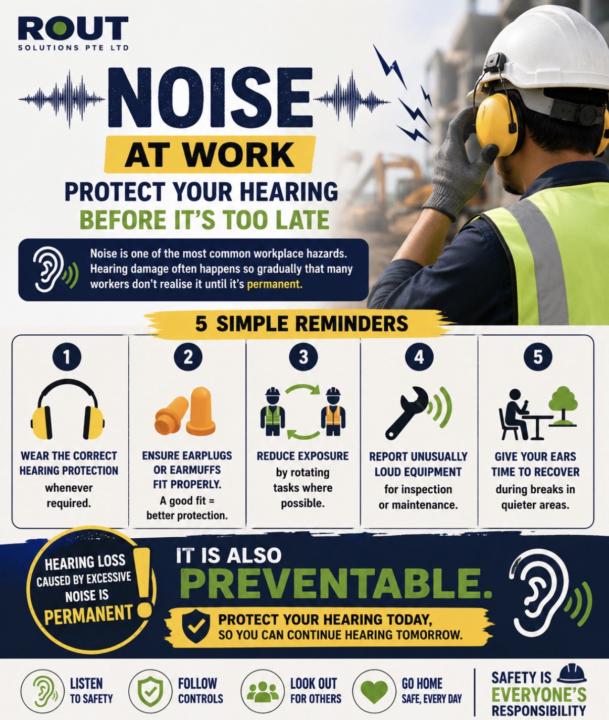
Protect The Ear Before It's Too Late
Noise is one of the most common workplace hazards, yet hearing damage often happens so gradually that many workers don’t realise it until it’s permanent. Whether you’re working around breakers, grinders, excavators, generators or other heavy machinery, always protect your hearing. Here are a few simple reminders: 🔸 Wear the correct hearing protection whenever required. 🔸 Ensure earplugs or earmuffs fit properly. 🔸 Reduce exposure by rotating tasks where possible. 🔸 Report unusually loud equipment for inspection or maintenance. 🔸 Give your ears time to recover during breaks in quieter areas. Hearing loss caused by excessive noise is permanent—but it is also preventable. Protect your hearing today, so you can continue hearing tomorrow.
2
0

23h •
Leadership Walks Matter
A leader's presence on site sends a message long before a single word is spoken. When leaders step out of the office and onto the worksite, they don't just observe the operation—they demonstrate that safety matters. A leadership walk isn't about finding fault. It's about being visible. Listening to workers. Understanding site challenges. Recognising good safety practices. And addressing risks before they become incidents. The most effective leadership walks focus on asking questions, not just giving instructions. Questions like: - "Is there anything stopping you from working safely today?" - "What hazards are you most concerned about?" - "Do you have the right tools and equipment for this task?" - "What can we do to make this job safer?" These conversations build something far more valuable than compliance. They build trust. When workers see leaders taking an active interest in their wellbeing, they're more likely to: ✅ Speak up about hazards. ✅ Report near misses. ✅ Share ideas for improvement. ✅ Take ownership of safety. On the other hand, if leadership only appears after an incident or during an audit, safety can start to feel like an obligation rather than a shared value. At ROUT, we believe leadership is measured not by how often you talk about safety in the boardroom, but by how often you're willing to walk the site, engage with your people, and lead by example. Because the strongest safety cultures aren't built from behind a desk. They're built on the ground—one conversation, one observation, and one leadership walk at a time. 💬 When was the last time a site walk led to a meaningful safety improvement in your workplace? We'd love to hear your experience in the comments.
1
0
2d •
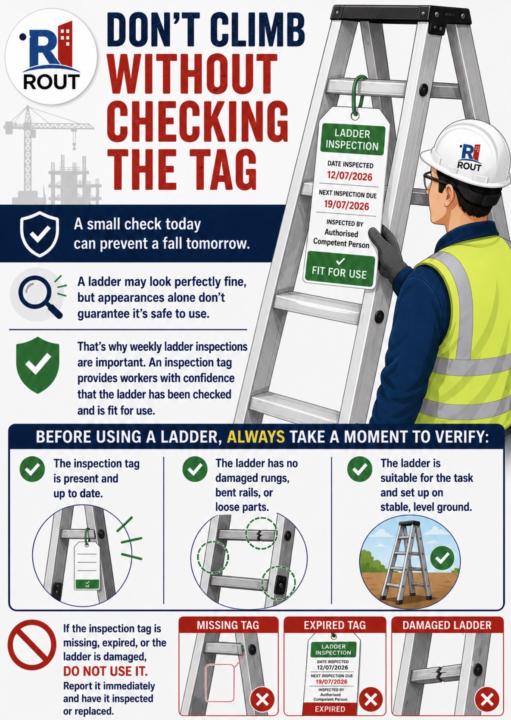
Don’t Climb Without Checking the Tag
A ladder may look perfectly fine, but appearances alone don’t guarantee it’s safe to use. That’s why weekly ladder inspections are important. An inspection tag provides workers with confidence that the ladder has been checked and is fit for use. Before using a ladder, always take a moment to verify: 1.The inspection tag is present and up to date. 2.The ladder has no damaged rungs, bent rails, or loose parts. 3.The ladder is suitable for the task and set up on stable, level ground. If the inspection tag is missing, expired, or the ladder is damaged, do not use it. Report it immediately and have it inspected or replaced. A simple tag may seem small, but it plays an important role in preventing falls and keeping everyone safe on site.
2
0

5d •
Workers will speak up when it is safe to be honest
I recently read an article discussing how workers are more likely to speak up when they feel psychologically safe. It reminded me that a strong safety culture isn't built by policies alone—it's built by everyday actions. Here are a few good practices that every supervisor and manager can adopt: ✅ Encourage open communication by listening without interrupting or judging. ✅ Thank workers for reporting hazards, near misses, and improvement ideas instead of blaming them. ✅ Build trust by treating every concern seriously and following up with actions taken. ✅ Conduct regular toolbox meetings where everyone has an opportunity to share their observations. ✅ Lead by example—supervisors should demonstrate safe work practices and be willing to admit mistakes. ✅ Recognise and appreciate workers who contribute to improving safety and quality. ✅ Promote a "learn, don't blame" culture by focusing on preventing future incidents rather than assigning fault. ✅ Ensure workers know they can stop work and report unsafe conditions without fear of punishment. ✅ Provide regular safety training and refreshers to keep everyone informed and confident. ✅ Remember: A workplace where people feel safe to speak up is a workplace that is safer, more productive, and built on trust.
3
0
1-30 of 44
skool.com/rout-safety-community-sg-4194
Singapore WSH community for networking, support, safety resources, job referrals & industry opportunities.
Leaderboard (30-day)
1
+22
2
+1
Powered by