
Write something
Pinned

Mar 15 •
Welcome to Clief Notes. Here's where to start.
1. Watch the intro video and introduce yourself in the intro post here 2. Start with The Foundation (free course). Concepts, folder architecture, prompting framework. Everything else builds on this. 3. Check in at the bottom of each lesson. Polls, discussion posts, other members working through the same stuff. Use them. 4. When you're ready to build real things, move to Implementation Playbooks (Level 2). When you're ready to build your own tools, Building Your Stack (Level 3). 5. Post your work. Ask questions. Help others when you can. What are you here to build?
Poll
4364 members have voted
Pinned
3d •
🌶️ CINCO DE MAYO FIRESALE — STARTS NOW 🌶️
Locked in for the next 5 days only. Ends May 5th at 10:00 AM EST. No exceptions. 🎉 Premium: $27 → $14/mo 🎉 VIP: $97 → $67/mo The closest you'll get to our original launch pricing. We're doing this because the community has shown up for us, and we want to show up back. 🤝 🔥 Already a member? Read this carefully. To lock in the new rate, you need to: 1. Cancel your current plan 2. Resign under the new price That's the only way the system can apply the new rate. We have way too many members for manual refunds, so we can't refund anyone who just signed up at current pricing. But the savings stack month over month, so if you plan to stick around (and you should 😁), the math works out fast. 🚫 A few ground rules: Please do not DM myself or Jake about pricing, exceptions, or extensions. We love you, but we're a small team and we need to stay focused on building. Everyone gets the same window. Everyone gets the same deal. If you miss it, you miss it. We'll do more things for the community down the road. ⏰ The clock: 🟢 LIVE NOW 🔴 Locks May 5th, 10:00 AM EST - Premium gets you The Vault and Afternoon Tea calls. - VIP gets you The Drawing Room, High Tea, and bespoke folder builds from Jake himself. If you've been on the fence, this is the moment. 🚀 Tag a friend who needs to be in here. Let's make Cinco a movement. 🎊 🌶️🌶️🌶️

1d •
How do you like to brainstorm? (For writing)
Context: I want to pitch a few talks to conferences in my field (game audio), and its not something I do regularly so I don't have established workflow for it. I do write linkedin posts and prep for my DND sessions, but that output is significantly different than a 30m to 1hr talk. I've been doing one approach, which I'll outline below, but I'm wondering if others have done this and have a more efficient way of getting to a final result, the below took me 2 sessions both a few hours each, and I'd love to compress that. Wondering about other approaches or resources to help create a better framework. Current process (captured in a skill after finishing last submission): 1. Claude asks : "What could you talk about from memory right now, without looking anything up?" and "What do you know how to do, or think about, that most people in your field don't?" (this takes a long time) 2. feed it which conference, deadline, and format the talk submission is 3. Claude researches past accepted talks for fit and content 4. We lock in thesis, pillars, and target audience (this takes the longest) 5. we do a draft in this order: Description, takeaway, outline 6. Pre-submission review (this part is easy with humanizer and the conference form submission) Wondering if there are places I could improve? And how would others approach this?
3h •
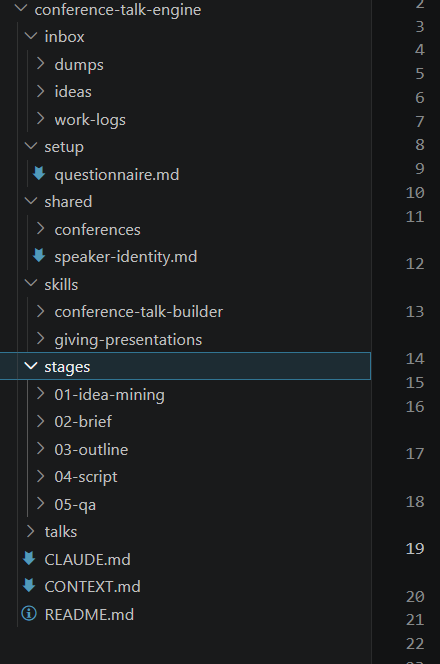
How to design a workflow - Conference Talk Engine (WIP) - update 5/3/2026
Practicing building in public and wanted to share what I've built with help from my other writing brainstorming thread from @Deacon Wardlow and @Siv Darmalingum @E G and @David Trammel Using some of their ideas I did research on the writers and topics they suggested using Notebook LM. I synthesized that research into digestible artifacts for claude to extract themes and guidelines for developing conference talks. I then described to Claude the workflow I wanted to build, can share that prompt if people are interested. And then I also used the workspace-builder as a model for the scaffolding for the conference-talk-engine and my own workspace as models for schema in the Claude and Context mds. The output of all of this was a spec document to build the workspace. I incorporated guidelines to use SOLID principles for coding to allow a built workspace to be extended and improved upon over time without having to rebuild the whole workspace, this is because I think it's better to build a prototype fast and then iterate rather than be 100% perfect. You want to spend time to make sure that the spec doesn't produce errors, but some things will only show up with actual use cases. I then researched existing skills relevant to my use case and came up with 2: conference-talk-builder and giving-presentations. I asked claude to evaluate my research and the existing skills to see what gaps could be improved in the existing skill. I then asked it to write the spec After first draft of the spec I ran a reader-test which is a custom skill derived from @Ari Evergreen 's 6 phase workflow. A rough breakdown would be: 1) research data inputs and relevant skills, compile any useful context relevant to your workflow; 2) analyze inputs with claude; 3) describe your ideal workflow and any models you want to emulate, make sure to mention you are building a spec first; 4) review plan for spec; 5) draft the spec using claude; 6) reader-test to qa the spec.
Mar 15 •
🏁 Foundations 1.3 Check-In
You learned the framework. Now try it on something you're actually working on. Vote below, then drop your prompt structure in the comments. Not the output. The structure. Show us how you set it up.
Poll
822 members have voted
1-30 of 942

skool.com/quantum-quill-lyceum-1116
Jake Van Clief, giving you the Cliff notes on the new AI age.
Leaderboard (30-day)
1

+809
2

+726
3

+466
4
+413
5

+398
Powered by