Activity
Mon
Wed
Fri
Sun
Jun
Jul
Aug
Sep
Oct
Nov
Dec
Jan
Feb
Mar
Apr
What is this?
Less
More
Owned by Alex
A listening-first community for busy working dads to share real challenges and help shape simple systems for presence without burnout.
Memberships
Agentic Foundations
8.1k members • Free
Clief Notes
25.4k members • Free
107 contributions to Clief Notes

8h •
Something’s not clicking for me here.
I think I’m mixing up some concepts here. What exactly is the difference between: - a well-designed folder/file structure - an AI agent - a full app I understand them individually at a basic level, but I don’t clearly see where one stops and the other starts and when you’d choose one over the other. In one of @Jake Van Clief videos, he said that he's using the folder structure as his app. I would appreciate If anyone can break this down in a simple way or with a real example. Thank you.

🚀
⭐
10h •
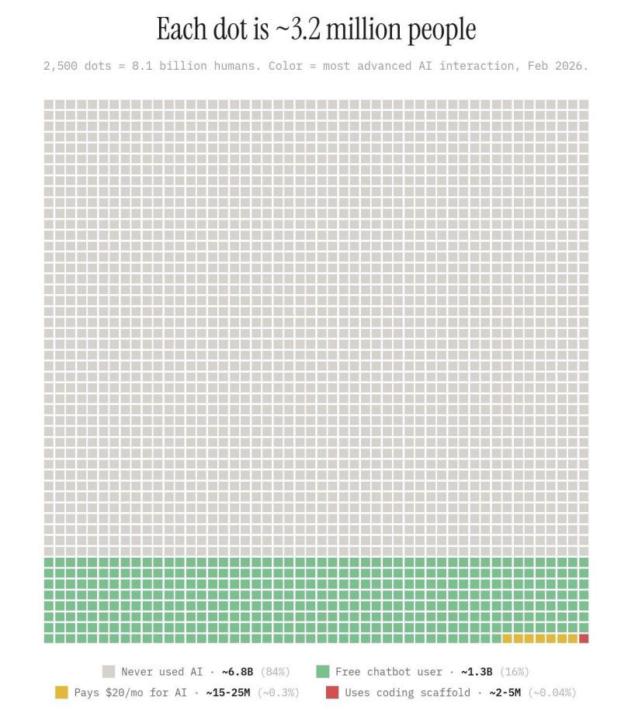
Each dot is 3.2 million people.
📊 You've probably seen this chart floating around LinkedIn and Twitter Each dot is 3.2 million people. ⬜ Grey is the 84% of humans who have never used AI 🟩 Green is the 16% who have used a free chatbot 🟨 Yellow is the 0.3% who pay for one 🟥 Red is the tiny sliver who use AI coding tools Most of the people sharing it have not actually said what it means. So here it is. 🔁 We live inside an algorithm. Mine shows me AI all day. Yours probably does too. Every reel, every post, every podcast clip, every ad. The feed makes it feel like the whole world has moved on without you and you are sprinting to keep up. Inside Clief Notes that feeling gets louder. You log in and see people building agents, shipping side projects, automating their inbox, talking about Claude Code and MCP servers like it is normal. In this room, it is. Step outside and almost nobody is doing any of it. 6.8 billion people have never opened a chatbot. Plenty of the ones who did opened it once, asked it something dumb, got a dumb answer, and decided the whole thing sucked. They are not coming back this year. Maybe not next year either. 🪖 When I was in the Marine Corps I never felt like I was doing anything special. I was surrounded by other Marines. Everyone around me could do what I could do. The standard was the standard. It was not until I left and stood next to people who had never served that I understood. The thing I thought was ordinary was rare. I just could not see it because I was inside it. That is what is happening to you in here. If you feel behind in this community, that is the right feeling to have. It means you are standing next to the people pushing the edge. Step outside this room and the thing you are calling behind is so far ahead of where most of the world is sitting that they cannot see you from where they are. And do not forget. The thing you built last week, the workflow you set up this morning, the conversation you just had with Claude. A version of you from two years ago would have paid good money to do any of it.
5 likes • 10h
One of the most grounded things I’ve read about AI in months. The Marine Corps analogy really hit and it's very true; it's so easy to mistake the 'room you're in' for the whole world. I needed that reminder that feeling behind actually just means I'm near people pushing forward, not that I'm losing ground. Also, the stat about 6.8 billion people never opening a chatbot is wild to sit with. Thanks for this.

2d •
I ran the numbers on our top posts. The #1 was 229 characters.
I built a pipeline with Claude Code to look at what's actually driving engagement here. Classified the top 30 posts by how grounded each one is in first-person experience vs. repackaged content. The top post by raw engagement: 229 characters, no hook, no structure. Someone shared a specific win in two sentences. 581 engagements. We all know that was @Alexander Paschka's Good News post. The AI-polished ones mostly fell flat. You can tell when someone ran it through a structure. Staccato opener, tension-and-release, etc. This community catches on fast. What kept showing up in the high-engagement posts: specific tools the person actually used, real numbers, at least one honest admission. Nothing fancy. The details were already there because the work was real. Kind of what you get from actually working inside Jake's ICM. You don't have to construct the specifics, the folder structure already has them. What's your tell when a post feels real vs. assembled?
5 likes • 2d
Real posts don’t try to prove anything, they just report what happened.
1 like • 11h
@Kevin Carrasco Lol 😉... I like that.
1d •
Raise your hand if you're stuck in "tutorial hell" with AI 👋
Be honest, which one are you right now? A - I watch/learn/tweak but never start B - I start, fail fast, then go back to watching C - I just build and ignore mistakes I'm solidly in A. Your turn, pick and comment why.
2 likes • 1d
@Andrew Carter That might actually be my problem. Thanks.
1 like • 11h
@Luke M Ask again!😀

2d •
Should I write my thesis about this?
As I’m reaching the end of my robotics and AI engineering studies and starting to work on my thesis, I have two options, on the topic. My initial subject was supposed to be about my AI learning platform, which I am building currently. But now, as I’m diving deeper to learning about the folder structures and seeing AI in completely different daylight, which I haven’t seen anywhere else I feel like I should do it about that instead. What do you guys think?
3 likes • 2d
I think you should stick with the AI learning platform because it’s something you’re already building, so you have momentum and tangible work.
1-10 of 107

@alex-nartey-1708
I test AI systems, tools, and online business ideas. No hype. Just what works (and what breaks) - one step ahead of beginners...
Active 1h ago
Joined Apr 5, 2026
Powered by