
Mar '24 • Art Tips
Creating depth and perspective
Creating depth and perspective in landscape paintings is essential to capturing the beauty and grandeur of the natural world. By carefully arranging elements such as mountains, buildings, and trees, artists can convey a sense of distance and space, adding realism and visual interest to their work. In this example painting, we will explore various techniques for creating depth and perspective.
Start by imagining a vast expanse of land, stretching far into the distance. The mountains in the background will serve as the ultimate focal point, representing the farthest point in your composition. Use light, muted colors and soft edges for these mountains to create the illusion of distance. Gradually darken and intensify the colors as you move towards the foreground.
Moving closer to the foreground, the middleground will be the next layer of interest. Here, we will incorporate various farm buildings to add complexity and detail. Place these buildings strategically, keeping them slightly smaller in scale than the mountains in the background. Remember to use lighter colors and less detail compared to the foreground elements. This will create the impression that these buildings sit between the viewer and the mountains, further enhancing the sense of depth.
A key technique for enhancing depth and perspective is the use of overlapping elements. By intentionally overlapping objects or elements in your composition, you create the sense that certain objects are in front of others. In our example, consider overlapping the farm buildings, allowing some to partially cover others. This will give the impression that these structures are staggered, leading the viewer's eye into the composition.
Next, let's introduce a path leading into the middleground. The path acts as a visual guide, drawing the viewer into the painting and leading their eye towards the focal point. Keep the path relatively thin and narrower as you move towards the background, and wider towards the foreground. Use shades of brown and gray with subtle variations to create texture and suggest a well-worn trail. By positioning the path strategically in relation to the buildings and mountains, you create a sense of distance and depth.
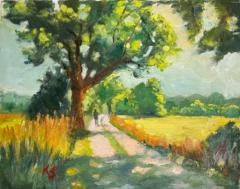
On the left side of the path, let's include a gumtree in the foreground. This tree will act as a framing element, adding visual interest and providing a sense of scale. Place it slightly off-center, but close enough to the path to guide the viewer's eye into the painting. Accentuate the tree's vibrant green leaves and textured bark, making it stand out against the rest of the composition. By providing a strong element in the foreground, the gumtree anchors the entire painting and enhances the perception of depth.
Remember, when creating depth and perspective in landscape paintings, it's crucial to consider the arrangement of elements. Varying the scale, detail, and intensity of colors as you move from the background to the foreground, and using overlapping objects, will help create the illusion of depth. By including a focal point like mountains, a path, and a foreground tree, you can guide the viewer's eye through the composition, creating a sense of exploration and immersion in the landscape. With practice and experimentation, these techniques will enable you to create captivating and realistic landscape paintings with depth and perspective.
10
10 comments
Creating depth and perspective
skool.com/painters-hub
🎨 Free community for landscape painters improving their skills. Learn to create professional-quality paintings you're proud to display or sell 😀
Leaderboard (30-day)
1

+207
2
+102
3

+73
4

+61
5

+49
Powered by