
Pinned

⭐
Jan 18 •
🗽 START HERE: How to join our Group Calls!
We built this community for people who want to talk, not just scroll. The real action happens in our group calls, where we argue ideas in good faith and tackle the week's biggest global events. Here is how you can participate: 🔥 1. Open Calls These are our public town halls. Open to everyone. Whether you want to take the stage to challenge a point or just listen in, this is the "public square." 💎2. Premium Calls For members who want to go deeper. These calls are exclusive to our supporters and offer a space for more focused discussion and priority access. - 📅 Check the Schedule & Join Here: https://www.skool.com/libertypolitics/calendar - 💎 Become a Premium Member: https://www.skool.com/libertypolitics/plans Heads up: We believe these conversations are worth sharing! Our group calls are recorded and may be posted to our social media channels. By joining the stage, you’re helping us bring these important discussions to a larger audience. By participating in group calls and voice discussions, you consent to being recorded. 👋 New to the group? Say hello! We want to get to know you. Drop a comment below to introduce yourself. Tell us where you're from and what you like to do for fun (outside of arguing politics!). Welcome to the community!

2d •
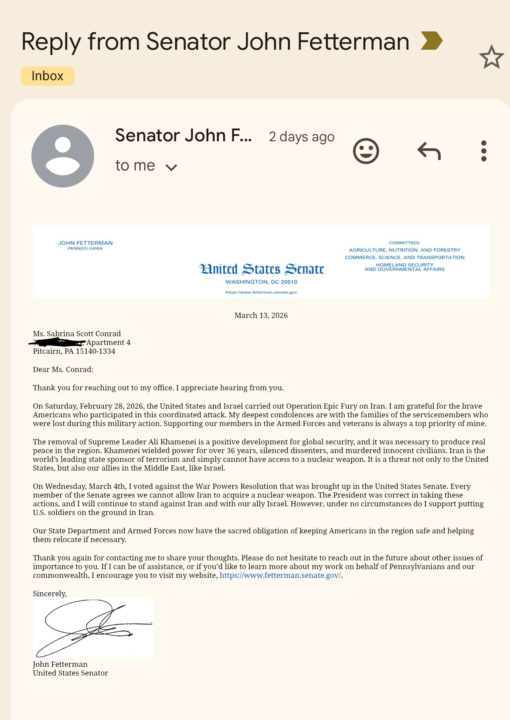
A letter from Senator John Fetterman
Screen Shot of a response to one of my emails to my Senator and my reply

3m •
Which is worse: A government that forcibly deconverts Muslims or bombs them
Which is worse a government that forcibly deconverts Muslims or bombs them? Country A: Goes into mosques and tells them they can no longer teach barbaric Quran verses or Hadiths. At best it's like a vanilla monotheism. Muslims are often rounded up into facilities to undergo deconversion. They can't pray or fast for Ramadan in these facilities. They work manufacturing jobs in these facilities. Their kids are sent to residential schools to innoculate them against Islam. Country B: This government is sharing a border with another country that is Muslim majority. The government indiscriminately bombs hospitals and refugee camps. They level urban sprawls with bombs. Children are often killed and injured in life altering ways in these bombings. Which one is worse? Edit: Armin convinced me that one of these was justified.
0
0

4d •
So… draft: yes or no?
According to White House Press Secretary Karoline Leavitt, the president “does not remove options off the table.” Officials say a draft is not currently planned, but the administration has refused to rule it out amid the Iran conflict. If the answer is truly no, why not just say so clearly? If yes, will the children of political elites be asked to participate? Source: https://youtu.be/4LxhsTC_RaA?si=QpJ7K4kF6jT1Z7ck

19m •
Shock, Decapitation, and Collapse: How 17 Days Rewrote The Mullah Regime's Military Reality”
Greetings Fellow Patriots, This assessment reflects open-source intelligence (OSINT) evaluation of the U.S. and Israeli air campaign against Iran as it stands as of March 16, 2026. Based on aggregated reporting from CENTCOM statements, IDF releases, and independent verification through satellite imagery and defense analysis organizations, the campaign demonstrates a highly structured approach to systemic military degradation rather than traditional attrition. What distinguishes this campaign is not simply the scale of strikes, but the operational design behind them. Rather than pursuing platform-by-platform destruction alone, U.S. and Israeli forces targeted the interdependent layers that enable combat effectiveness across the Iranian military system. The opening phase prioritized suppression of air defenses and command-and-control infrastructure, effectively collapsing Iran’s ability to detect, coordinate, and respond. Within days, the destruction of strategic radars and long-range SAM systems resulted in uncontested air superiority, fundamentally altering the battlespace. Once this layer was removed, subsequent operations transitioned from contested strikes to methodical target elimination. The degradation of Iran’s ballistic missile capability illustrates this approach. Continuous targeting of transporter erector launchers reduced operational capacity by approximately 65–70%, while simultaneous strikes on production facilities drove missile and drone output down by roughly 90%, eliminating any meaningful regeneration capability. Parallel efforts against naval forces, airbases, and aviation assets further compounded these effects. The Iranian navy has been rendered combat ineffective, airbases systematically neutralized, and remaining aircraft either destroyed or operationally irrelevant in the absence of air defense coverage. In parallel with the degradation of conventional military capabilities, the campaign has also targeted the regime’s internal security apparatus—specifically IRGC command elements and Basij infrastructure—aimed at undermining the mullah regime’s capacity for domestic repression. Strikes against command nodes, headquarters, and affiliated security structures have disrupted the centralized mechanisms used to control and suppress the Iranian population, contributing to a broader decapitation of both external and internal power projection. As a result, the regime is not only losing its ability to wage war abroad, but also its ability to enforce control at home, introducing a critical internal vulnerability that may prove decisive in shaping post-conflict dynamics.
0
0
1-30 of 2,517

skool.com/libertypolitics
Talk politics with others who care, in live calls and community posts. Share your views, ask questions, or just listen in.
Leaderboard (30-day)
1

+491
2

+346
3

+328
4

+307
5
+284
Powered by