
Pinned

⭐
8d •
🗽 START HERE: How to join our Group Calls!
We built this community for people who want to talk, not just scroll. The real action happens in our group calls, where we argue ideas in good faith and tackle the week's biggest global events. Here is how you can participate: 🔥 1. Open Calls These are our public town halls. Open to everyone. Whether you want to take the stage to challenge a point or just listen in, this is the "public square." 💎2. Premium Calls For members who want to go deeper. These calls are exclusive to our supporters and offer a space for more focused discussion and priority access. - 📅 Check the Schedule & Join Here: https://www.skool.com/libertypolitics/calendar - 💎 Become a Premium Member: https://www.skool.com/libertypolitics/plans Heads up: We believe these conversations are worth sharing! Our group calls are recorded and may be posted to our social media channels. By joining the stage, you’re helping us bring these important discussions to a larger audience. By participating in group calls and voice discussions, you consent to being recorded. 👋 New to the group? Say hello! We want to get to know you. Drop a comment below to introduce yourself. Tell us where you're from and what you like to do for fun (outside of arguing politics!). Welcome to the community!

17h •
Just a take
I didn't agree with everything Harris said here, because I ultimately think Trumps goal is to get Europe and the British Isles to get the own power up. I think bullying the allies is a bad play but I think that's his actual goal. But Harris does a great job of a quick over-view of why the strategy isn't a great idea, and why America needs Allies

3d •
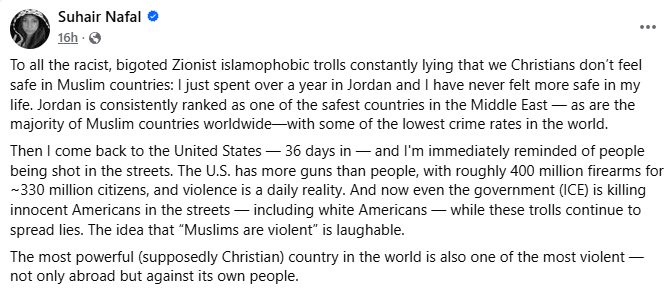
Dear Israelis'. I need this debunked i'm sure it's AI or something but it's on X.
https://x.com/MarleneASarroff/status/2014632267449303454?s=20



38m •
Debunking the Notion: Muslim Countries are the Safest (A Misleading Narrative Promoted by Islamists and Leftists)
I fundamentally disagree with the broad assertion that all Muslim-majority countries are inherently safe or that the U.S. is uniquely dangerous due to its Christian identity. For instance, Jordan is among the safer nations in the Middle East, but this safety stems primarily from its small size, stable monarchy, effective security measures, and lower population density, rather than any religious or cultural superiority. However, it's important to note that Jordan is not free from crime; it experiences petty theft, occasional violence, and has a history of anti-Palestinian tensions. The Gulf monarchies, such as the UAE, Qatar, and Saudi Arabia, achieve low crime rates mainly through their vast wealth, which finances extensive surveillance, strict policing, tight immigration controls, and the segregation of low-income migrant workers. Their safety is a product of economic power and authoritarian governance rather than solely cultural or religious factors. Many Western nations—and several U.S. states—often rank higher than Jordan and most Gulf countries regarding safety, lower homicide rates, and overall personal security. Countries like Iceland, Switzerland, Norway, Japan, and even some conservative U.S. states (Vermont, New Hampshire, Idaho, Wyoming) consistently appear among the safest globally, according to indices like the Global Peace Index and Numbeo crime statistics. Interestingly, within the U.S., the most dangerous urban areas are often found in liberal states and cities (California, New York, Illinois, etc.). Contributing factors include lax immigration enforcement and certain progressive criminal justice policies, such as bail reform and reduced policing, which critics argue have exacerbated violent crime. Meanwhile, conservative states with stricter law enforcement tend to report lower rates of violent crime. Ultimately, personal and public safety is influenced more by governance, economic conditions, population management, law enforcement effectiveness, and policy choices than by religious identity or the distinctions between “Muslim” and “Christian.”
0
0
1-30 of 1,498
skool.com/libertypolitics
Talk politics with others who care, in live calls and community posts. Share your views, ask questions, or just listen in.
Leaderboard (30-day)
1
+685
2

+567
3

+281
4
+235
5

+226
Powered by