

May 18 •
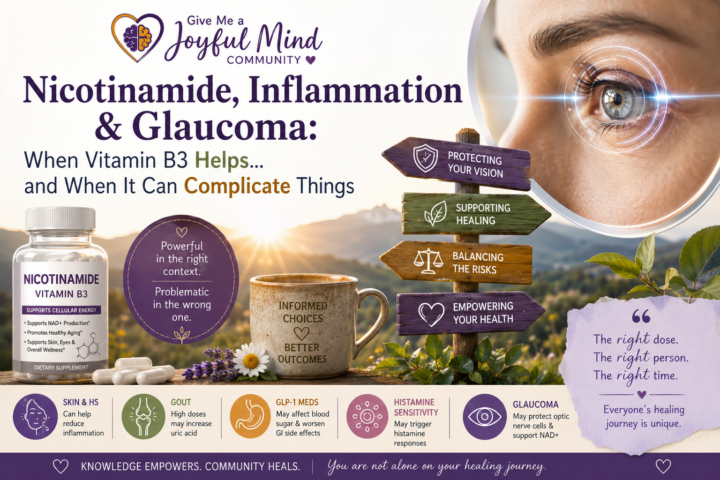
Nicotinamide, Inflammation & Glaucoma: When Vitamin B3 Helps… and When It Can Complicate Things
There is something deeply fascinating about nutritional science: the same compound that helps one part of the body heal can sometimes create challenges somewhere else entirely. And nicotinamide — also known as niacinamide, a form of vitamin B3 — is a perfect example of this complexity. At first glance, nicotinamide sounds almost universally beneficial. It is praised for its antioxidant properties, its role in cellular repair, its anti-inflammatory effects, and its ability to support energy production inside the mitochondria — the “power plants” of our cells. But once you begin looking at conditions like gout, histamine disorders, GLP-1 medications, hidradenitis suppurativa (HS), or glaucoma, the conversation becomes far more nuanced. Because biology is rarely simple. So… What Actually Is Nicotinamide? Nicotinamide (niacinamide) is one of the two primary supplemental forms of vitamin B3. The two main forms are: Nicotinamide / Niacinamide The non-flushing form commonly used in skincare, supplements, and research. Niacin (nicotinic acid) The flushing form that often causes redness, warmth, and tingling sensations. Both are forms of vitamin B3, but they behave differently in the body. Nicotinamide is particularly important because it helps the body create a coenzyme called NAD+ (nicotinamide adenine dinucleotide), which is essential for cellular energy production, DNA repair, mitochondrial function, and healthy ageing processes. Without enough NAD+, cells struggle to function efficiently. Why Nicotinamide Is Often Considered Anti-Inflammatory In most contexts, nicotinamide is actually considered protective and calming to inflammatory processes. Research has shown it may help: Reduce oxidative stress Lower inflammatory cytokines Support skin barrier repair Calm acne and rosacea Improve eczema Support cellular resilience This is why it appears in so many skincare products and inflammatory skin protocols. But here is the important part: Anti-inflammatory in one tissue does not automatically mean universally beneficial everywhere in the body.
2
0
May 15 •
My Day at the RVI: The "Dormant" Miracle and the Art of the Quiet Eye
Trading drops for a permanent solution. Today was a day of absolute validation at the RVI. If you had told me back on the 14th of March, when I was being offered steroids and invasive surgery for a flare-up—that I’d be standing here today with a "clean" eye, I’m not sure I would have believed it. But the work I’ve put in over the last six weeks has changed the game. Challenging the Textbooks When the consultant leaned into the slit-lamp today, the room went quiet. He couldn't find a single trace of the uveitis. No debris, no inflammatory cells, nothing. It was so pristine that he actually turned to his colleague and asked if there had ever been a recorded case of a "full recovery" from Fuchs. They eventually settled on the word "dormant," but I know better. The intensive systemic healing and the peptide protocols I’ve been running have been miraculously effective. To go from a surgical crisis in March to an eye so clear the doctors are questioning their own records is a win I’m going to savour. The New Roadmap: The PreserFlo MicroShunt Because my eye is now so "quiet," I am in the perfect position for the PreserFlo MicroShunt. Since I can't tolerate the systemic side effects of beta-blockers, the "fog" and the breathing issues, this tiny 8mm tube will handle the drainage for me. But here’s the catch: for this surgery to work, I have to stop healing. If my body repairs the surgery site as effectively as it just cleared the uveitis, the shunt will scar over and fail. I have to shift from "Building" to "Guarding." The Protocol Shift: Construction Holiday vs. Peacekeepers To give this shunt a chance to settle, I’m putting the "Construction Crew" on a strict holiday. I’m pausing the heavy-hitters: BPC-157, TB-500, ARA-290, and Semax. They did their job perfectly, but now I need my body to stay "lazy" so it doesn't knit that new drain shut. Instead, I’m moving to a "Quiet Eye" stack focused on CNS calm and pure inflammation control: 1. The Peacekeeper Peptides KPV: To keep the cellular inflammatory switches in my eye turned firmly to "OFF."
1
0
May 14 •
When Saving the Eye Starts Damaging It: Why I’m Pressing Pause at Stage Four
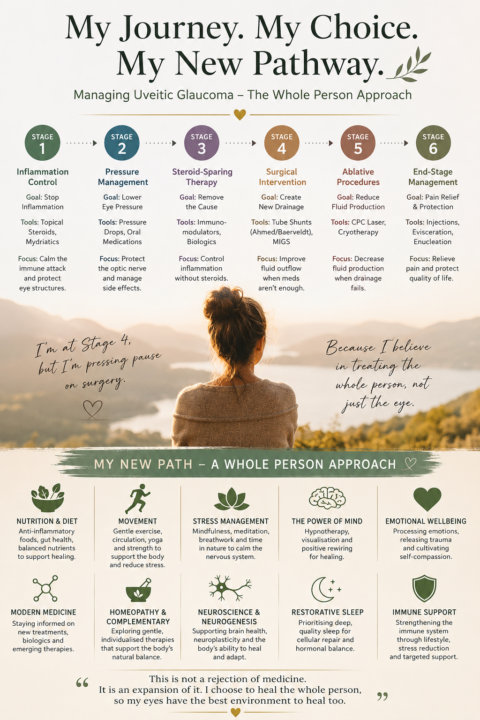
There’s a phrase often used in ophthalmology when dealing with chronic inflammatory eye disease: “It’s a balancing act.” And honestly, that’s exactly what it feels like. For years, my treatment journey has involved trying to preserve the structure of my eye while also managing the consequences of the very treatments designed to save it. It’s a constant negotiation between inflammation, pressure, pain, vision, medication tolerance, and surgical intervention. Clinically, I now sit at what would be described as Stage 4 of the uveitic glaucoma pathway, surgical intervention. But this is where I’ve decided to pause. Not because I’m “giving up.”Not because I’m ignoring medicine.But because I no longer believe the current pathway has fully considered the whole person. The Standard Journey The traditional progression often looks something like this: Stage 1: Inflammatory Control High-dose steroids and dilating drops are used to stop the immune system attacking the eye. Stage 2: Pressure Management As steroid use increases eye pressure, glaucoma medications are introduced to try and protect the optic nerve. Stage 3: Steroid-Sparing Therapy Systemic immune-modulating drugs and biologics are introduced to reduce dependency on steroids. Stage 4: Surgical Intervention When pressure remains uncontrolled, drainage surgeries or tube shunts are often recommended. And this is the point I’ve reached. Why I’m Pressing Pause What I’ve realised is that throughout this entire journey, almost every intervention has focused on the mechanics of the eye. Pressure.Drainage.Inflammation.Structural preservation. But very little attention has been paid to: - chronic stress, - nervous system dysregulation, - trauma, - sleep, - inflammation as a whole-body process, - nutrition, - movement, - metabolic health, - emotional wellbeing, - neuroplasticity, - or the role the mind may play in healing and adaptation. No one has truly sat down and explored the wider terrain of what might be contributing to ongoing inflammation and immune dysregulation.
May 6 •
Connecting
2 lovely ladies who are on this journey with me @Anna Brennan and @Alicia Pocaigue just connecting you both.
1
0
May 3 •
Let's chat
Please share your journey as there are a few of us all learning from each other.
1
0
1-9 of 9
powered by

skool.com/joyful-mind-community-4081
The Spiritual, Practical community for Manifestation and Meditation Mastery. Build confidence & purpose. Teacher Training available. Join FREE!
Suggested communities
Powered by