

May 20 •
NEW HYPNO GEEKS PODCAST EPISODE
https://www.buzzsprout.com/705534/episodes/19176741What happens when the life you worked so hard to build no longer fits who you really are? In this powerful episode of the Hypno Geeks Podcast, I sit down with Charlotte Mather to explore burnout, ADHD, masking, nervous system overwhelm, authenticity, hypnotherapy, business, and what it truly means to rebuild your life in a way that works with your brain instead of against it. Charlotte shares her journey from a high-pressure six-figure career in corporate finance into building a thriving hypnotherapy business and academy rooted in freedom, purpose, and neurodivergent-friendly approaches to healing and entrepreneurship. This conversation is deeply honest, funny, emotional, validating, and incredibly reassuring for anyone who has ever felt: ✨ exhausted by traditional workplaces ✨ trapped behind the “golden handcuffs” of security ✨ different, overwhelmed, or misunderstood ✨ burnt out from masking or trying to “fit in” ✨ unsure whether they could ever build a life or business their own way We talk about the realities of late ADHD diagnosis, why some traditional hypnosis approaches don’t work for neurodivergent minds, how authenticity is becoming more important than ever in an AI-driven world, and how self-compassion can completely change the way you see your past and yourself. There are so many moments in this episode that will make you laugh, nod your head in recognition, and probably feel a little less alone. ⏰ Highlights: 00:00 – Corporate burnout & freedom 13:00 – Leaving banking behind 20:00 – Building a hypnotherapy business 34:00 – What training often misses 49:00 – AI & the “trust recession” 54:00 – ADHD & late diagnosis 1:07:00 – Neurodivergent hypnosis approaches 🎧 Listen now and let us know what resonated most with you.
May 8 •
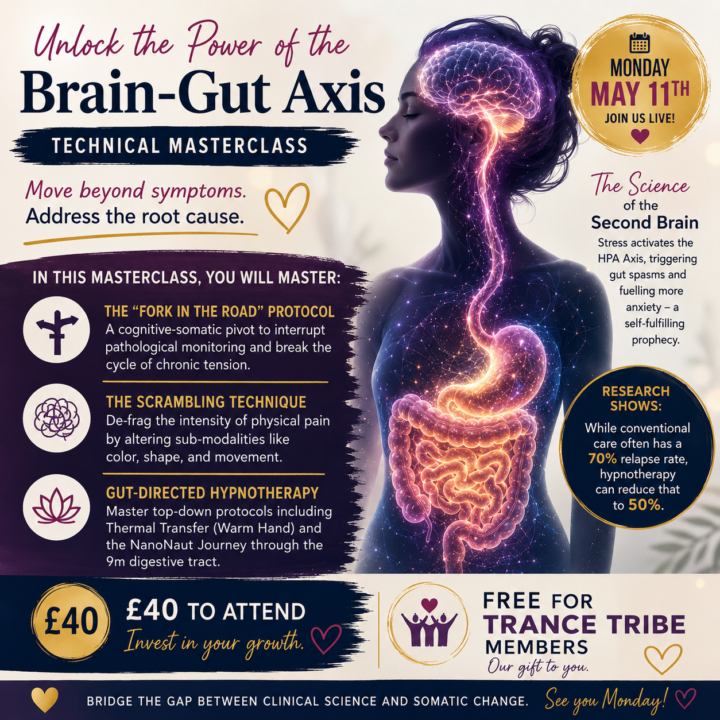
Hypnotherapy Masterclass
There’s a reason the gut doesn’t just “settle”… And it’s not because someone isn’t trying hard enough. This Monday, I’m hosting a technical masterclass on the Brain–Gut Axis, exploring how the nervous system and digestion become locked into a loop—where stress triggers the gut, and the gut fuels more anxiety. Inside this session, I’ll be sharing practical, in-the-room approaches you can actually use, including: ✨ The Fork in the Road – a simple but powerful way to interrupt that internal spiral ✨ The Scrambling Technique – shifting the intensity of physical discomfort ✨ Gut-directed hypnotherapy tools like Thermal Transfer and the NanoNaut Journey This is where clinical understanding meets real somatic change—supporting the body, not fighting it. 📅 Monday, May 11th 💫 £40 to attend 💫 Free for Trance Tribe members If you’re a hypnotherapist and ready to move beyond managing symptoms and start working with the root patterns… you’re so welcome to join us.
2
0
May 7 •
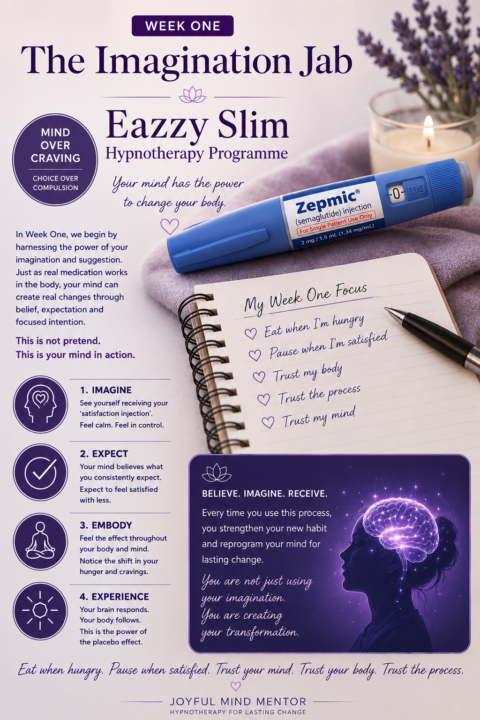
Week One: Reclaiming Your Body’s “Enough” Signal
The Eazzy Slim Hypnotherapy Programme There is something quietly powerful that happens when you stop fighting your body and begin listening to it instead. Week One of the Easy Slim Hypnotherapy Programme is not about restriction, calorie counting, or forcing discipline. It is about something far more intelligent and sustainable. It is about reconnecting with the moment your body naturally says, “that’s enough.” The Truth About Hunger (and Why It Is Not Your Fault) Within the brain sits a highly intelligent regulatory system, your satiety centre, located in the hypothalamus. Its role is to signal when to eat and when to stop, using chemical messengers such as GLP-1, a hormone released in response to food. When this system is functioning clearly, eating becomes simple. There is no constant preoccupation with food, no sense of being out of control, and no tendency to eat beyond comfort. Instead, there is a natural rhythm: eating when hungry and stopping when satisfied. However, in the modern environment, this signal is often disrupted. This is not due to a lack of willpower, but rather a combination of factors such as ultra-processed foods, habitual grazing, chronic stress, and a gradual disconnection from bodily awareness. The result is what many people experience as “food noise” a persistent mental chatter around eating. Why the “Jab” Works (and What We Are Replicating Naturally) Medications such as Ozempic and Mounjaro work by amplifying the body’s satiety signals. They effectively increase the intensity of the message that says “I am satisfied,” while quietening the background drive to continue eating. What is important to understand is that this mechanism is not artificial. It is an enhancement of a system that already exists within you. Your body already possesses the capacity to regulate hunger and fullness effectively. The role of the mind in this process is often underestimated, yet it is central to how these signals are experienced and interpreted.
1
0
Mar 18 •
Why Self-Actualisation Isn’t the Final Destination
For many years, personal development has been framed around a single, compelling idea: becoming the best version of yourself. This concept, popularised through Abraham Maslow’s Hierarchy of Needs, places self-actualisation at the peak—a state where an individual realises their fullest potential, aligns with their purpose, and lives authentically. It has shaped the way we understand growth, success, and fulfilment. Yet, towards the end of his life, Maslow recognised that this was not the complete picture. Beyond self-actualisation lies another, often overlooked stage: self-transcendence. This is not about the self at all, but about moving beyond it. It marks a profound shift in perspective, from asking, “How can I become my best self?” to “How can I contribute to the growth and wellbeing of others?” It is the transition from inward focus to outward service, from personal fulfilment to collective impact. In therapeutic practice, particularly within hypnotherapy, this transition is not theoretical, it is something that unfolds in real time. Individuals often begin their journey seeking relief: from anxiety, from trauma, from limiting beliefs that have shaped their lives. They come to heal, to understand themselves, and to regain a sense of control. And in doing so, they begin the process of self-actualisation. However, something remarkable tends to happen once that work deepens. As individuals start to release old patterns and reconnect with their inner resources, a new awareness often emerges. They begin to recognise that their experiences, especially their challenges, hold value beyond their own healing. What once felt like obstacles become sources of insight, empathy, and strength. In this space, many feel a natural pull towards helping others. Not from a place of obligation, but from a genuine desire to contribute. This is the essence of self-transcendence. It is not about losing oneself, but about expanding beyond the confines of the individual identity. It is about recognising that personal growth finds its deepest meaning when it is shared, when it becomes a bridge for others to cross.
0
0
Feb 22 •
Why Accreditation Is the Pillar of Professional Hypnotherapy
Let’s start with something that often surprises people. In the UK, hypnotherapy is not statutorily regulated. There is no “Hypnotherapy Act.” No protected title. Technically, anyone can call themselves a hypnotherapist. And that’s exactly why accreditation matters so much. I am the Joyful Mind Mentor and Director of Studies at the Northern College of Clinical Hypnotherapy, a school that holds multiple accreditations. Not because they look impressive on a website. Not because they’re nice badges to collect. But because they represent accountability. In a profession without statutory regulation, voluntary self-regulation is not optional. It is essential. The Strength of Voluntary Self-Regulation Hypnotherapy in the UK operates within a framework of Voluntary Self-Regulation overseen by the Professional Standards Authority (PSA). This means professional registers are independently assessed to ensure they meet robust standards around: Governance Education and training Fitness to practise procedures Complaints processes Public protection This is not a “soft option.” It is a conscious commitment to being measured against agreed national standards. Practitioners registered with bodies such as the Complementary and Natural Healthcare Council (CNHC) must complete substantial, structured training, including: A minimum of 450 hours of total study At least 120 training hours Demonstrated occupational competence That is not a weekend workshop. That is professional formation. Accreditation Is Accountability At the Northern College of Clinical Hypnotherapy, we hold multiple accreditations because we believe in external scrutiny. Accreditation means: Our curriculum is evaluated beyond our own internal standards Our assessment processes are reviewed Our ethics framework is examined Our governance is transparent It means we answer to something bigger than ourselves. And in a field where we work with trauma, anxiety, addiction, identity, grief and deep emotional change, that level of accountability is non-negotiable.
0
0

1-30 of 35
powered by

skool.com/joyful-mind-community-4081
The Spiritual, Practical community for Manifestation and Meditation Mastery. Build confidence & purpose. Teacher Training available. Join FREE!
Suggested communities
Powered by