

May '25 •
I was called out
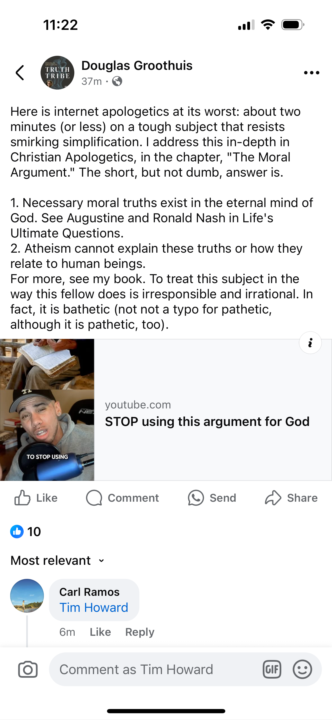
Looks like all of you are being taught by the worst internet apologist 🤣💀 But in all seriousness, this is a really REALLY bad take from someone who is a scholar. My take is entirely informed by the theistic heavy weights such as Joshua Rasmussen and Trent Dougherty. Remember this one for the rest of your lives: 1️⃣Logically, the argument with the weakest premise is the strongest argument. 2️⃣The perception of morality is obviously a weaker premise than the objectivity of morality. This is not hard.


May 1 •
Structural perspective on Fine Tuning
Recently, during the debate prep on Thursday, Tim used an objection to things with beginnings needing causes in the property of quantum fields to generate particle-antiparticle pairs seemingly at random with no source. While the obvious response to this is to point out that just because we don't observe the cause doesn't mean there isn't one, and this effect is still contingent on the properties of the fields themselves. However, this led me to think about this effect and how the naturalist would use this process to explain where stuff comes from. A few important notes. 1. Both the Theist and Atheist are following Ockham's Razor, so the theory with the most post hoc assumptions is worse. 2. In physics it is a well-known principle that the source of the vast majority of physical laws comes from symmetries in the universe. 3. One common theory for the Big Bang is that the massive energy condensed into particle anti particle pairs in a process called creation or pair production. 4. The way this process doesn't violate the conservation of energy on normal scales is that the particles and antiparticles annihilate each other. One might ask if these particles always annihilate each other how could the universe come about. The answer is this: In our universe where basically all of the fundamental laws of physics are derived from symmetry we have one absolutely necessary violation of this called CP violation. This causes the decays of Kaons to slightly favor matter to antimatter. The physics itself is not as important as the asymmetry. If the naturalist is to attempt to impose a simple mechanism for the structure of the laws then they would be most reasonable to choose symmetry as this mechanism. To account for this effect they would also need to create an arbitrary limit to this mechanism and establish an asymmetry. This shows that not only are the constants (like the tuning pegs on a guitar) are finely tuned for life and existence, but the underlying structure (the guitar itself) is also finely tuned.
Apr 26 •
⚠️ Must WATCH
One of my favorite debates EVER on arguments for God (specifically the contingency argument) is Rob Koons vs Graham Oppy. If you want to see what’s it like in real-time to engage and trade frameworks of good reasoning across worldview lines at the highest level, this debate features it like I’ve yet to see elsewhere. This should give you a good idea at what I’m aiming to make all you competent in inside the group training sessions. Pay attention to the nuances and you’ll be blown away.

Apr 22 •
Question about contingency
I recently learned about Kants Critique of Pure Reason and I was wondering if his argument indirectly undermines arguments from contingency for Gods existence. Because arguments from contingency require us to conceptualize causality and necessity beyond the bounds of space and time(or beyond experience), doesn’t it follow that we can’t really pull any knowledge from these arguments if we accept Kants framework? I’d be open to any corrections if I misunderstood Kant (probably) or arguments from contingency!
1-30 of 46
Leaderboard (30-day)
1

+8
2

+8
3

+7
4

+5
5

+4
Powered by