Activity
Mon
Wed
Fri
Sun
Jul
Aug
Sep
Oct
Nov
Dec
Jan
Feb
Mar
Apr
May
Jun
What is this?
Less
More
Memberships
Inspiring Philosophy Academy
50 members • $25/month
11 contributions to Inspiring Philosophy Academy

17d •
Common to apologetics discussions is the notion of “good answers” vs “bad answers.”
If you’ve been on the internet for any significant period of time, you’ve come across creators, comments, and debates where someone throws around the phrase “that’s a bad answer” or “that doesn’t answer the problem.” But for whatever reason, no one has stopped to ask: what do we mean by “good answer”? This has always baffled me. If both parties (assuming good intent) desire to be as objective as possible, then why has this notion of “a good answer” not been unpacked or precisified? It seems like the most obvious and fundamental step to take. And yet, mainstream apologetics never stops to first provide clarity. Here’s what we don’t want: a good answer being one where the person receiving the answer feels satisfied. Why? Because that turns something objective into something psychological. If our goal is to track the truth, then why is our litmus test for rationality someone’s psychological state, rather than the merit of the reasons given? That is clearly not the right way to go. Ultimately, we don’t care about the psychology of answers, but the epistemology of answers. Epistemology concerns anything to do with giving reasons for a belief. In apologetics, epistemology is the cornerstone of what we do. So the question becomes: what is the right epistemology of answers? And to that, we turn to a fun little concept called “ad hocness.” You’ve probably heard this term used a lot. “That’s ad hoc!” someone declares, as though the rest of the discussion is now moot. However, there’s quite a bit to say about this concept, and it’s much more nuanced than many make it out to be. Ad hocness occurs when the explanation given to save the truth of one’s belief(s) cannot be ascertained from the principles within that person’s already-held framework. In other words: when resisting having one’s belief(s) defeated, if what’s appealed to is not already expected within their system, it’s said to be ad hoc. Now, you can already see how most who throw around the term do not use it in this rigorous of a manner. Keep note of that.

2 likes • 17d
You put it very cleanly thanks!
20d •
⚠️ Q&A Canceled
Hey all! Unfortunately, I have to last-minute cancel today’s Q&A due to unforeseen circumstances. We will back on next week 🔥 Thank you for understanding 🙏🏽
0 likes • 20d
Hope all is well Tim 🙏
24d •
The nail in the coffin for divine agency theories
The most common reply to arguments for a high Christology is an appeal to divine delegation, or agency. A Christian might say something like, "Jesus calmed the storm in Mark, who but God can do that?" The dissenter replies, "That's because Jesus was given divinely authorized power, just as Moses was when he split the Red Sea. You wouldn't call Moses God, would you?" At first glance, the symmetry seems accurate. But look beneath the surface, and a serious problem emerges. What the dissenter is really doing is anchoring their interpretive framework to adjacent Jewish agency texts, passages featuring mediatorial figures such as prophets, angels, and messengers, or even inanimate objects like the ark of the covenant. The goal is to draw a parallel between Jesus and figures who mediated the presence of YHWH without ever being YHWH. The trouble is that no such parallel actually works in totality. Now you might be thinking, "But doesn't Jesus carry out divine prerogatives, just as those other figures did?" Yes, He does, but that's a distraction from the real point of contention. The real issue is what I'll call the overextension problem. The overextension problem: Agency-only models use Jewish agency parallels to explain more than those parallels can bear. They can account for how an authorized agent represents YHWH, but they cannot, on their own, explain why Christ personally occupies the YHWH-only subject-position. That subject-position turns on something I'll call identity-emphasis. Identity-emphasis: the way a text signals which figure is being made the focal bearer of divine significance in a given passage. How do we know this is the crux? Simple: in every proposed parallel, whatever mediates YHWH's presence and authority never retains an identity of its own, it functions purely as a channel for YHWH's speech and action. So here's the logic of the agency-only model: YHWH commands → the human agent obeys and signifies the act → YHWH completes it. Take Moses at the sea. He stretches out his hand, but it is YHWH who drives the waters back:
1 like • 24d
Good stuff Tim keep up the good work!

May 9 •
🚨 NEW COURSES 🚨
Hey guys, as we slowly build out the program to include MORE high level training, we want to know what YOU guys would be looking for first. I'll add some options we already plan on adding, but feel free to comment any topics you want to be trained on (or even WHO you would like to see teaching as part of the course!)
Poll
29 members have voted
1 like • May 9
A Bayes course would be insane genuinely
Apr 30 •
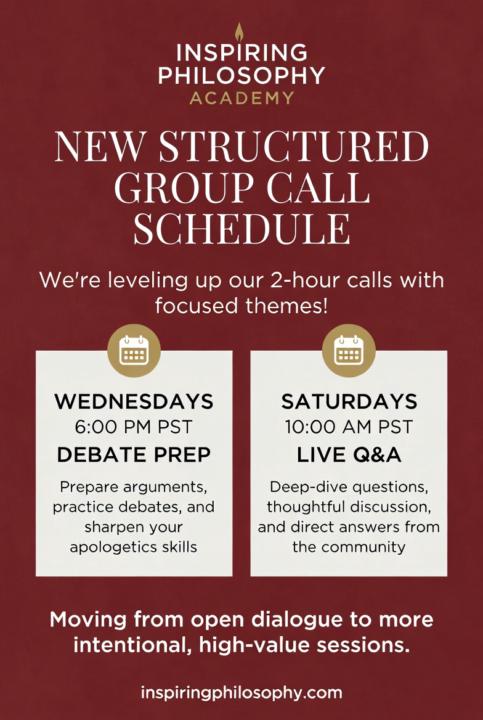
🛎️ Call Structure Update 🛎️
Moving forward, our calls will be intentional and focused on the following themes: - WEDNESDAYS - Debate Prep: Some of you learn best through hands-on scenarios and challenging conversations. These calls will give you the opportunity to you walk through lines of reasoning, honing your understanding of deep concepts through mock debate, hypothetical scenarios, and thought experiments. - SATURDAYS - Q&A: Some of you have questions that will arise throughout the week, and as you go through the course. This call is for you. You'll get individual time with Tim (or guest scholar) to ask whatever questions you may have about apologetics, philosophy, theology, etc. These changes will help you come prepared to each call knowing exactly what to expect. (If you have any questions, feel free to comment on this post or email matt@inspiringphilosophy.com)
1 like • Apr 30
That’s awesome! Will Thursday calls keep the same structure? With the added extra hour of course
1 like • Apr 30
@Inspiring Philosophy Thanks Matt appreciate it
1-10 of 11

Active 1d ago
Joined Mar 29, 2026
Powered by