
Write something
Pinned

⭐
4d •
🍞 This Week We're Baking Challah
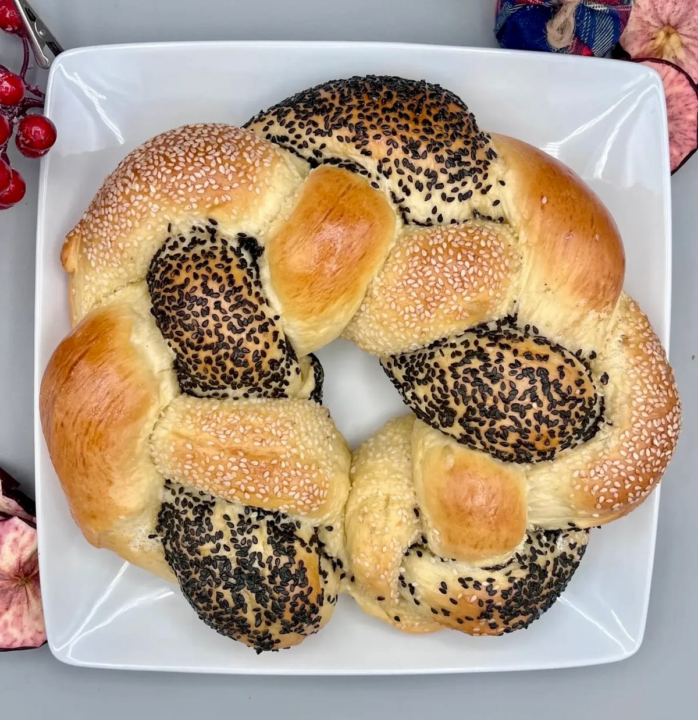
After pizza week we're shifting gears. This week we're baking challah, the braided bread that's been on celebration tables for thousands of years. It's the bread of Shabbat. The bread of welcome. The bread of homecoming. I've got a personal reason for putting this one on the schedule, and I'll tell you the whole story this week. For now, here's the lay of the week. 🥖 𝗢𝗻𝗲 𝗱𝗼𝘂𝗴𝗵, 𝘆𝗼𝘂𝗿 𝗰𝗵𝗼𝗶𝗰𝗲 𝗼𝗳 𝘀𝗵𝗮𝗽𝗲: Three-strand braid: The most approachable shape, and the one most home bakers start with. If this is your first challah, this is your braid. Six-strand braid: The classic Shabbat shape, more involved but absolutely doable. We'll walk through it Friday step by step. Round: The shape used for Rosh Hashanah and celebration. Symbolizes the cycle of the year and the unbroken thread of family. Beautiful at any table. 🌱 𝗖𝗿𝗲𝗮𝘁𝗶𝘃𝗲 𝗽𝗲𝗿𝗺𝗶𝘀𝘀𝗶𝗼𝗻: Top with sesame, poppy, or everything seeds. Add raisins to the dough if that's your tradition. The only line we hold is no butter or dairy in the dough itself. Challah is meant to be shared at any table, and that's the rule that protects it. 📚 𝗪𝗵𝗮𝘁 𝘄𝗲'𝗹𝗹 𝗰𝗼𝘃𝗲𝗿 𝘁𝗵𝗶𝘀 𝘄𝗲𝗲𝗸: The dough, what makes it different from any other enriched bread. The Herr Sherman story, and why this bread shaped how I teach. Braid breakdowns, three-strand and six-strand, with the round as an alternative. Egg wash, seeds, and getting that deep mahogany shine. The tradition behind the bread, taught with respect, not religion. 🥖 Recipe: https://pantry.bakinggreatbread.com/recipes/special-round-challah This is one dough, one teaching, and a room full of different shapes coming out of different ovens on Saturday. Pull out your eggs, your flour, your honey, and bake with us. Perfection is not required. Progress is. Henry ⭐🔥 Special Round Challah — Yeasted https://pantry.bakinggreatbread.com/recipes/special-round-challah Special Round Challah — Sourdough https://pantry.bakinggreatbread.com/recipes/special-round-challah?variant=sourdough
Pinned
⭐
1d •
How to Braid Challah: 3-Strand & 4-Strand
In this video, Matthew Duffy shows you exactly how to braid challah using two classic techniques: the 3-strand braid and the beautiful 4-strand crown. Whether you’re new to challah or want to elevate your shaping game, this step-by-step tutorial will guide you through the process with clarity and confidence. Henry ⭐🔥 Special Round Challah — Yeasted https://pantry.bakinggreatbread.com/recipes/special-round-challah Special Round Challah — Sourdough https://pantry.bakinggreatbread.com/recipes/special-round-challah?variant=sourdough One-sheets (printable): - Yeasted: https://pantry.bakinggreatbread.com/recipes/special-round-challah/one-sheet - Sourdough: https://pantry.bakinggreatbread.com/recipes/special-round-challah/one-sheet?variant=sourdough
Pinned
⭐
2d •
🍞 The Story of Challah: Where the Bread Comes From, and What It Means
Before we braid on Saturday, I wanted to tell you where this bread comes from. Because the recipe is only half of it. The other half is the meaning that's been kneaded into it for thousands of years. The word "challah" came from the Torah originally, and it didn't mean a loaf. It meant a small portion of dough that was set aside as an offering, every time bread was made. Over time, the word migrated. The portion, and then the whole loaf, both came to be called challah. The bread carries the name of its own commandment. The braided shape we know came later, in medieval Europe, when Jewish communities in places like Germany and Austria made the braided loaf the standard bread for Shabbat. Two loaves on the table. A cloth over them. Candles beside them. Every part of it carries meaning that goes back further than any of us. I'm not Jewish, and I'm not teaching religion here. I'm a baker who respects what this bread is. And if I've gotten anything wrong in the way I tell it, please tell me. I'll listen. Watch the deck. Then come bake with us Saturday. 🍞 Recipe: https://pantry.bakinggreatbread.com/recipes/special-round-challah Perfection is not required. Progress is. Henry ⭐🔥

35m •
Sometimes mistakes turn out alright…
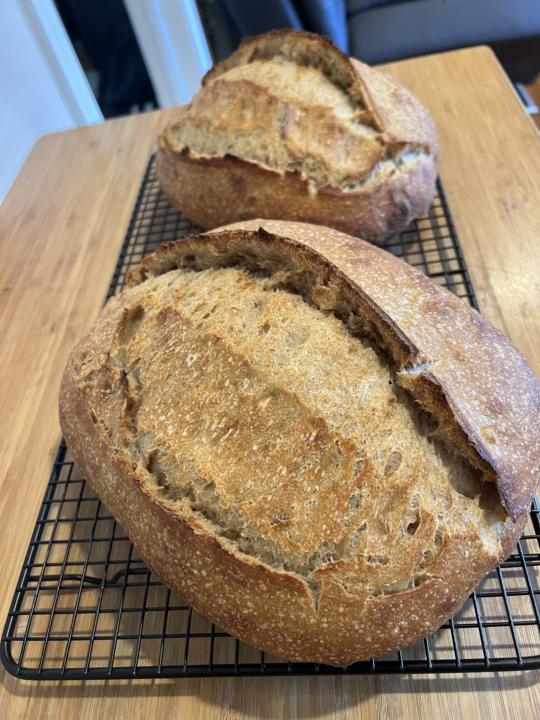
Yesterday I was mixing a batch of dough and put in my desired amount of high gluten flour. Then I needed to add the same amount of all purpose flour… but, as I was pouring the flour into the bowl I realized I had whole wheat flour, not all purpose flour.😖 I immediately halted pouring in more WW flour at close to 300g. You can’t separate the flour from the other flour so I thought now what am I going to do?🤔 I decided if I’m going to use 1200g of total flour like I normally do… 300g would mean I’d be making 25% whole wheat loaves of bread.🤷♂️ So I rounded out the WW flour to exactly 300g and added enough all purpose flour to get me to 1200g total flour, including the 120g of flour from Hank. 540g high gluten flour 300g WW flour 240g all purpose flour 840g water 240g Hank 24g salt —————- 2184g total weight 1. Mix everything except the salt and Fermentolyse for an hour. 2. Add the salt by dimpling it in and using the pincher method and the Rubaud method and then do about a dozen slap and fold repetitions… until you can feel it starting to become smooth and cohesive. Bench rest covered by inverted mixing bowl for 30 minutes. 3. Do stretch and folds just to help align the gluten strands more. The gluten development is pretty much adequate at this point. Rest under mixing bowl for 30 minutes. 4. Do gentle coil folds to align gluten again. Do windowpane test, it passed. Put dough in lightly greased bulk fermentation vessel at 81°f after the gluten development process is complete. Put vessel on heating pad set at 84°f… until it has risen 25%. 5. After the dough has risen 25% I dump it out of the lightly greased vessel without touching it or popping any bubbles. I divide it with my 9” bench scraper and preshape it with the scraper to… a no hands preshaping process pops fewer bubbles.😁 Cover with inverted mixing bowls and bench rest for 20 minutes. 6. Final shape + into no Lenin liner/no rice flour bannetons + bench rest for 10 minutes + lace bottom seam together to get better tension + put plastic bowl caps over the top on the banneton to prevent dehydration, no rice flour + into 38°f fridge @80°f for overnight cold proofing. 7. Next morning… bake cold right out of the fridge. Score first and put right onto the 510°f baking steel and covered for 20 minutes with the baking shell to retain the steam. 8. Remove Shell and allow the crust to brown to my desired color and get the interior temperature up to 205/210°f.
2d •
Blending flour just out of curiosity…
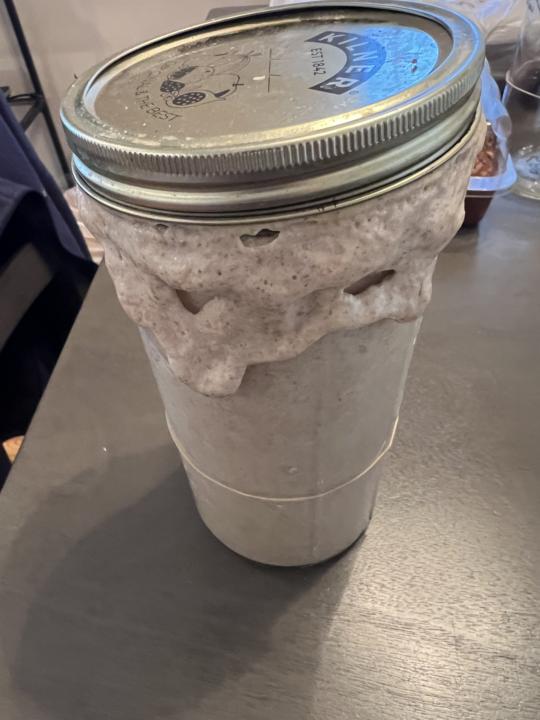
You can probably tell I alway use 1200g total flour in my batches of dough and I usually use 20% inoculation… but I’m very flexible with the blend of flour and the hydration percentage. I was sitting having my morning coffee and some sourdough toast with peanut butter thinking… hmmm, what should I make today. I got to wondering what would happen if I mix my cheap high gluten flour with my cheap all purpose flour and threw in some expensive King Arthur whole wheat flour. Then I got to thinking what if I made the blend as close to 33% each… remember my buddy Hank has some Dark Rye flour he brings to the party too, so I can’t be exactly 33% each but I could get close. 👨🍳 it’s an interesting formula… Flour blend - 340g High Gluten = 31.5% - 370g AP = 34.3% - 370g WW = 34.3% - plus Hank contributing: 60g HG 30g WW 30g Rye Total flour: - HG = 400g - AP = 370g - WW = 400g - Rye = 30g So the final blend is approximately: - 33% High Gluten - 31% AP - 33% Whole Wheat - 3% Rye That’s actually a very balanced flour blend. I reached: 33% rise in 3 hours 15 minutes with: - 20% inoculation - 78% hydration - dough temperatures in the low 80s - Hank was absolutely loaded for bear today. 🐻 The whole wheat and rye also contributed extra enzyme activity and fermentation speed. What I expect tomorrow Based on the photos from my recent 50% WW experiment… ✅ darker crust ✅ stronger aroma ✅ slightly more acidity ✅ slightly smaller average cell size than my white loaves ✅ excellent oven spring ✅ very even crumb ✅ outstanding sandwich bread ✅ outstanding toast What I’m really watching for… Not the ears. Not the spring. The crumb. This blend may end up sitting in a very sweet spot between: - My highly structured 50/50 HG/AP loaves and - My 50% WW loaves The AP should lighten the crumb. The HG should provide strength. The WW should provide flavor. The rye should quietly help fermentation. 33% HG / 33% AP / 33% WW + a little rye is an intriguing blend that needs to be tested. It
1-30 of 1,937
powered by
skool.com/crust-crumb-academy-7621
#1 Sourdough Community on Skool 🍞
Coaching, not judgment. Sourdough, starter, yeasted, enriched & every bread between.
✅ ProveWorth Certified ⭐⭐⭐⭐⭐
Suggested communities
Powered by