
Write something
Pinned

⭐
🔥
1d •
This Week's Bake — The Pretzel Loaf, Two Tracks
Look at how far we've come. We've learned to watch the dough, not the clock. We've worked on shaping and scoring. We've handled wet dough and figured out how to manage it without panicking. We've built our first preferments and seen what a poolish can do. Now we're going to take everything you've learned and build on it. This week we're baking the pretzel loaf. Two tracks. Same loaf. Yeasted with a poolish if you don't have an active starter, or sourdough if you do. Same hydration, same flour weight, same bath, same bake. Just two different ways to get the dough started. Here's what we're adding to your toolkit this week. The alkaline bath. Most home bakers have never used one. It's the step that turns a regular loaf into a pretzel loaf. Three things happen in that bath, and once you understand the why, you'll never look at a pretzel the same way again. Scoring an alkalized crust. The bath seals the surface tight, which means your score has to do real work. We'll get into where to place it and how deep to go. Reading the bake. The five-minute butter rule. What success looks like when you cut into the crumb. The three most common mistakes and how to fix them before they happen. Here's the thing about doing this together that you can't replicate baking alone in your kitchen. When you bake on your own, you only see your loaf. You don't know if your bulk fermentation went too long or too short until you've cut into it. You don't know what underproofed looks like at hour four versus hour six. You don't know if your bath was strong enough until the loaf comes out pale and you're not sure why. In a bake-along, you're seeing dozens of doughs at every stage at the same time. Someone's hours ahead of you. Someone's hours behind. Someone's about to make the same mistake you almost made yesterday, and you can warn them. Someone else figured something out you didn't, and now you know it too. You get exposed to bread you might never have tried on your own. The pretzel loaf is a perfect example. How many of you would've boiled a bread dough in alkaline water if you weren't doing it as a community? Probably not many. But you'll do it this Saturday, and your kitchen's going to smell like something it's never smelled before.
Pinned
⭐
🔥
5h •
WORD OF THE DAY: PRETZEL CRUST
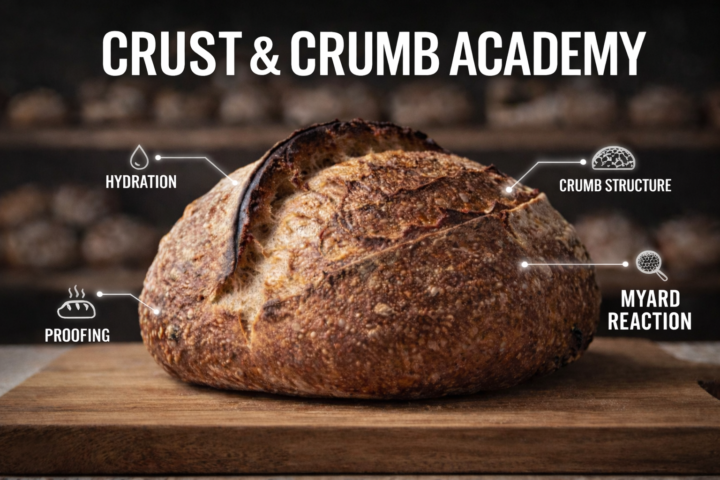
Ever baked something that looked like a pretzel… but didn’t taste like one? That’s the crust. That deep color and flavor don’t come from the oven alone. They’re built before the bake. Once you see that, the whole process makes more sense. This is one of those details that changes the result completely.
Pinned
⭐
🔥
Jan 6 •
A Note About the Culture We're Building Here
A lot of you came from Facebook. I run Baking Great Bread at Home over there, 40,000+ members, and I love that community. But I want to be honest about something. On Facebook, you often get one of two things: criticism without substance or compliments without critique. Someone posts a loaf and the comments are either "Beautiful!" when there's clearly something going on, or unhelpful jabs that don't teach you anything. People mean well. They're trying to be kind. But kindness without honesty doesn't make you a better baker. This is a different place. Crust & Crumb Academy is exactly that: an academy. This is where you come to hone your skills and get better. That means when you ask for feedback, you're going to get it. Real feedback. Specific feedback. The kind that actually helps you improve. I'll always be kind. I'll always be encouraging. But you're not going to get empty platitudes from me. If I see something in your crumb, your shaping, your scoring, I'm going to tell you what it is and how to fix it. That's what coaches do. And I want you to do the same for each other. When someone posts a bake and asks for critique, give them something useful. Tell them what you see. Ask questions. Share what's worked for you. That's how we all get better. This is a teaching environment. We're not here to collect compliments. We're here to make better bakers. Perfection is not required. But growth is the goal. Let's get to work. ~Henry
⭐
🔥
2h •
Reading a Poolish, Coming Right Up
Right after that runaway poolish, I caught my breath, scraped the counter, and pulled the camera back out. Made a short video walking through how to actually read a poolish when it’s ready. The bubbles, the dome, the dip in the middle, the smell, the texture. All the cues your dough is giving you that most new bakers miss. There’s a fun moment in there too. I show what happens when you put a dry finger in versus a wet hand. One sticks like glue, the other comes out clean. Wet hands, every time. That’s the move that saves your sanity when you’re working with sticky dough. Posting it here in a few minutes. Watch for it. Henry ⭐🔥

⭐
🔥
2h •
Member Spotlight: Jayla Weaver
Listen to what Jayla wrote about her first baguette. "I was ready to call it quits SEVERAL times with this one. I stared down flat, lifeless loaves. But I had come too far to quit. I scored it, popped it in the oven, and she came out not perfect, but she persevered. Somewhat proud of my first baguette. Overall this failure felt like a small success." Read that last line again. "This failure felt like a small success." That's the sentence I want every baker in this community to write down somewhere they can see it. @Jayla Weaver used AP flour instead of bread flour. Her dough ripped on the last coil. She didn't have a baking stone or parchment paper. She put a painted dish in a 500-degree oven and got smoke. She baked at 475 the whole time because she was rattled. She stayed up too late watching the oven. And she finished the bake. That's a baker. Not someone who got every variable right. Not someone who had the perfect setup. Someone who hit seven obstacles in a row and pulled a baguette out of the oven anyway. That's the only kind of baker who ever gets good at this. The rest quit at obstacle number two and tell themselves they're not cut out for it. The first baguette is supposed to be hard. You're not supposed to nail it. What you're supposed to do is exactly what Jayla did. Show up, take the punches, score the dough even when you're scared, and learn something you can carry into the next bake. Jayla, you're going to look back at this loaf in a year and laugh at how much progress you've made. But this one matters. This is the bake that proved you don't quit when it gets hard. Every loaf after this one is built on that. Welcome to the community, the real one. Where bakers come not to get likes, but to get better. Perfection is not required. Progress is. — Henry ⭐🔥

1-30 of 1,532
powered by

skool.com/crust-crumb-academy-7621
#1 Sourdough Community on Skool 🍞
Coaching, not judgment. Sourdough, starter, yeasted, enriched & every bread between.
✅ ProveWorth Certified ⭐⭐⭐⭐⭐
Suggested communities
Powered by