
Write something

⭐
🔥
5h •
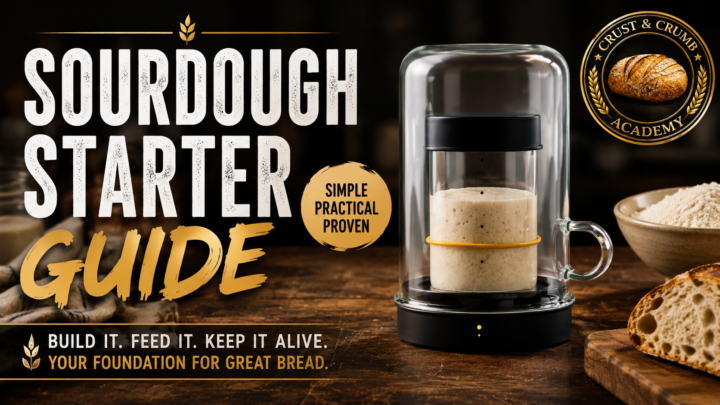
🫙 The Sourdough Starter Care Guide Just Got a Facelift
I went back through our Sourdough Starter Care Guide and gave it a complete refresh. It is not just prettier. It is easier to navigate, easier to understand, and much more useful when you are standing in the kitchen wondering what your starter is trying to tell you. The guide can always be inside the classroom button at the top of our page. https://www.skool.com/crust-crumb-academy-7621/classroom/5e132945?md=10b2221ee5774f8aaed5306cf692d08d Inside the updated guide, you will learn how to: ✅ Build a starter from scratch ✅ Feed it without wasting a mountain of flour ✅ Recognize peak activity and baking readiness ✅ Choose the right jar and keep it clean ✅ Prepare your starter for bake day ✅ Tell harmless hooch from contamination ✅ Dry and store a backup ✅ Understand starter temperature, flavor, and feeding rhythm I also added new visual examples, clearer chapter navigation, a starter resource library, and links to the tools we use throughout the Academy. Whether your starter is brand new, neglected in the refrigerator, or bubbling happily on the counter, this guide will help you understand what to do next. 🔗 Open the updated guide: https://sourdough-starter-guide.vercel.app/ Bookmark it. Keep it close. Come back whenever your starter starts speaking a language you do not understand yet. This free guide contains clearly labeled affiliate links. Perfection is not required. Progress is. ~Henry⭐🔥
⭐
🔥
13d •
I'm here, sort of...
Quick heads up. Skool is rolling out some changes that affect us, things like our visibility, plus new rules about what we can and can't put on our About page. That touches our discovery and a few other areas, so I want to work through it carefully and make sure we stay compliant. I'll have my head down for the next couple of hours getting it sorted. I'm still here though, and I promise I'll get back to any questions or anything you need as soon as I'm back this afternoon. Henry ⭐🔥

⭐
🔥
19d •
New Member Welcome | Let’s talk bread 🍞
When we first opened the Academy, I used to do a new member welcome post every so often. Then I got away from it, and here's why. I started welcoming every single new member personally instead. Here's what that looks like behind the scenes. When you join the Academy, we ask you a few questions. One of them is what you hope to learn or gain by being here. I read every answer. Then I follow up with each of you personally and hand you something to get started, a recipe, a video, a blog post, an article, whatever fits what you told me you wanted. So if you've joined us recently, you haven't gone without a welcome. That's been happening quietly all along, and it isn't changing. What is changing is this. A welcome from me is one thing. A welcome from all of you is quite another. So from now on, I'm bringing you into it. I'm going to introduce our new members right here in the feed so you can meet them too. A big welcome to our newest members @Geraldine Kendall @Anthony Reed @Pam Penney @Mehmetcan Yılmaz @Thu Phuong @Dianne Stone @Jenn Taylor @Amy Kahler @Melissa Likes @Robin Royce @Donna Laycock @Jamie Dietrich @Toni McCord @Abby Bowlin @Lesli Hansen @Jenny Rader-Bakos @Joel Kellen @Susan Chitty @Bianca Abella @Mpasa Monageng and @Gaelene E . You’re in the right place if you want to stop guessing and start baking with confidence.
⭐
🔥
24d •
The Bread Authority — and a little game to go with it
Hey everyone, Both of my parents were teachers. The way they knew a lesson had truly landed wasn't a grade on a test. It was watching a student walk off and succeed on their own with the skill they'd just been taught. That was the proof. That's exactly what I built the Bread Authority to do for you. When you sit down to tackle a new recipe, I want you to have an entire encyclopedia at your fingertips, and Krusty, your friendly bread baking assistant, right there beside you. A place to search out the answer in an article. A place to see the what-for, the how-to, the when-should-I, and the why in a video. A place to find the fix for a problem fast, so you can bake on your own with confidence. Here's how it came to be. When a member would ask me about the poke test, or windowpane, or a wide-bladed lame, or why their bulk fermentation stalled out, I knew I had something that could help. The problem was finding it. It could be in one of 300+ blog posts, or 175 articles, or 48 classroom modules, or somewhere in over 400 YouTube videos. Maybe even one of our shorts. Putting my hands on what I needed took 30 to 45 minutes sometimes. That's not a good use of time, yours or mine. So I built the Bread Authority. It's a digital Rolodex of everything I've ever published, organized so I can get to the right piece of content in seconds instead of half an hour. Now I'm turning it into a game. Head over to bakinggreatbread.com/bread-authority. Scroll down a bit and you'll see the Scavenger Hunt. That's where you come in. I pulled 17 questions from a pool of 34, mixed difficulty, with a speed-run option if you want to race the clock and progressive streak celebrations as you chain correct answers together. Hit Hot Streak, then On Fire, then Unstoppable, then Legendary, then Bread Authority. When you finish, you can post your score straight to the live leaderboard, or copy your result and paste it back here so we can all see how you did.
⭐
🔥
21d •
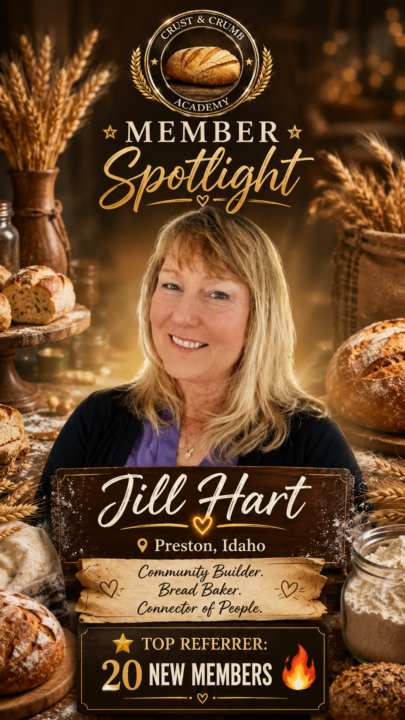
🌟 Member Spotlight: Jill Hart
Pull up a chair. I want to introduce you to someone who's been quietly making this the Academy better from the very first day she walked in. @Jill Hart, Preston, Idaho. When I was brand new to Skool and didn't know which end was up, Jill was the first person to reach out. Not to sell me anything. Not to pitch me. Just to say welcome, here's how this works, and I'm glad you're here. That's who she is. She joined the Academy and brought that same energy straight to this table. She's been one of the most consistent, encouraging, and genuinely caring people in this room. And in the last month alone, she's referred 20 new members to us. Twenty. From all over the place. That's not a strategy. That's somebody who actually believes in what we're doing here and tells people about it because she wants them to have it too. Jill, this kitchen is better because you're in it. Thank you. Now. For those of you who've been curious about Substack and want to figure out how to use it in your own business, Jill runs one of the best communities on the platform for exactly that. Go check her out. 👉 https://www.skool.com/you-world-order/about?ref=d1d544174fe74ebf92fc971fff0b8ebe Perfection is not required. Progress is. Henry ⭐🔥
1-30 of 189
powered by
skool.com/crust-crumb-academy-7621
#1 Sourdough Community on Skool 🍞
Coaching, not judgment. Sourdough, starter, yeasted, enriched & every bread between.
✅ ProveWorth Certified ⭐⭐⭐⭐⭐
Suggested communities
Powered by