

Jan 15 •
🗺️ Voice AI Conversation w/ 3D Maps - Full FREE App
It's not just answering questions — it's showing you. "Hey, show me the best coffee shops near the Eiffel Tower" And it just... does it. Pans the map. Zooms in. Highlights spots. Talks back to you about what it found. This isn't search. This is conversation. --- What is this thing? Voice AI Conversation with Google Maps — a voice-powered AI agent that actually controls Google Maps while you talk to it. Ask it anything: - "What's the fastest route avoiding highways?" - "Find me beachfront hotels under $200 in Portugal" - "Show me where all the national parks are in Utah" - "Zoom out and show me the whole country" It doesn't just answer. It shows you. In real-time. While talking back. --- Why this hits different We've all typed into Google Maps. But talking to a map that responds, moves, and explores WITH you? That's a completely different experience. It's like having a knowledgeable local guide who also happens to control a giant interactive map on your wall. The Open Source Repo: https://github.com/moshehbenavraham/chat_with_google_maps --- The nerdy part (for my fellow builders) 🔧 Started with Google's AI Studio demo — cool proof of concept, but basically a toy. Nearly FULLY AUTOMATICALLY built: - Full authentication system - Secure backend (no exposed API keys 🔐) - Database for saving your stuff - AI monitoring dashboard and logging - Local/Dev/Production deployment on Vercel - 18,500+ lines of code Built the entire thing using the Apex Spec System — an open-source spec-driven Plugin/Skill for Claude Code. Every feature was spec'd out first, then built systematically. Complex project, zero chaos. 🔗 github.com/moshehbenavraham/apex-spec-system --- The future is conversational We're moving from: Click → Type → Talk This is just the beginning 🚀 Voice + AI + Maps is one combination. What about Voice + AI + your industry? The patterns we built here — security, monitoring, auth, database — they're reusable building blocks.

Feb 4 •
Using Claude to Make Money...
I've just finished my latest video: a three and a half hour zero-to-hero Claude Code explainer. I've included the most recent improvements on Claude to move as fast as possible and get a product which ACTUALLY makes money: https://youtu.be/roYQt9rL8Kc This is the actual method I'm using right now to generate solutions which people are genuinely excited to pay me! A real win-win... If you guys can drop some love on the video, I'd be SUPER grateful to try and help others with this... 🙏🏼

Nov '25 •
What’s a creator win you had this week? Big or small — let’s hear it. Post:
Let’s wrap up the week the right way. Maybe you filmed something, fixed your workflow, found a new tool, or even finally posted after procrastinating. What’s one creator win you had this week?

Mar 22 •
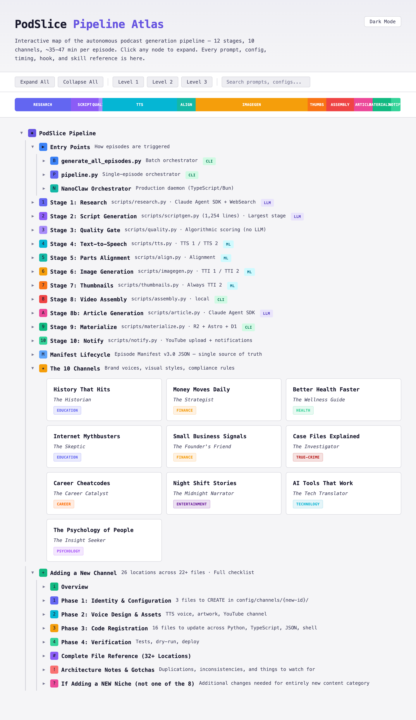
I Run 10 YouTube Channels. I Don't Make a Single Video. Here's what that actually looks like
I woke up this morning to 10 fresh podcast episodes. Fully researched. Scripted. Narrated. Visuals timed to every beat. Published to YouTube, RSS, and my own website. I didn't make any of them. A machine on my desk did. While I slept. I launched these channels at the end of February. It hasn't been a month yet. Some channels are pulling 1,000+ views and gaining subscribers - with zero ads, zero promotion, zero outreach. But here's what I need you to understand: this is not a prompt. When people hear "automated content," they picture someone typing a topic into a chatbox and hitting publish. That's not what this is. That's not even close. What I built is a multi-stage production pipeline. Not a single generation step - a sequence of independent systems, each with its own job, its own rules, and its own quality bar. Every stage has to pass before the next one starts. If something isn't good enough, it gets caught, flagged, and redone automatically. Here's what that actually means in practice: Every episode starts with real research. Not "summarise this topic." Actual source-finding, fact-checking, angle evaluation. The kind of editorial groundwork a good producer would do before writing a single word. Most automated content skips this entirely. Mine can't - the pipeline won't let it move forward without it. Then there's the writing. And this is where I spent most of my 45 days. I didn't just generate scripts - I built an entire set of rules around how spoken language works differently from written language. How rhythm changes when someone is listening instead of reading. How a pause lands. How a transition should feel. Early versions sounded like a textbook. Now they sound like someone talking to you. After the writing comes the part most people don't think about: quality control. Every script gets evaluated across multiple dimensions before it moves on. There's a hard pass/fail threshold. I've watched the system reject its own output dozens of times and come back with something genuinely better. Nothing mediocre gets through. That's not a nice-to-have - it's the reason the content performs.
Mar 5 •
I emailed 600 people I hadn't spoken to in 14 years
I emailed 600 people I hadn't spoken to in 14 years. 5 of them became my first paying customers — within 60 minutes. Here's what I built and why. I'm partially dyslexic. Long text has always been a struggle. Since high school I've been converting written content to audio — articles, reports, white papers, ebooks. I kept building tools to do this. Eventually one of them got good enough that content creators started asking for it. A friend wanted it for creating custom bedtime stories for her kids. Another had a stack of ebooks he'd never read — wanted them as audio for his commute. Others were producing YouTube content and tired of paying per-character for cloud voiceover tools. That personal tool became a full desktop voice AI studio. 63 voices, voice cloning, 23 languages, multi-speaker editing, professional mastering. Everything runs locally — no uploading scripts to someone else's server. Then 3 days ago I emailed 600 customers from a product I built in 2012. Plain text, no design. Some of them bought. Revenue before the product even launched publicly. Tonight it goes live. For content creators here — how much of your workflow involves voiceovers? And what's your biggest frustration with the tools you're using now?
1-15 of 15

skool.com/content-academy
Build a profitable content strategy, efficient team & automated process
Leaderboard (30-day)
1

+10
2
+8
3

+8
4

+8
5

+6
Powered by