
Pinned

👑
Jul 1 •
Welcome to Clief Notes. Here's where to start.
1. Go check out 📚Navigating The Course to see how to get around and what's here. 2. Start with The Foundation. Concepts, folder architecture, prompting framework. Everything else builds on this. 3. Check in at the bottom of each lesson. Polls, discussion posts, other members working through the same stuff. Use them. 4. When you're ready to build real things join in on our Biweekly competitions and win some real cash. ⭐ Competitions Mega Thread 5. If you are wanting to dive into the masterminds, grab all the past templates, artifacts and resources. Upgrade and head into the The Vault for Premium and The Drawing Room (VIP) for VIP 6. Post your work. Ask questions. Help others when you can. What are you here to build?
Pinned
👑
1d •
The Clief Notes AI is live 📣
It’s live. Starting today, everyone in Clief Notes has access to the new Clief Notes AI. The easiest way to use it? Don’t overthink it. Ask it the question you would normally ask me. “Where should I start?” “What should I focus on next?” “Where did you talk about [topic]?” It’ll use what’s already inside Clief Notes to help answer you and point you toward the right lesson or resource when there’s something worth going deeper on. The goal isn’t to give you another AI tool to play with. It’s to make everything already inside this community easier to actually use. If you want Access to it Comment "READY" and we'll send you access to it!
Pinned
👑
19h •
Added a New Form to my Architect skill.
https://github.com/RinDig/icm-architect Most AI tools try to understand your project by stuffing as much of it as they can into one chat. That is slow, expensive, and they still miss the thing that matters: if I change this, what else breaks? The new System map form walks a repo (or a notes folder) and writes a small catalog instead: - What the pieces are — in your words and in the code’s words (“Chat” is actually called Incubator) - What is real vs leftover vs fake — so nobody builds on a feature that only exists in an old doc - If you change X, what else moves — and what looks related but is the wrong thing You do not get a 40-page audit report. You get index-card pages. A later agent opens the catalog, one card, and the file it points at. That is it. Same idea as the rest of ICM: the folder is the map. A person can open it. An agent can walk it. Nobody has to hold the whole system in their head. Ask it to “map this repo”

17d •
I built Jake's ICM architect skill, but for agency work
Last week, I tried out Jake's icm-architect skill, which he also posted here. There were a few legitimate issues the skill found that needed fixing, and I quickly patched those in my infrastructure. What surprised me, though, was that the structural part itself (which I built before I joined here and started learning about Jake's ICM methodology) was not only completely fine, but when applied to my use case, it was even better than what the skill suggested. Jake's skill is set up for fairly general use cases, as well as for people who don't know how to organize a specific idea or project in a way that works well for agents. After I patched the holes the icm-architect skill found, I gave it some thought and created my own version. I named it Agency ICM Builder. https://github.com/krsnczky/agency-icm-builder The difference is in what it assumes. One folder per client, and keeping them apart is rule two, not an afterthought: any learning whose client is ambiguous goes to a quarantine inbox instead of getting guessed into the wrong folder. In an agency, cross-client bleed isn't untidy, it's a liability. Expertise and state are split the same way, by construction. Departments hold what's true for a service across every client, client folders hold per-client state, and the two never mix. A few weeks ago, I posted here about my memory system, for which I created a public plugin, and this new skill complements it perfectly. You could say the memory kit is the soul/brain of my infrastructure, and this skill helps you build the body around it. Once you plug the memory kit in, you'll have a very strong foundation for your infrastructure. https://github.com/krsnczky/agency-memory-kit It won't fit everyone. If you're not doing client work at all, the client separation is dead weight and Jake's icm-architect is the better starting point. And if you want a framework with a database and orchestration code, this isn't that either. It's markdown files in folders, and that's the whole design.

Mar 15 •
🏁 Foundations 4.1 Check-In
First session done. Vote below, then drop your OS and any issues you hit in the comments. If you got stuck, someone here has probably solved it already.
Poll
567 members have voted
1-30 of 3,104
skool.com/cliefnotes
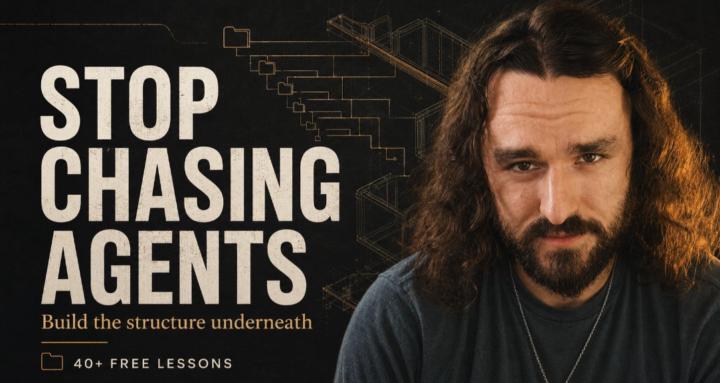
What we give away free beats most paid courses. Build durable AI systems with a Marine vet and Edinburgh researcher. 40+ lessons, growing.
Leaderboard (30-day)
1

+1147
2

+915
3

+683
4

+582
5

+552
Powered by