
Pinned

👑
⭐
13d •
Welcome to Clief Notes. Here's where to start.
1. Go check out 📚Navigating The Course to see how to get around and what's here. 2. Start with The Foundation. Concepts, folder architecture, prompting framework. Everything else builds on this. 3. Check in at the bottom of each lesson. Polls, discussion posts, other members working through the same stuff. Use them. 4. When you're ready to build real things join in on our Biweekly competitions and win some real cash. ⭐ Competitions Mega Thread 5. If you are wanting to dive into the masterminds, grab all the past templates, artifacts and resources. Upgrade and head into the The Vault for Premium and The Drawing Room (VIP) for VIP 6. Post your work. Ask questions. Help others when you can. What are you here to build?
Pinned

12h •
❗The Lyceum opens this Thursday: live webinar at 7 PM ET❗
Thursday, July 16 at 7:00 PM ET. Quick version for anyone who hasn't been following: The Lyceum is Eduba's 12-week AI certification program and the first credential we've ever issued. Over 3,000 people are on the waitlist and seats per cohort are limited. What we'll cover in the hour: 01 / The structure. 12 weeks, three sprints, nine live sessions, 18 hours of instruction, 12 instructors per cohort. 02 / The cohorts. Technical, Business, and Creator. Same core curriculum, weighted differently. We'll walk through how to pick yours. 03 / The competition. $250,000+ in prizes across the tiers and how your capstone feeds into it. 04 / The certification. What you have to do to earn it and what it actually certifies. 05 / The investment. What it costs, how payment works, and who should not enroll. Then live Q&A until the questions run out. One more thing. At the end of the session we're doing something for the people actually in the room. It's capped at a small number, it goes in the order people claim it, and we're not putting it in writing. Be there and stay to the end. The session is live only. No recording going out. Thursday · July 16 · 7:00 PM ET skool.com/live/XM7969jTG7L Come with the hard questions. Bring the skeptical ones too. That's what the hour is for.
Pinned
👑
⭐
6d •
🤝 NEW: The Connection Hub is live
👋 Welcome to the Connection Hub - The Vault · Clief Notes So I was on the onboarding call this today, and one thing kept coming up that I couldn't stop thinking about: The biggest value of this new age isn't just the tools. It's the people. 👥 Specifically — people who understand AI the way THIS community teaches it. Not "prompt hacks" and not "10x your output" nonsense, but actually building systems, thinking in workflows, and treating AI like a real part of how you work. That's a rare group. And a lot of you told me the same thing: 💬 "I'd love to work with someone who gets this." 💬 "I want to break into [industry] but don't know anyone in it." 💬 "Who else here does what I do?" So instead of letting those connections happen by accident... I built a place for them. 👇 🗂️👋 Welcome to the Connection Hub - The Vault · Clief Notes It's a simple set of pages, split by industry. You find your corner, drop a quick intro about what you actually do and what you're looking for, and connect with people who speak your language.

23h •
Don't let Trust do the Job your Architecture should be Doing
Let's consider a five-person firm. Maybe a consulting firm (as was the build by @Eytan Levy ). Each consultant has a workspace of markdown files, client context, working notes, output logs, and Claude Code runs on top of it. The whole thing lives in one company repo. Everyone clones it, pulls in the morning, pushes at the end of the day. It works. I'd build it the same way. Now ask what's stopping consultant three from opening client seven's folder. The honest answer is nothing. She just doesn't. There's a contract, there's training, she's a professional, and you know her. That's a real control and I'm not going to pretend otherwise. But it's worth being precise about what's actually holding the system together, because it isn't the architecture. Git permissions stop at the repo boundary. Inside the repo, everything is readable by everyone who cloned it. The thing keeping client seven private is not a permission. It's a person. That costs you nothing while it's true. The problem is that nothing in the system tells you the day it stops being true. And it stops for ordinary reasons. You hire past the point where you personally know everyone. You bring a contractor in for one engagement. Someone leaves for a competitor. You sign a client whose contract says their data can't sit on personal devices. You take on a client who competes with a client you already have, and the gap between two folders suddenly needs to be an actual wall. On the day one of those lands, you reach for the lever and find out what you really have. You remove the person from the repo. That stops their next pull. The clone they made three weeks ago is on their laptop, complete, and it stays there. Repo permissions govern who can get it. They don't govern who has it. That is distribution control, and most people think they bought access control. The part I keep my eye on is calling this a big-company problem. It isn't a headcount thing. A fifty-person firm of salaried employees under proper contracts might be perfectly fine. A three-person shop with one contractor who also works for your competitor is not. The trigger isn't scale. It's the first time there's someone inside the system you wouldn't personally vouch for. That usually shows up with growth. It doesn't have to.

33m •
You're Probably Missing A Key Part of Model Agnostic Structure
If your main files still sit under ~/.claude or ~/.codex, you're still not quite there yet, or more importantly, safe. Think: if the Claude app decided to nuke itself tomorrow, wiped the whole application folder and everything inside it, how cooked are you? With what Grok AI pulled off recently (downloading whole Repos of information without permission), you can never be too safe. <- PLEASE read up on this if you're not caught up. Now, however ridiculous the idea you might think, the proposition still stands. If your instructions, context routing, and memory all live inside ~/.claude (or wherever your app stores its files), you don't have a model-agnostic structure. You have an app-dependent one. If Claude suddenly decides to stop supporting certain file customizability and directly, it'll be an immense and frustrating headache to fix. While it likely won't happen soon, or at all tbh, the simple fix is decoupling. My whole global system, I personally named it "BABEL," lives in its own folder directly, version-controlled, completely separate from any app folder. What sits inside the Claude and Codex apps is just a thin layer of symlinks and shims pointing back to my global ICM structure. If my Claude wiped its own folder right now: - My instructions, memory, registries, skills, docs are completely fine. - Restoring is one simple prompt for me. Re-point the symlinks, and I'm good. - Want to move to a different client entirely? Same source files, new shim layer. The brain doesn't move at all, and even a fresh, completely new LLM harness is good enough to wire itself in with symlinks. Was inspired to post this after the recent Grok incident; happy to break down how the symlink layer works if anyone wants it.
1-30 of 2,501
skool.com/cliefnotes
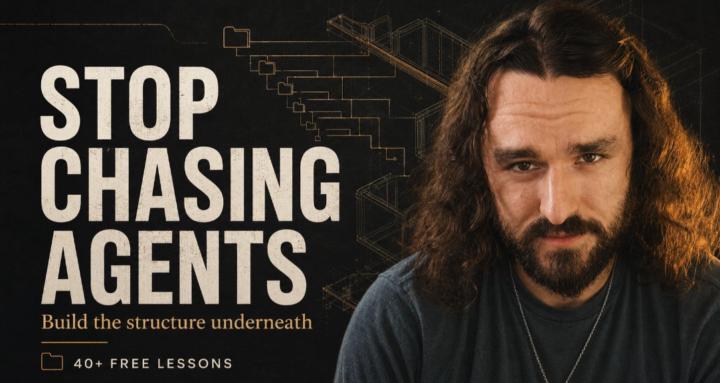
What we give away free beats most paid courses. Build durable AI systems with a Marine vet and Edinburgh researcher. 40+ lessons, growing.
Leaderboard (30-day)
1

🔥
+1707
2

+1315
3

+1010
4

+999
5

+936
Powered by