
Write something
Pinned

17h •
🏆 HOW COMPETITIONS WORK FROM NOW ON 🏆
Quick update on the competition schedule so everyone knows what to expect. 📅 NEW CADENCE: TWICE A MONTH We're dropping comps on the 15th and the 30th of every month. Two chances to compete, every month, on a set schedule you can plan around. ✍️ WHY THIS SCHEDULE Spacing them out this way means we can give tailored feedback on every single submission. Not just the winners. Everyone who enters gets notes on what worked, where it's weak, and what to do next. 🎁 WHAT WINNERS GET Along with the prize, every winner gets a 15-minute one-on-one with Jake. Use it to talk through your build, ask questions, or bring whatever else is on your mind. Two comps a month. Feedback on every entry. Direct time with Jake for the winners. Mark your calendar for the 15th and let's get to work!
Pinned
17h •
🎆 GOOD NEWS: THE SALE STAYS OPEN. HAPPY 4TH 🎆
We're holding the last sale through the holiday weekend so nobody misses it. 🎉 Premium: $27 → $14/mo 🎉 VIP: $97 → $67/mo This is the cheapest it will ever be. Once it closes, the price is gone for good. ⏰ New deadline: July 5th, 10:00 AM EST. This is the last extension. If you've been on the fence, sign up now. You lock this rate in and keep it every month going forward. 🖥️ ONE MORE REASON TO JOIN The week of July 5th we're dropping the software we've been building for this community. It goes out for beta testing first, and only Premium and VIP members get access. Sign up before the sale closes and you're in from day one.

👑
⭐
Mar 10 •
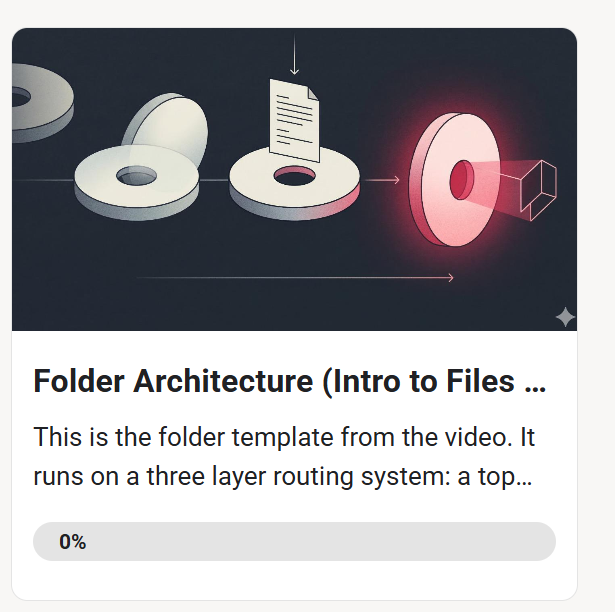
New Video: How I Structure Folders to Replace AI Agents
Just dropped a 23 minute deep dive on the folder architecture I keep showing snippets of. This time I actually walk through the whole thing from scratch and explain every layer. Covers: what tokens are and why they matter, what markdown is, the three layer routing system I use, how CLAUDE.md works, how skills plug into the system, and how naming conventions replace databases. I also built a template you can download and start using today. If you're on Premium or VIP the template files are already in The Vault. If you're on free, the video covers everything conceptually so you can build your own version no need to upgrade! Just want to add more value to my early supporters before the full paid content is done being recorded. Drop your questions in the comments. I want to know where I moved too fast or what needs a deeper dive so I can make the next one better.

15h •
Sonnet 5: My model's model
I Don't talk to Sonnet 5. My model does (Opus). I sit with one Claude. I direct it, I review what it hands back, I take the call when something's ambiguous. That's the seat I'm in. What I don't see directly is what that Claude dispatches to when the work is execution, not judgement. Loop tasks, cron jobs, every UltraCode fan-out. That's a different seat, one level down, and until now it ran on whatever was cheap enough to risk unattended. Sonnet 5 just moved into that seat. Near-Opus reasoning, full context, Sonnet pricing. I didn't upgrade my model. My model's model did. Who's dispatching for you, and did you notice when they got better? //A<3

3h •
ICM and Binary Files
To optimize version control, we avoid tracking binary files like Docx or Excel. Instead, the repository stores a Python generator script and Markdown files containing the specific parameters for each document. The script compiles the Markdown into the final binary artifact, ensuring minimal repository size and semantic diffs. We apply this pattern to engineering quotation spreadsheets. The LLM creates a MD file after analysing the specific sale. The Python script generates an Excel file from the MD parameters. However, users must modify the generated Excel directly to adjust the Bill of Materials (e.g., adding rows or changing products) for real-time sensitivity analysis. This human intervention alters the sheet structure, breaking the unidirectional flow and causing standard deterministic reverse-parsing to fail. The proposed mechanism to handle this is: 1. The user edits the Bill of Materials directly within the generated Excel artifact. 2. A deterministic Python script attempts to parse this modified sheet to update the original Markdown parameters. 3. If structural modifications cause the deterministic script to fail, an LLM agent is triggered as a fallback to probabilistically parse the unstructured sheet and reconstruct the Markdown data. I am looking for objective feedback on the architectural robustness of this pipeline, specifically regarding latency, reliability, and the viability of using an LLM as a fault-tolerant layer for reverse-parsing human-altered structured data.
1-30 of 2,179

skool.com/cliefnotes
What we give away free beats most paid courses. Build durable AI systems with a Marine vet and Edinburgh researcher. 40+ lessons, growing.
Leaderboard (30-day)
1

🔥
+1762
2

🔥
+1692
3

+1230
4

+992
5
+615
Powered by