
Pinned

👑
⭐
6d •
Welcome to Clief Notes. Here's where to start.
1. Go check out 📚Navigating The Course to see how to get around and what's here. 2. Start with The Foundation. Concepts, folder architecture, prompting framework. Everything else builds on this. 3. Check in at the bottom of each lesson. Polls, discussion posts, other members working through the same stuff. Use them. 4. When you're ready to build real things join in on our Biweekly competitions and win some real cash. ⭐ Competitions Mega Thread 5. If you are wanting to dive into the masterminds, grab all the past templates, artifacts and resources. Upgrade and head into the The Vault for Premium and The Drawing Room (VIP) for VIP 6. Post your work. Ask questions. Help others when you can. What are you here to build?
Pinned
👑
⭐
3h •
📢 Recordings of Tea Masterminds are live: The Second Brain
🧠 This round was about what a second brain actually is: a context layer you and your AI both read, not a notes app. The Afternoon Tea is the teaching. The High Tea is the room putting it to work on scale, memory, trust, and security. Here is what I want you to understand about these drops, because it is the whole point of being in here. While the videos are valuable and being able to sit and answer your questions is a big reason for them that's not the only value they hold. 📄 Every drop is a set of working files. Markdown built to be used and reused. Each one ends with the exact data to give your AI for your own situation. This round also ships a starter folder you can open, run the self-audit on, and walk away with the skeleton of your own second brain in a sitting. 🤖 I build them expecting you to feed them to your AI. That is the design. Hand a whole round to Claude in a few minutes, whether or not you made it live. The room's thinking is in the files, so you lose almost nothing by catching it later. 🔄 They adapt. A prompt pack is frozen. These are meant to be reshaped: update the context, swap in your own work, bend the templates to your process. And they grow on my side too, as we learn together in these calls. The call is dialogue. The package is that dialogue, crystallized into something you can run. Next round builds on this one. ☕ Afternoon Tea 6 →Afternoon Tea 6 (Second Brain Chat) 🫖 High Tea 10 → High Tea 10 (Second Brain Deep Dive) 🧭 How you should use these: 🔹 Show up live when you can. Your questions shape the next drop. 🔹 When you can't, rewatch, or drop the files into your AI and run the prompt at the bottom. 🔹 Open the starter folder and build your own version. Rename it to your work. It is yours to keep. 📚 A mastermind ends when the call ends. What you get here keeps working after: a structured version of your own thinking (and some of my own thinking!) that improves every round. In my opinion that is worth more than the hour in the room. (or three as some of you stick around in these calls to chat)
Pinned
👑
⭐
1d •
Ai before ChatGPT: The Interview.
In this interview I sit down with Matt from NLP Logix. He's been working in the AI space longer than most people have been working in general. We dive into what changed and what is it going to be important about the future. This is a three part series, I will be posting another two videos from another two experts in mathematics and Engineering! Please like and comment on YouTube if you have time as well!

22h •
If you can't trace it, you can't trust it.
*Note: This was from Fable for a linked In post. I gave it the puzzle solver the 2 examples and it build the rest Including the tag line. I thought it was interesting from both Fable direction, me, and AI. So sharing. At my core, I'm a puzzle solver. Give me a problem with a clear "this shouldn't be happening" and I'll hunt it down. Two favorites from my analyst work: → A device in the field was dropping 0.3% of its API calls. Every dashboard said "fine." I isolated the device traffic onto a clean network, ruled out layers one at a time, and traced it to the IP's firewall silently scanning credentials. Days of work for a fraction of a percent — a fraction of a percent of thousands of calls is real failures for real customers. → Historical revenue reports kept shifting after the books were closed. The data model checked out. The queries checked out. The cause: manually backdated payments, invisible unless you knew exactly where in the data to look. Both cases were solved the same way: refuse to accept "probably fine," follow the evidence one layer down, repeat. That attitude now shapes how I build AI agents. Every automation I ship is auditable end to end. My GitHub triage agent logs every decision and escalates to a human the moment it can't parse a situation. My negotiation engine validates every LLM output against a deterministic rules engine — 638 tests pin the behavior. When something misbehaves, I can tell you where, why, and exactly what the model saw. Agents will go wrong. I build them so you can find out why. If you can't trace it, you can't trust it.

7h •
Business Owners who are not marketers/sales people, what do you use?
I have a lot of ideas, which I want to test but I have very little experience with marketing or sales(storytelling). I see a lot of skills(on skills.sh) but they don't seem to help me much since I don't really know how it is supposed to work(without AI) to judge the outcome. Do you hire talent to help your set up things to judge how your pipeline is performing? Do you practice your content making and then feed it to AI to get your voice? Or is it a creative process and you don't really outsource that to AI?
1-30 of 2,335
skool.com/cliefnotes
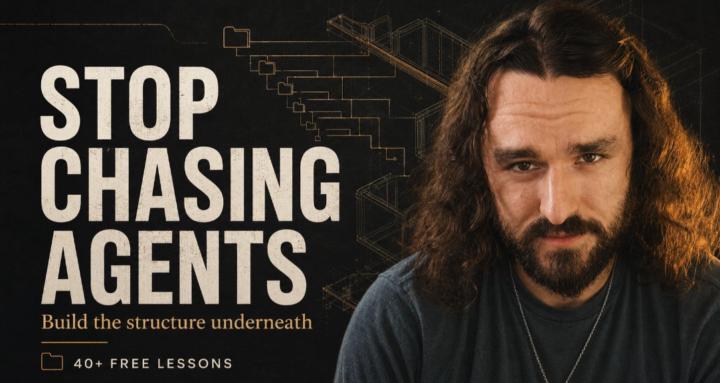
What we give away free beats most paid courses. Build durable AI systems with a Marine vet and Edinburgh researcher. 40+ lessons, growing.
Leaderboard (30-day)
1

🔥
+1616
2

🔥
+1565
3

+1559
4

+903
5

+766
Powered by