
Pinned

👑
⭐
7d •
Welcome to Clief Notes. Here's where to start.
1. Go check out 📚Navigating The Course to see how to get around and what's here. 2. Start with The Foundation. Concepts, folder architecture, prompting framework. Everything else builds on this. 3. Check in at the bottom of each lesson. Polls, discussion posts, other members working through the same stuff. Use them. 4. When you're ready to build real things join in on our Biweekly competitions and win some real cash. ⭐ Competitions Mega Thread 5. If you are wanting to dive into the masterminds, grab all the past templates, artifacts and resources. Upgrade and head into the The Vault for Premium and The Drawing Room (VIP) for VIP 6. Post your work. Ask questions. Help others when you can. What are you here to build?
Pinned
👑
⭐
6h •
🤝 NEW: The Connection Hub is live
👋 Welcome to the Connection Hub - The Vault · Clief Notes So I was on the onboarding call this today, and one thing kept coming up that I couldn't stop thinking about: The biggest value of this new age isn't just the tools. It's the people. 👥 Specifically — people who understand AI the way THIS community teaches it. Not "prompt hacks" and not "10x your output" nonsense, but actually building systems, thinking in workflows, and treating AI like a real part of how you work. That's a rare group. And a lot of you told me the same thing: 💬 "I'd love to work with someone who gets this." 💬 "I want to break into [industry] but don't know anyone in it." 💬 "Who else here does what I do?" So instead of letting those connections happen by accident... I built a place for them. 👇 🗂️👋 Welcome to the Connection Hub - The Vault · Clief Notes It's a simple set of pages, split by industry. You find your corner, drop a quick intro about what you actually do and what you're looking for, and connect with people who speak your language.
Pinned
👑
⭐
1d •
📢 Recordings of Tea Masterminds are live: The Second Brain
🧠 This round was about what a second brain actually is: a context layer you and your AI both read, not a notes app. The Afternoon Tea is the teaching. The High Tea is the room putting it to work on scale, memory, trust, and security. Here is what I want you to understand about these drops, because it is the whole point of being in here. While the videos are valuable and being able to sit and answer your questions is a big reason for them that's not the only value they hold. 📄 Every drop is a set of working files. Markdown built to be used and reused. Each one ends with the exact data to give your AI for your own situation. This round also ships a starter folder you can open, run the self-audit on, and walk away with the skeleton of your own second brain in a sitting. 🤖 I build them expecting you to feed them to your AI. That is the design. Hand a whole round to Claude in a few minutes, whether or not you made it live. The room's thinking is in the files, so you lose almost nothing by catching it later. 🔄 They adapt. A prompt pack is frozen. These are meant to be reshaped: update the context, swap in your own work, bend the templates to your process. And they grow on my side too, as we learn together in these calls. The call is dialogue. The package is that dialogue, crystallized into something you can run. Next round builds on this one. ☕ Afternoon Tea 6 →Afternoon Tea 6 (Second Brain Chat) 🫖 High Tea 10 → High Tea 10 (Second Brain Deep Dive) 🧭 How you should use these: 🔹 Show up live when you can. Your questions shape the next drop. 🔹 When you can't, rewatch, or drop the files into your AI and run the prompt at the bottom. 🔹 Open the starter folder and build your own version. Rename it to your work. It is yours to keep. 📚 A mastermind ends when the call ends. What you get here keeps working after: a structured version of your own thinking (and some of my own thinking!) that improves every round. In my opinion that is worth more than the hour in the room. (or three as some of you stick around in these calls to chat)

🔥
2h •
We didn't find Jake by accident
There's something happening in here that I feel like I need to surface. I just cut a short from our conversation with Brian Clark on Bullhorns & Bullseyes. If you don't know Brian, he's the founder of Copyblogger—started it as a one-man site in 2006, before "content marketing" was even a phrase, and it's been called one of the most influential blogs in the world. He didn't invent blogging, but he's about as close as anyone to inventing what blogging became for business. Near the end of the episode, he says... "We're tribal. We can't shake our evolutionary upbringing, where you are attracted to people like you. That used to be based on appearance or geography, and now it's identity. And what is identity? It's a bundle of beliefs." He'd just said belonging is going to be more coveted, not less, as AI floods everything with things we can't tell are real. And the belonging that's left standing isn't geographic. It's not "we live near each other" or "we look alike." It's "we believe the same things." Now, for those of us in this community, we didn't all show up already agreeing on everything, and we didn't converge here because Jake is the guy to follow. We converged because @Jake Van Clief said something true first, and a few thousand of us recognized our own belief in it before we had words for it ourselves. That's how this works—someone has to say it first, most of us here, especially in the beginning, didn't need to be convinced. We were being reminded. This concept isn't new. It takes the same shape as every real reformation does. Belief stops living inside one person or institution and starts living in whoever recognizes it. Jake didn't build a following. He built a mirror, and we all walked up and saw ourselves in it. @Ruben Aguirre already did this in here—put his actual beliefs on the table, not a bio. If you're willing, I'd like to hear yours, too. But I'll go further than that. You've already been doing the belief work if you've built an ICM.
2d •
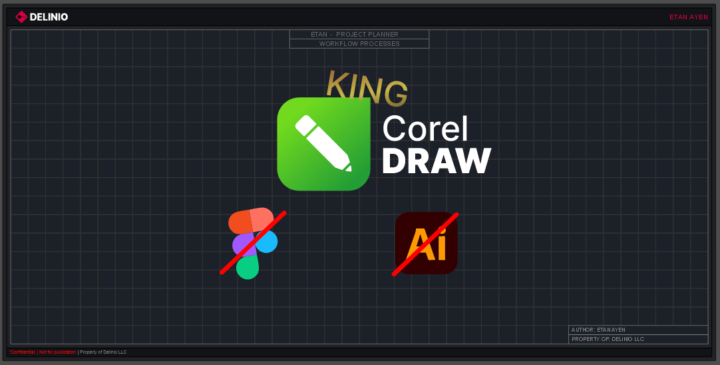
Vector Art & Project Planning
Figma... I just don't care for it, it's great for collaboration amongst a team, etc, but I don't want to be confined to it's structure and limited capabilities. For every new tool that can work a bit faster, you always lose one primary component: CONTROL.... and Adobe Illustrator, what I can say, they try... but you end up spending more time managing layers than you do drawing. So, the real KING remains throned and always will; Corel DRAW, the absolute total answer to everything vector. This Legacy platform is central to everything I do. Design, planning, everything starts here. Here's a shot of my custom planning board design. I gave you only a piece of the actual workflow view, so you can get the idea, but there's so much I can't show you. A complete schematic of the entire logic before one line is written. A visual roadmap to success for every project. This is the way (if you can draw). (btw, I don't even view layers in my workspace GUI, in Corel Draw it's useless and unnecessary.)
1-30 of 2,369
skool.com/cliefnotes
What we give away free beats most paid courses. Build durable AI systems with a Marine vet and Edinburgh researcher. 40+ lessons, growing.
Leaderboard (30-day)
1

🔥
+1607
2

🔥
+1519
3
🔥
+1473
4

+896
5

+807
Powered by