
Write something
Pinned

Jun 18 •
Why Our Approach Is Different
Why Our Approach Is Different One of the biggest challenges in health today is that most people are looking for a quick fix. A magic pill. A miracle supplement. A new protocol. A trendy gadget. A shortcut. And honestly, I understand why. When you're exhausted, in pain, struggling with your weight, dealing with digestive issues, autoimmune symptoms, hormone problems, brain fog, poor sleep, or simply feeling frustrated by a body that isn't cooperating, relief can't come fast enough. That's exactly why the health industry continues to market products as if they're the holy grail. Every week there's a new supplement. A new superfood. A new biohack. A new promise. And while many of these products may have value, most are presented without context. Without purpose. Without intentionality. Without customization. Without evidence that they're the right fit for the individual using them. The truth is that no supplement works in isolation. No product is one-size-fits-all. And no health solution has the exact same answer for every person. That's why so many people spend years chasing promises. They buy another supplement. Try another diet. Follow another influencer. Purchase another program. And eventually find themselves more tired. More frustrated. More confused. More hopeless. Not because they're failing. But because they've never been taught how the body actually works. That's where our approach is different. At Bedrock, we aren't looking for the fastest solution. We're looking for the most sustainable solution. We're not interested in temporary symptom relief if the underlying problem remains untouched. We're interested in helping people create permanent change. That means we focus on: ✓ Purpose ✓ Intentionality ✓ Customization ✓ Evidence ✓ Education ✓ Long-term sustainability We help people understand why they're taking something. What it's supporting. How it works with other nutrients. How it fits into the bigger picture. And most importantly... How to adapt as their body's needs change over time.
Pinned
Jan 2 •
The Bedrock Health Matrix: Our philosophy and services
Welcome to Bedrock Nation! This document explains The Bedrock Health Matrix—our faith-rooted, evidence-based approach to healing and the services we offer. Inside you’ll see: our Faith • Function • Foundation philosophy, the 7 pillars of health, the Matrix framework (assessment, genetics, labs, lifestyle + coaching), and the Bedrock Roadmap that guides your journey from discovery → design → develop → thrive. Start here to understand how we personalize care, why we “test, don’t guess,” and how our community supports long-term change. When you’re done reading, drop a comment with: 1) your #1 goal, and 2) your biggest obstacle right now.
Pinned
Nov '25 •
Welcome to Bedrock Nation
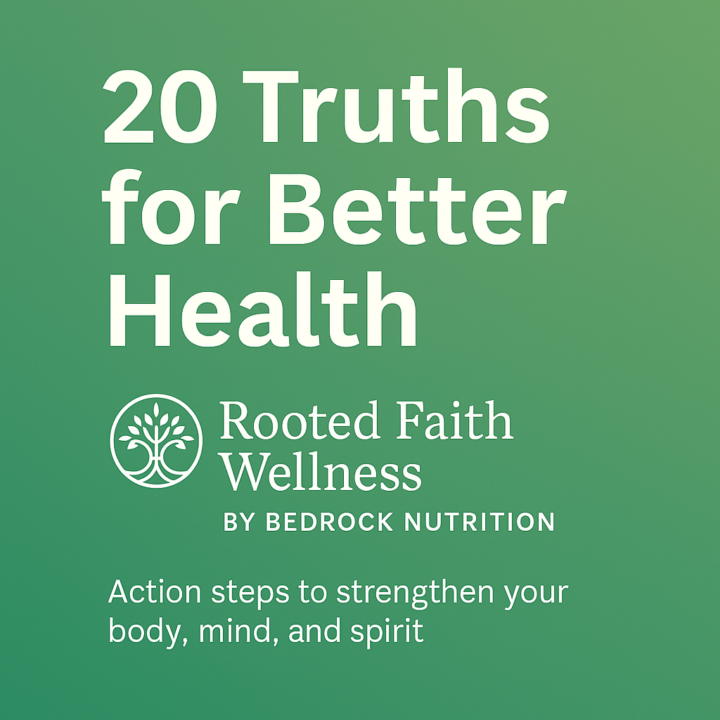
We are so glad you are here! This is your space to learn, grow and connect - free from Facebook's distractions and censorship. Start Here: 1. Take your Free HIPAA Compliant Health Assessment and schedule a free 15 minute consultation by phone with one of our team. https://adobe.ly/41cHOYw (upon receipt of your assessment one of our team will contact you to set this up) 2. Download our 20 Truths to Better Health Guide (attached) 3. Introduce yourself in the comments and tell us what "Getting back to your Bedrock (Foundation)" means to you!
8d •
THINK! 🧠✝️ | A New Food for Faith Episode (11/4/26)
When did we stop thinking for ourselves? Today I recorded something that has been weighing heavily on my heart, and quite frankly, something I feel compelled to speak about. Not because of who won or lost an election. Not because someone disagrees with my political opinions. But because I'm deeply concerned about the abandonment of independent thought, the erosion of critical-thinking skills, and our increasing willingness to allow politicians, media personalities, institutions, and social pressure to dictate what we believe. And as Christians, I believe we have a moral and spiritual obligation to do better. In this episode of Food for Faith, we're talking about three things: 🧠 1. WE NEED TO BECOME THINKERS. Education is not synonymous with intelligence. Memorizing information isn't the same as understanding it. And repeating someone else's talking points doesn't constitute an informed opinion. We need to question assumptions, examine evidence, understand opposing arguments, and develop the intellectual humility to recognize when we might be wrong. ⚖️ 2. WE HAVE A MORAL OBLIGATION TO SEEK TRUTH. Truth doesn't change based on political affiliation, personal preference, or popularity. If we're willing to scrutinize those we oppose but blindly defend those we support, we're not exercising discernment. We're practicing partisan loyalty. And there's a difference. ✝️ 3. CHRISTIANS CANNOT AFFORD TO BE LUKEWARM. Romans 12:2 calls us to be transformed by the renewing of our minds. 1 Thessalonians 5:21 tells us to prove all things and hold fast to what is good. ALL things. Including the ideas, people, and institutions we already trust. Our faith should never require us to abandon the minds God gave us. And taking a stand for our convictions means understanding what we believe, why we believe it, and whether those convictions align with biblical truth. A diploma is not proof of discernment. Information is not wisdom. And political allegiance is not conviction. I don't expect everyone to agree with me. I don't expect everyone to share my opinions.
6d •
YOUR CHOLESTEROL IS A NUMBER. YOUR CARDIOVASCULAR HEALTH IS A SYSTEM.
Two new studies. Nearly 294,000 participants in one. And a discovery about arterial inflammation that challenges how we think about cardiovascular risk. For decades, we’ve been taught to look at a cholesterol panel and draw conclusions. High LDL? You’re at risk. High HDL? You’re protected. Normal cholesterol? You’re fine. But what if the biology is far more complicated than we’ve been led to believe? Two studies published in 2026 are giving us some fascinating reasons to dig deeper. And before anyone jumps to conclusions, these studies do NOT prove that cholesterol is harmless. What they do is challenge the idea that any single biomarker tells the whole story. 🔬 STUDY #1: DOES HIGH HDL CHANGE THE RISK ASSOCIATED WITH APOB? Researchers analyzed 293,872 participants in the UK Biobank, following cardiovascular outcomes over approximately a decade. Their findings, published in the European Journal of Preventive Cardiology, were particularly interesting. Higher apoB was associated with increased cardiovascular risk. That wasn’t surprising. But here’s what caught my attention. As HDL cholesterol increased, the statistical relationship between apoB and cardiovascular events became weaker. In other words, the relationship between apoB and cardiovascular risk wasn’t identical across every metabolic profile. Now, does that mean someone with extremely high LDL or apoB is automatically protected because they have high HDL? NO. And that’s an important distinction. This was an observational study. It doesn’t establish that HDL neutralizes apoB or that raising HDL will prevent cardiovascular events. But it does raise a question worth asking: Why would we interpret one biomarker without considering the biological environment in which it exists? This is especially relevant to the ongoing conversation about lean-mass hyper-responders — individuals who sometimes develop dramatically elevated LDL while consuming carbohydrate-restricted diets, despite having high HDL and very low triglycerides.
2
0

1-30 of 270
powered by
skool.com/bedrock-nation-8489
Free wellness community for faith based living, functional health and real connection - off social media, rooted in purpose - learn, grow and heal.
Suggested communities
Powered by