
Write something

May 13 •
Your Logbook is a Legal Document - Treat it Like One.
Pilot logbook entry mistakes that end airline applications: The 5 critical errors, the 5 patterns, and the 5 minor ones. Pilots spend years building flight time, but very few spend the same energy making sure their logbook accurately reflects it. When you apply to a major airline, your logbook doesn’t just get glanced at. It gets audited. Line by line. Category by category. And what examiners find, or don’t find, will directly impact whether you move forward. Here’s the breakdown every pilot needs to read before they submit a single application. THE CRITICAL ERRORS: these can end your candidacy These aren’t technicalities. These are application-ending discoveries that raise immediate integrity concerns. 1. Falsified or inflated flight time. This is the cardinal sin of aviation recordkeeping. Rounding 0.8 hours to 1.0 consistently across hundreds of entries adds up fast, and examiners are trained to spot it. Logbook totals that don’t align with known aircraft performance, block times, or employer records will trigger an immediate red flag. If your cross-country time seems implausibly high for the hours you flew at a given operator, someone will notice. The word for this isn’t “rounding.” It’s falsification, and it will not only cost you the job. It can cost you your certificate. 2. Misrepresented PIC time. This is one of the most common serious errors, and it often isn’t intentional. But intent doesn’t matter in a hiring review. Logging PIC time when you were the sole manipulator of the controls but not the acting PIC, or logging PIC time as a safety pilot without clearly documenting the arrangement, creates ambiguity that reads as inflation. Know the FARs governing PIC logging. Apply them correctly. Every time. 3. SIC time logged incorrectly. Logging SIC time in aircraft that don’t require two pilots, without proper documentation of a required second-in-command, is a regulatory issue, not just a bookkeeping one. Airlines will identify this, particularly when cross-referencing your time against the aircraft types flown and the operations conducted.
Jan 12 •
Update: Southwest currently has 804 aircraft. They have orders for up to 615 more - you do the math.
❤️ Southwest Airlines Announces 850+ New Hires in 2026! Here's What You Need to Know SOUTHWEST AIRLINES - THE COMPLETE INSIDER'S GUIDE Company Overview: - Fleet: 815+ aircraft (all Boeing 737, largest 737 operator in the world) - Bases: ATL, BNA, BWI, DAL, DEN, HOU, LAS, LAX, MCO, MDW, OAK, PHX, AUS (coming in ‘26) - Pilot Group: ~10,500+ pilots - Culture: "LUV" culture, employee-first, unique point-to-point model LIFESTYLE REALITIES Scheduling System: Line Bidding - Unique trip-trading culture with the company ELITT (Electronic Line Improvement Trip Trade) system including reserve and amongst pilots (Trip Trade Give Away) - More control over your schedule than traditional line bidding - Ability to move your vacation left or right up to 3 days - Junior pilots: 17-19 days off, reserve likely for the first year - Senior pilots: 18-22 days off possible with efficient trip trading - Key difference: Can trade trips with company and other pilots freely Base Quality of Life: - DAL (Dallas Love Field): Large base, senior-friendly, central location - HOU (Houston Hobby): Major base, lower cost of living, Texas tax benefits - DEN (Denver): Lifestyle base, growing rapidly, mountain access - BWI (Baltimore): East Coast hub, expensive area, senior base - MDW (Chicago Midway): Major base, weather challenges, all 737 variants - PHX (Phoenix): Fast growing, excellent weather, lifestyle destination - LAS (Las Vegas): Lifestyle base, ETOPS/domestic flying, growing, moderate seniority - LAX (Los Angeles): CA base, ETOPS flying, high cost of living - OAK (Oakland): CA base, ETOPS flying, Bay Area access, expensive to live, high cost of living - MCO (Orlando): Newest major base, theme parks, humid climate - ATL (Atlanta): Smallest base, predominantly former AirTran pilots - AUS (Austin): Opening March ‘26 Pay & Progression: - Industry-leading Year 1 pay - Year 1 FO: ~$126/TFP (~$150K annually) HIGHEST Year 1 in industry - Topped out FO ~$258/TFP (~$310K annually) - Year 12 Captain: ~$343/TFP now, ~$368 beginning 2028. (~$410 - $500 annually) - Profit sharing: Historically strong (6-8% of annual earnings) - 18% 401k match with a spillover Monthly Based Cash Balance Plan of 2% for any earnings above the IRS limit - TFP Note: in order to make an apples to apples comparison, multiply TFP by 1.15 to equal hourly pay rate - Unique benefit: Free unlimited travel for employee + eligible passengers
May 31 •
What Does Your PRD Say About Your Aviation Career?
What’s actually in your Pilot Records Database (PRD), and why airlines compare it line-by-line to your application. Most pilots spend hours perfecting their resume and logbook. Very few take the time to review the one record that airlines are required by federal law to check before they can hire you. The Pilot Records Database, your PRD, is not optional background noise. It is a mandatory pre-hire screening tool, and what’s in it can validate your application or quietly derail it. Here’s everything you need to know. What is the PRD? The Pilot Records Database is an FAA-managed system established under the FAA Reauthorization Act of 2018. It replaced the older PRIA (Pilot Records Improvement Act) process and became mandatory for Part 121 and Part 135 air carriers. Before any covered employer can extend a job offer, they are legally required to query your PRD. This is not a courtesy check. It is a federal requirement. The intent is straightforward: create a centralized, standardized record of a pilot’s professional history so that safety-relevant information doesn’t get buried, overlooked, or conveniently omitted. What’s actually in your PRD Your PRD is a composite record pulled from multiple sources. Five categories matter. 1. FAA Records. Your airman certificates, ratings, medical certificate history, and any FAA enforcement actions or certificate actions taken against you. Warnings, suspensions, revocations all live here. 2. Air Carrier Employment Records. Any Part 121 or Part 135 operator you’ve worked for is required to submit records to the PRD. This includes: - Dates of employment and separation - Reason for separation (resignation, termination, furlough) - Training records and proficiency check results - Any unsatisfactory training events or check ride disapprovals - Records related to accidents or incidents during your employment This is the category most pilots underestimate. A single disapproval from a regional carrier years ago is in that record. A training difficulty at a cargo operator is in that record. There is no statute of limitations on disclosure. The record reflects your history.
May 21 •
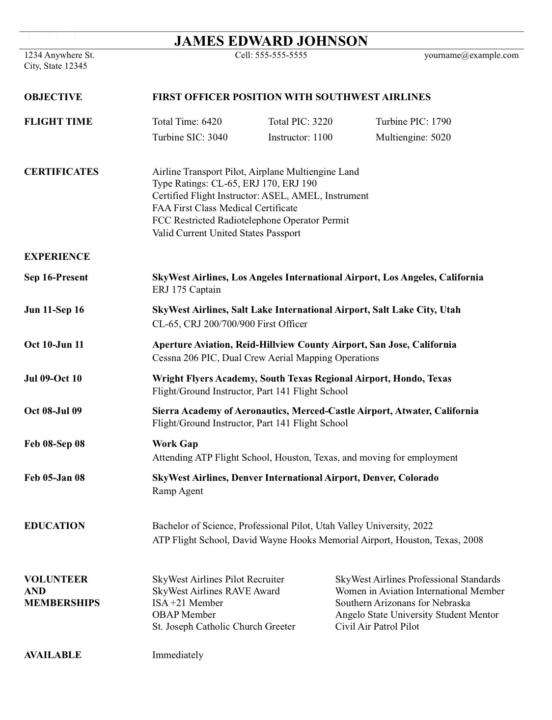
The Resume - Your Entire Aviation Career on One Page
Recruiters spend 6 to 7 seconds on a pilot resume. Here’s what they actually look for in that window. You spent half a day working on it. They spent less time reading it than it takes to complete a before-takeoff checklist. That’s not cynicism. That’s the reality of airline hiring at scale. When a recruiter is processing hundreds of applications during an open window, your resume doesn’t get a careful read. It gets a scan. And in those first few seconds, the decision is already forming. The pilots who understand this build their resumes differently. Here’s what they know. The 7-second reality Research consistently shows that recruiters spend an average of around 7 seconds on an initial resume review before deciding whether it warrants a deeper look. In that window they are not reading. They are pattern-matching. They are looking for the credentials they need to see, in the places they expect to find them, presented in a format that doesn’t make them work. If your most important information isn’t immediately visible, it effectively doesn’t exist. This changes everything about how a pilot resume should be constructed. The goal isn’t to tell your entire story. The goal is to survive the first seven seconds and earn the next sixty. Why less is more The instinct most pilots have is to include everything. Every aircraft touched. Every collateral duty. Every ground school instructed. Every committee served on. The thinking is that more credentials equal more credibility. The reality is the opposite. A dense, overloaded resume forces a recruiter to work, and recruiters buried under mountain of resumes don’t do extra work. They move on. Every line that isn’t directly relevant to the hiring decision is a line competing with the lines that are. When everything looks important, nothing is. The pilots who get interviews understand that a resume is an argument, not a biography. You are not documenting your career. You are making a specific case for why you belong in this cockpit, at this airline, right now. Every element that doesn’t serve that argument weakens it.
3
0
May 17 •
Attention to Detail isn’t a Soft Skill in Aviation. It’s What Airlines Use to Evaluate Cockpit Risk in the Application Process.
In aviation, attention to detail is not a personality trait. It’s a survival mechanism. Every checklist, every NOTAM review, every weight and balance calculation exists because the margin for error at 35,000 feet is essentially zero. A missed item on a checklist, a misread altimeter, a skipped callout, these aren’t inconveniences. They are the first link in an accident chain. Airlines know this better than anyone. The $2 billion liability problem - Every time a pilot pushes back from the gate, the airline is accepting an enormous risk transfer. The aircraft, the passengers, the cargo, the crew, the legal exposure, the brand. Conservatively, you are a $2 billion liability the moment the parking brake releases. The hiring department isn’t just filling a seat. They are functioning as an underwriter, evaluating risk before issuing a policy. And like any good insurance company, they are looking for signals. They cannot ride jumpseat on every leg you’ve ever flown. They cannot watch you brief an approach or call out a traffic conflict. What they can do is hand you an application and watch what you do with it. Your resume, your logbook, your application. These are not administrative hurdles. They are your first performance evaluation. Every inconsistency, every rounding error in flight hours, every formatting mistake, every omission is a data point. And the conclusion a hiring manager draws is a logical one: if this pilot cuts corners here, where else are they cutting corners? The inference is intentional - Airlines explicitly use application quality as a proxy for cockpit behavior because the inference is reasonable and defensible. A pilot who submits a logbook with mismatched totals, a resume with inconsistent dates, or an application missing required documentation has already demonstrated something, and it isn’t what they intended to demonstrate. Conversely, a pilot whose application is clean, accurate, consistent, and complete has sent an equally clear message: I take this seriously. I don’t let things slip. I am the same person on paper as I am in the airplane.
1-13 of 13

skool.com/aviator-intelligence
Helping pilots navigate their aviation careers. From CFI to the majors, and every step in between, we guide you through the journey to your dream job.
Leaderboard (30-day)
1

+1
2

+1
3

+1
Powered by