
Write something

17d •
“Find Your Friction” Lessons Learned
2 Execs and I are meeting today to choose a small team in our company to begin the 6-week pilot. If anyone has any lessons learned after applying the “finding your friction” step we reviewed then I’d be grateful to benefit from your experience!

30d •
Jeff's Daily Dose: Perfect 10 Doesn't Always Win
Madison Chock & Evan Bates stepped off the ice last night in Milan believing they'd just skated the performance of their lives. 3-time reigning world champions. A decade-plus partnership. They lost the Gold anyway. The French duo that beat them ... Laurence Fournier Beaudry & Guillaume Cizeron ... had been skating together less than a year. They made visible errors. Wobbly step sequences. Messy twizzles. Yet, the judges still gave them the edge. "It's a subjective sport," Bates said. Hard to argue with that. Here's what stopped me cold (pun intended) Chock nailed it when she said through tears: "There needs to be some sort of judgment for the judges. So that we know we're getting the best from the judges & have a level and fair playing field." She's not just talking about figure skating. She's talking about Your company. Right now, most organizations are "judging" their AI transformation the same way Olympic ice dance judges score a free dance ... subjectively. Gut feel. Vibes. Someone in the C-suite says "I think it's going well" & everyone nods along. That's how you lose the Gold. Here's the pivot. When you're rolling out AI across your organization, you need to judge the judges. Meaning: who is evaluating whether your AI initiatives are actually working? What are they measuring? And are those metrics fair across every team? 3 things to do over the next week: (1) Pick one AI initiative in your company. Just one. Ask the person leading it: "How do we know this is working?" If the answer sounds like an ice dance score ... vague, subjective, open to interpretation ... you've got a problem. (2) Define what a "perfect skate" looks like before anyone hits the ice. The clearest signal of a broken evaluation system is one where the criteria get decided after the performance. Set your success metrics before you launch, not after. (3) Watch for the "French judge" problem. In the Olympics, people immediately questioned whether national bias influenced the scoring. In your company, the equivalent is the executive who champions a tool & then "evaluates" its success. Separate the sponsor from the scorekeeper.
0
0

Feb 10 •
*Live* See a real-world AI Case Study
Today (Tues 2/10) at 1p ET / 12p CT / 11a MT / 10a PT See how one company actually planned & executed an AI transformation. I've lined up the company's CEO & the head of their AI implementation firm. Together, they'll walk thru what they did, how, the challenges they overcame, and how you can do the same in your business. Here's the Zoom link. See you there, Jeff
Feb 6 •
Jeff's Daily Dose: The Ribbon of Death
Tonight the Winter Olympics kick off in Milan. San Siro Stadium. Mariah Carey. Andrea Bocelli. 2 billion people watching. But the event I can't stop thinking about is Saturday's Men's Downhill. The course is called the Stelvio in Bormio, Italy. The skiers call it something else: "The gray ribbon of death" It's 3,442 meters of ice so slick one former racer said "you could look down & do your hair in the mirror." Speeds over 90 mph. A nearly vertical drop at the start. A jump at the end that launches you 150 feet in the air. And in between ... zero rest. Your legs are screaming the entire way down. Last year, a French medal favorite crashed during a practice run & was airlifted off the mountain with a brain injury. His teammate was furious. "They don't deserve to have the Olympic Games here." But another skier nailed why it's perfect for the Olympics: "The tracks that are more treacherous, that have higher consequences ... that's when you focus. It's the most alive I've ever felt." Sound familiar? That's what AI feels like for a lot of leaders right now. The ribbon of death. Treacherous. Icy. Moving at 90 mph. One wrong move & you're airlifted out. But it doesn't have to be. Yesterday, we held our Pilot to Profit live session & the response was terrific. I walked through the step-by-step framework for completing your first AI business process in 6 weeks. Not theory. Not hype. The actual sequence of moves. If you missed it ... here's the replay link. The difference between the Stelvio & your AI transformation? You don't have to go 90 mph out of the gate. You pick one process. You follow the steps. You get a win. Then you build from there. No ribbon of death required. Here's my recommendation: Watch the replay. Then commit publicly right here. Drop a "Yes" below and tell us ... what's the ONE process you're going to pilot first? Saying it out loud changes everything.
0
0

Jan 29 •
Jeff's Daily Dose: It's just human nature
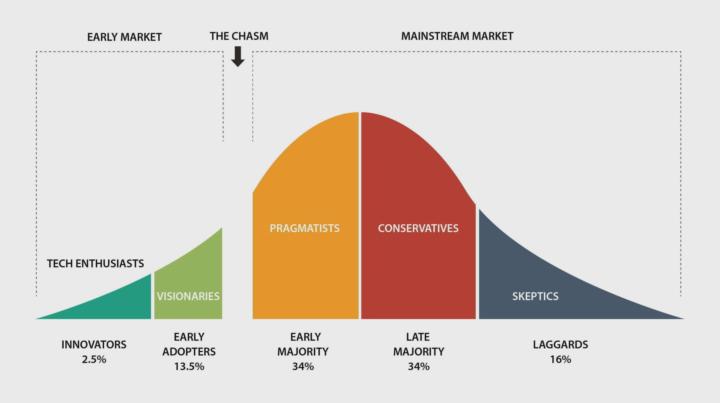
One of our Roundtable members, CEO of a 150-person company, got blindsided. He'd rolled out AI tools companywide. Same training. Same resources. Same deadline. 3 months later? 20% of his team was crushing it. 60% was fumbling along. And 20% hadn't logged in even once. He thought he had a training problem. He didn't. He had a "human" problem. Clayton Christensen's infamous "Adoption Curve" (5 types of people: innovators, early adopters, early majority, late majority, laggards) doesn't just apply to customers buying products. It applies to your employees adopting AI, too. See the bellcurve pix below. Not because they're tech people or non-tech people. Because they're people. This is how humans adopt anything new... from the printing press to cars to smartphones to AI to that weird standing desk trend from 2015. So stop treating your AI rollout like everyone will magically get on board at the same pace. They won't. 👍🏼 Find Your Early Adopters These folks are gold. They're the ones already experimenting with Claude & Gemini on their own time. They're sending you articles about AI. They're asking "what if we tried..." in meetings. Don't wait for them to raise their hands. How to find these 16% of your people? > Ask your managers: "Who on your team is already tinkering with AI tools?" > Look for the people who get excited when things break... because it means they get to figure something out. Then harness their energy. Appoint them your AI Champions. Give them permission to experiment. Have them train their peers. Nothing spreads adoption faster than a trusted colleague saying "let me show you something cool." 👎🏼 Face The Uncomfortable Truth About Laggards Some of your people will be late. That's fine... the late majority just needs more proof & hand-holding. Budget extra time for them. But some people will never get there: "The Resisters" I'm not being harsh. I'm being realistic. A percentage of your team will resist AI no matter what you do. They'll find reasons. They'll create workarounds. They'll slow everyone else down.
1-15 of 15

skool.com/aireadyroundtable
Master the "people part" of AI in 90 days. Live Q&A, expert interviews, proven frameworks, and a vetted community of leaders navigating the AI shift
Leaderboard (30-day)
1

+5
2

+2
3

+2
4
+2
5

+2
Powered by