Activity
Mon
Wed
Fri
Sun
Mar
Apr
May
Jun
Jul
Aug
Sep
Oct
Nov
Dec
Jan
Feb
What is this?
Less
More
Memberships
AI Ready Roundtable
412 members • Free
3 contributions to AI Ready Roundtable

4d •
Jeff's Daily Dose: Following Your Employees Home.
My first job out of grad school was at Intuit ... makers of QuickBooks and TurboTax. I had no idea that what I learned there would be the single most useful lesson for leading through AI ... 30 years later. Here's what happened. Intuit's co-founders, Scott Cook and Tom Proulx, had a problem. They'd built Quicken, personal finance software they thought was intuitive. Customers said it was great in surveys. But support calls kept flooding in. Surveys lied. Focus groups lied. People told Intuit what they thought Intuit wanted to hear. So Scott & Tom invented something radical. They called it "Follow Me Home" research. The concept was dead simple: Ask a customer buying the software at a retail store if an Intuit employee could literally follow them home and watch them use it. No helping. No guiding. Just observing. (People said yes, kinda bizarre.) What they discovered was brutal. People didn't read the instruction manual. They didn't follow the Setup Wizard. They invented bizarre workarounds that no engineer would have predicted. The gap between how Intuit designed the experience and how people actually experienced it was ginormous. That gap changed everything about how Intuit built products. We adopted the assumption that nobody would ever read the instruction manual. And this should change everything about how you approach AI in your organization. Here's the connection: Right now, most leaders I talk to are doing one of two things with AI. They're either (1) dabbling with tools themselves & assuming their experience reflects their team's reality. Or they're (2) surveying their people ... asking "Are you using AI?" and "Do you find it helpful?" ... and getting polished, useless answers. Both approaches have the same flaw Scott & Tom discovered in the early '90s. People don't do what they say they do. Your marketing director will tell you she's "using AI for content creation." What does that actually mean? Is she pasting entire strategy docs into ChatGPT and blindly publishing the output? Is she using it to brainstorm headlines and then rewriting every one? You have no idea ... and neither does she, really, until someone watches. Literally.


1 like • 3d
With several years of experience in B2B market research I can wholeheartedly agree there is a huge gap in respondents' attitudes vs behaviors! Good idea and approach Jeff.
17d •
Jeff's Daily Dose: It's just human nature
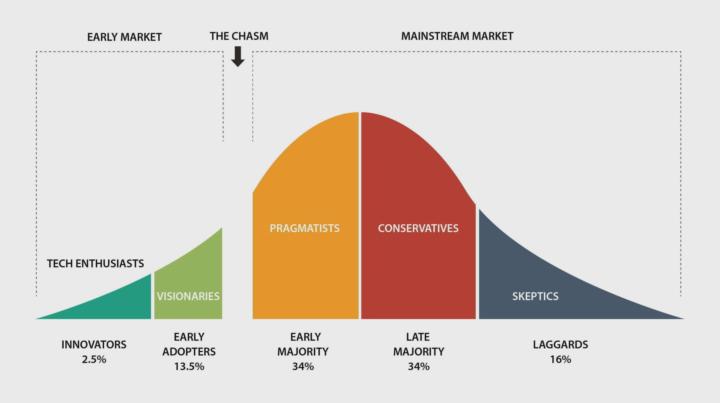
One of our Roundtable members, CEO of a 150-person company, got blindsided. He'd rolled out AI tools companywide. Same training. Same resources. Same deadline. 3 months later? 20% of his team was crushing it. 60% was fumbling along. And 20% hadn't logged in even once. He thought he had a training problem. He didn't. He had a "human" problem. Clayton Christensen's infamous "Adoption Curve" (5 types of people: innovators, early adopters, early majority, late majority, laggards) doesn't just apply to customers buying products. It applies to your employees adopting AI, too. See the bellcurve pix below. Not because they're tech people or non-tech people. Because they're people. This is how humans adopt anything new... from the printing press to cars to smartphones to AI to that weird standing desk trend from 2015. So stop treating your AI rollout like everyone will magically get on board at the same pace. They won't. 👍🏼 Find Your Early Adopters These folks are gold. They're the ones already experimenting with Claude & Gemini on their own time. They're sending you articles about AI. They're asking "what if we tried..." in meetings. Don't wait for them to raise their hands. How to find these 16% of your people? > Ask your managers: "Who on your team is already tinkering with AI tools?" > Look for the people who get excited when things break... because it means they get to figure something out. Then harness their energy. Appoint them your AI Champions. Give them permission to experiment. Have them train their peers. Nothing spreads adoption faster than a trusted colleague saying "let me show you something cool." 👎🏼 Face The Uncomfortable Truth About Laggards Some of your people will be late. That's fine... the late majority just needs more proof & hand-holding. Budget extra time for them. But some people will never get there: "The Resisters" I'm not being harsh. I'm being realistic. A percentage of your team will resist AI no matter what you do. They'll find reasons. They'll create workarounds. They'll slow everyone else down.
1 like • 9d
Interesting to factor the adoption curve into our thinking. Success in early stage new product development isn't profits, it is quickly gaining traction toward a solution with a very small segment that is enthusiastically engaging. It seems like many are expecting AI (around for a few short years) to already be at the top of the curve. The "chasm" is unlikely to be crossed without engaging innovators and learning quickly.
9d •
2/5 Live Coffee w/Jeff Was Solid
Another really good session today - I found this one especially so. As Jeff related many of us are in a "fog" of how and where to start. Add to that there are numerous studies coming out that indicate the vast majority of AI projects aren't delivering ROI. Together I believe it further delays adoption. Jeff reviewed a piloted approach in the spirit of crawl - walk - run, with good filtering questions, to break through the fog and get invaluable experience. ROI is addressed in the debrief yet isn't a critical factor in this initial pilot. Gaining leadership experience and support from the team are the critical success factors. Solid!
1-3 of 3

@mike-nemeth-8578
Helping customers gain and maintain their competitive advantage.
Active 1d ago
Joined Jan 19, 2026
ENTJ
Powered by