

35m •
Monday Marketing
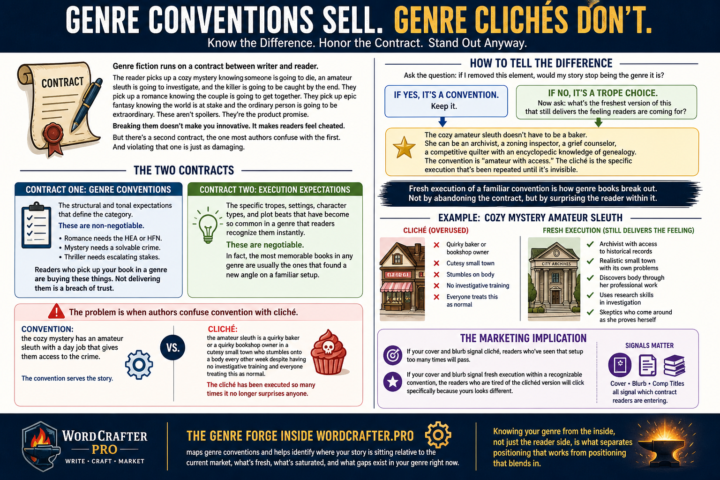
Genre Conventions Sell. Genre Clichés Don't. Genre fiction runs on a contract between writer and reader. The reader picks up a cozy mystery knowing someone is going to die, an amateur sleuth is going to investigate, and the killer is going to be caught by the end. They pick up a romance knowing the couple is going to get together. They pick up epic fantasy knowing the world is at stake and the ordinary person is going to be extraordinary. These aren't spoilers. They're the product promise. Breaking them doesn't make you innovative. It makes readers feel cheated. But there's a second contract, the one most authors confuse with the first. And violating that one is just as damaging. The Two Contracts Contract one: Genre conventions. The structural and tonal expectations that define the category. These are non-negotiable. Romance needs the HEA or HFN. Mystery needs a solvable crime. Thriller needs escalating stakes. Readers who pick up your book in a genre are buying these things. Not delivering them is a breach of trust. Contract two: Execution expectations. The specific tropes, settings, character types, and plot beats that have become so common in a genre that readers recognize them instantly. These are negotiable. In fact, the most memorable books in any genre are usually the ones that found a new angle on a familiar setup. The problem is when authors confuse convention with cliché. Convention: the cozy mystery has an amateur sleuth with a day job that gives them access to the crime. Cliché: the amateur sleuth is a quirky baker or a quirky bookshop owner in a cutesy small town who stumbles onto a body every other week despite having no investigative training and everyone treating this as normal. The convention serves the story. The cliché has been executed so many times it no longer surprises anyone. How to Tell the Difference Ask the question: if I removed this element, would my story stop being the genre it is? If yes, it's a convention. Keep it. If no, it's a trope choice. Now ask: what's the freshest version of this that still delivers the feeling readers are coming for?
1
0
1d •
Show Your Work Saturday!
My Actual Outline for Hazel Thornfield, Book One So I shared a lot of what I've been workign on for YOU this morning and last night. Today is a show the work on what I've been working on for me. In testing interactions between software I'm starting several ideas a day and generating/writing a book about every two-three days. Desperately need to make time for the publishing/marketing step, so this is my next target for WCP and the skillset. Improve what is already tehere in WCP to be more useful and faster to production. ******* Saturday is behind-the-curtain day. Today I'm showing the actual working outline for the first Hazel Thornfield cozy mystery, before the draft existed. Not a polished retrospective. The real thing, with the gaps and the wrong turns. What I Started With The premise that survived the sharpening process was this: A retired archivist moves to a small Kentucky lake town to restore a Victorian property she's inherited, discovers a body inside the sealed basement, and realizes the dead man has been there since 1987 and the entire town knew. That's it. That was the anchor. The five structural points I locked before I wrote a word: Opening: Hazel arrives. The house is worse than the photographs. She is already regretting every decision. Inciting incident: She finds the body in the basement during the first renovation inspection. The condition of the body and the circumstances of the sealing make it immediately clear this was not an accident. Midpoint: She learns the dead man's identity and discovers that the most respected family in town had a direct connection to him. The mystery doubles back on itself. Crisis: Her investigation puts her in genuine danger and she's given a credible opportunity to walk away, hand it to the sheriff, and leave town entirely. She almost takes it. Resolution: The truth involves a crime that was understandable, arguably justifiable, and still wrong. Hazel has to decide what to do with it. That's the outline. One paragraph, five points, fits on a napkin.

3d •
Friday Fixes
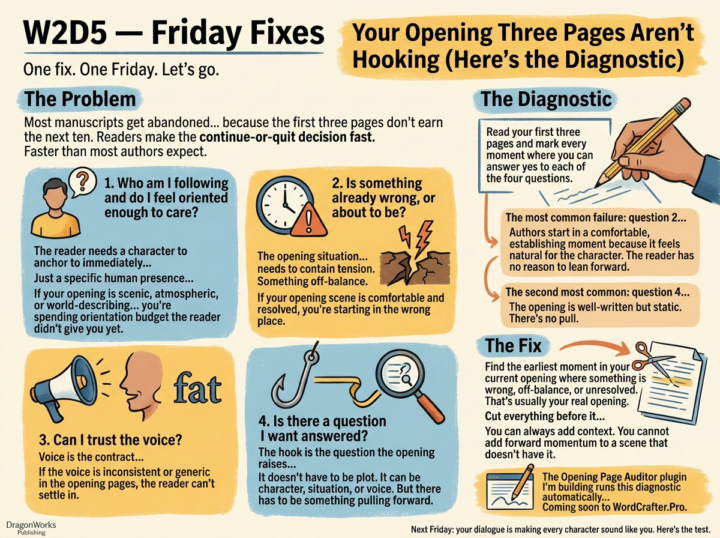
Your Opening Three Pages Aren't Hooking (Here's the Diagnostic) One fix. One Friday. Let's go. The Problem Most manuscripts that get abandoned by readers, agents, or reviewers don't fail because of a bad story. They fail because the first three pages don't earn the next ten. Readers make the continue-or-quit decision fast. Faster than most authors expect. The opening pages have to answer four questions before the reader consciously realizes they're asking them. The Four Questions Your Opening Must Answer 1. Who am I following and do I feel oriented enough to care? The reader needs a character to anchor to immediately. Not a full backstory. Not a character sketch. Just a specific human presence doing something specific that tells us who we're with. If your opening is scenic, atmospheric, or world-describing before a character appears, you're spending orientation budget the reader didn't give you yet. 2. Is something already wrong, or about to be? The opening situation doesn't need to be the inciting incident. But it needs to contain tension. Something off-balance. A question the scene implies even if it doesn't state. If your opening scene is comfortable and resolved, you're starting in the wrong place. 3. Can I trust the voice? Voice is the contract. The opening pages tell the reader how this book is going to feel to read. Pacing, register, humor or the lack of it, how close to the character's interiority we're going to get. If the voice is inconsistent or generic in the opening pages, the reader can't settle in. 4. Is there a question I want answered? The hook is the question the opening raises that the reader needs answered enough to turn the page. It doesn't have to be plot. It can be character (what is she hiding?), situation (how does this resolve?), or voice (where is this going?). But there has to be something pulling forward. The Diagnostic Read your first three pages and mark every moment where you can answer yes to each of the four questions. If any question goes unanswered for more than a page, that's the gap.
4d •
Thoughtful Thursday
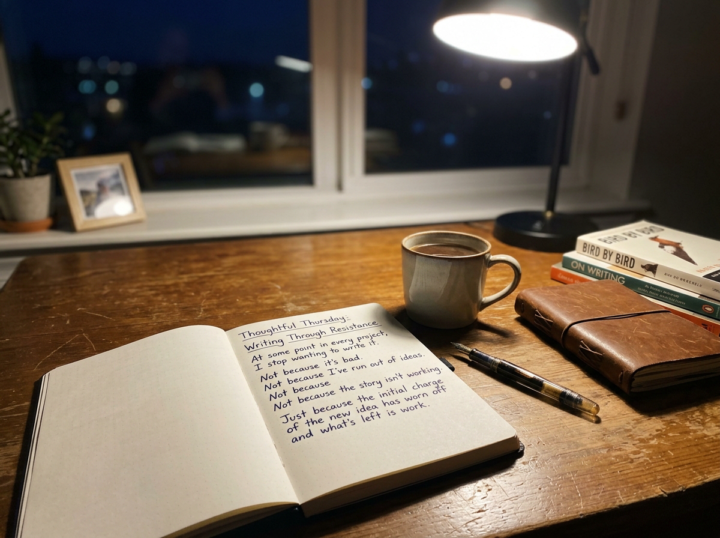
Writing Through Resistance (Not Through Pretending It's Not There) At some point in every project, I stop wanting to write it. Not because it's bad. Not because I've run out of ideas. Not because the story isn't working. Just because the initial charge of the new idea has worn off and what's left is work. For a long time I treated this as a signal. The resistance meant something was wrong. Maybe the story wasn't right for me. Maybe I needed a different project. Maybe I should take a break and come back fresh. What I've figured out is that the resistance is just the project settling into reality. It happens to almost everything at around the same point. And the authors who finish books aren't the ones who don't feel resistance. They're the ones who stopped treating it as meaningful information. What Resistance Actually Is The new project feeling is a neurochemical event. Novelty generates dopamine. Your brain rewards you for starting. It does not reward you at the same rate for continuing. By the time you're thirty or forty percent into a draft, the novelty has expired. The reward system has recalibrated. The work now generates satisfaction in a different, slower way, the kind that comes from completion and craft, not from the buzz of beginning. The writers who get stuck at 40% aren't less talented or less dedicated. They're just misreading what the resistance means. They think the low-reward phase is a sign the project is wrong. It's not. It's a sign the project has become real. What I Do With It Instead A few things that actually help: Name the specific friction, not just the general feeling. "I don't want to write" is too vague to fix. "I don't know what happens when she gets to the warehouse" is a problem with a solution. Most resistance dissolves when you identify what specifically is causing it. Lower the bar for the next session. The blank page is the hardest part. If you end a session by writing the first line of the next scene before you close the document, the next session has somewhere to start. The resistance is about starting. Give yourself a start.
5d •
Work Flow Wednesday
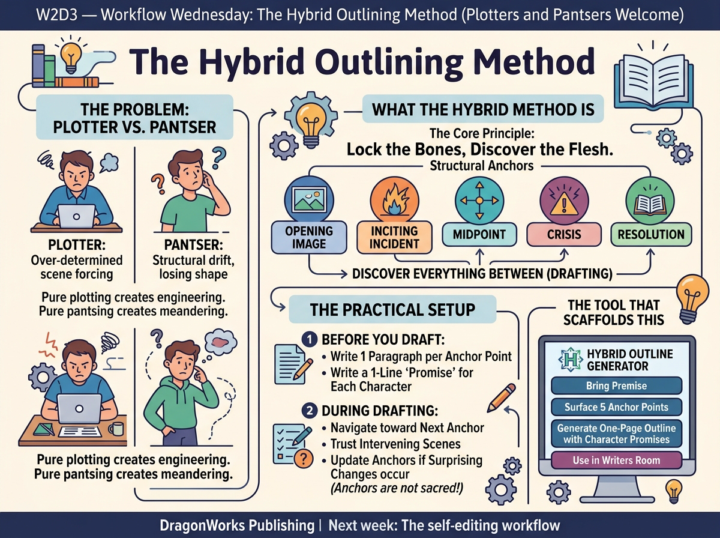
The Hybrid Outlining Method (Plotters and Pantsers Welcome) The plotter-versus-pantser debate is one of those conversations that feels important and is mostly a distraction. Here's what's actually true: pure plotting produces manuscripts that feel engineered. Pure pantsing produces manuscripts that meander. Most published novels are written by people who do some version of both, even if they don't call it that. The hybrid method isn't a compromise. It's just an accurate description of how stories actually get written. What the Hybrid Method Is The core principle: lock the bones, discover the flesh. You decide a small number of structural anchors in advance. These are the plot points that cannot move without requiring a completely different story. Everything between those anchors is discovered during drafting. For a novel, the anchors are usually: The opening image or situation (what the reader walks into). The inciting incident (what forces the story into motion). The midpoint (what changes the direction of the second half). The crisis (the worst moment, where everything is lost). The resolution (where things end, even if you don't know exactly how they get there). Five points. That's the skeleton. Everything else, all the scenes and beats and character moments and subplots, gets discovered in the draft. Why This Works Better Than Either Extreme The plotter's problem is over-determination. When every scene is plotted in advance, the draft stops being a discovery process and becomes transcription. The writer stops listening to what the characters are doing and starts forcing them to hit marks. The prose knows it. The pantser's problem is structural drift. Without anchors, the story tends to follow whatever is most interesting in the moment, which is not always what the story needs. The second half loses shape. The ending arrives before the reader is ready or long after they've stopped caring. The hybrid method gets you a container that holds the story's shape without predetermining its texture.
1-30 of 61
skool.com/ai-pro-writers-studio
The Home for AI-Powered Authors. Master story, prose, and marketing with expert AI personas to finish & sell your book fast. Never write alone again
Leaderboard (30-day)
1
+372
2

+200
3
+127
4

+111
5

+94
Powered by