Activity
Mon
Wed
Fri
Sun
Aug
Sep
Oct
Nov
Dec
Jan
Feb
Mar
Apr
May
Jun
What is this?
Less
More
Memberships
AI Pro Writers Studio
96 members • Free
Story Hacker AI
1.7k members • $67/month
146 contributions to AI Pro Writers Studio

4h •
New WordCrafter.Pro Feature
I call this Dynamic inline prompting. I did a quick 4 minute video to show how this is used and while its a simple little addition it is incredibly powerful! Select a Block of text up to 2000 Characters and in the pop-up menu that shows up there is a new option "Custom Rewrite" . Choose "Custom Rewrite and a window opens showing you the text you selected a drop down with a selection of inline prompts you can create or I can share with you to reuse over and over again OR... Now you can write a short prompt to modify the selected text using the current selected model. It will show you the result and you can choose to retry, close the window, or replace the selected text with the new. AND.... you can use any of the inline prompts from the list as a starter and edit them for your use right now! Examples: Make more tense, add more steam, make this more detailed, I tried adding a couple of extra pictures below but skool wouldn't let me. If you are working now, just refresh the page and it will work.

2 likes • 4h
Now this is really cool, quick on point and both texts are fully visible. I will be using this. I see the 100 number is very close. How's that AI tool coming? Great Work!
1d •
Claude Sonnet 5
New and cheaper??? Ive updated the models in Wordcrafter.pro and am playing with Sonnet 5 to see what it can do. If anyone tries it share your feelings below.

1 like • 10h
Well, I guess I'd better stop editing and get in as much writing as I can until the price goes up.
2d •
A Website versus a Landing Page
In my quest to learn more about author websites I'm doing more research to Learn the difference: A website is a comprehensive collection of web pages designed for exploration, branding, and education. In contrast, a landing page is a standalone, single web page created for a specific marketing campaign, designed to drive one focused action (like capturing a lead or selling a product). - Use a Website when: You are building your brand's digital foundation. Websites are ideal when you want people to learn about your company history, browse multiple products, read a blog, or contact customer support. - Use a Landing Page when: You are running paid ad campaigns, offering a free downloadable resource (e.g., an eBook), promoting a limited-time sale, or hosting an event. By stripping away navigation menus, you force visitors to either complete your Call-to-Action (CTA) or leave, vastly increasing conversion rates for that specific offer. - How They Work Together Many successful authors use both in tandem. For instance, a brand's full website will house all its information, but when they run a special summer sale, they will create a dedicated landing page. Paid ad traffic is sent straight to the landing page to maximize sales, while organic traffic explores the main website. An author with multiple books may find a complete website useful, but incorporate dedicated landing pages within it. Because you want to sell products, showcase a catalog, and build a long-term audience, a single standalone landing page is not enough. You need a multi-page platform that serves as your digital headquarters. Why a Website is the Core Requirement Your broad goals require different pages and complex functionalities that a single landing page cannot handle: - E-commerce Store: You need a shopping cart and payment processor to sell physical paperbacks, hardcovers, and promotional merchandise directly. - Book Catalog: A dedicated "Books" page allows readers to browse your entire history, with direct external links sending eBook buyers to Amazon. - Permanent Home: An "About the Author" page builds long-term trust, while a blog can keep readers returning organically. - - What do you use, or plan to use?

1 like • 2d
Uh, what is link juice?
0 likes • 1d
@Michael Culp Thanks, I learned something new today.
3d •
Welcome to New Members!
Welcome all new folks to the Professional Writing System, Help with Writing whether you use AI or not and the support Channel for WordCrafter.Pro, very shortly adding BookWeaver, and PlotCrafter (squashing bugs) If you are reading this and not here for WordCRafter.Pro that's cool too. We are a community of writers who use AI to help write stories that are meaningful and real (or so we hope). My goal for everyone here is to be productive, successful, and prolific in your writing. No matter how you want to write. We are here to help! So a big welcome for: And apologies for the delay..... @J P @Ebone Holmes @James Ford @Jacob Perry @Abdullah Muhammad @Laguna Oasis @Liora Vale @Kimmy Miller @Haider Chattha Welcome to the Room!!

5 likes • 2d
Welcome @J P @Ebone Holmes @James Ford @Jacob Perry @Abdullah Muhammad @Laguna Oasis @Liora Vale @Kimmy Miller @Haider Chattha Welcome aboard the writing train where learning, and doing it your way is a real thing. And don't forget to ask questions and share because there's always one of us that may not know that yet. My share for today is: I'm trying Wispr Flow free account and really liking it. Will try for the student discount since I still have my college email account too. I wish you the very best in success and writing all your great creative ideas.
3d •
Marketing Monday
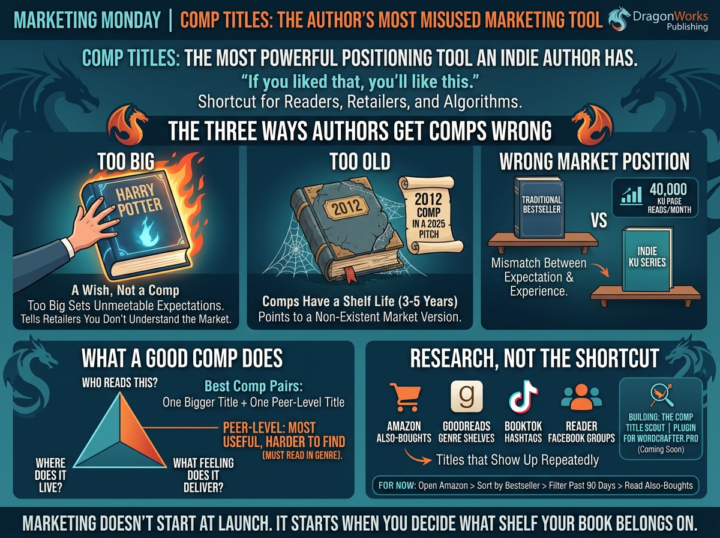
Comp Titles: The Author's Most Misused Marketing Tool Comp titles are the most powerful positioning tool an indie author has. They're also the one most authors get completely wrong. A comp title tells a reader, a retailer, and an algorithm: "If you liked that, you'll like this." It's a shortcut that bypasses the need to explain your entire book. Done right, a comp title does more marketing work than a blurb. Done wrong, it makes you invisible at best and actively misleading at worst. The Three Ways Authors Get Comps Wrong Using titles that are too big. "It's like Harry Potter but for adults" is not a comp. It's a wish. Harry Potter is one of the best-selling series in publishing history. Comparing yourself to it doesn't tell a reader where to shelve you. It tells a retailer you don't understand the market. Comps work by setting specific expectations. A title that big sets expectations no debut or mid-list author can meet. Using titles that are too old. Comp titles have a shelf life. Most industry guidance puts it at three to five years for a useful comp. If your target reader discovered your comp title in college and graduated a decade ago, that comp is pointing at a version of the market that no longer exists. Readers change. Genres evolve. A 2012 comp in a 2025 pitch is a red flag. Using titles from the wrong market position. A traditionally published bestseller and an indie series with 40,000 Kindle Unlimited page reads per month are in different market positions even if they share a genre. Comping up too far creates a mismatch between the expectation you set and the experience you deliver. What a Good Comp Does A good comp title answers three questions simultaneously: Who reads this? Where does it live on the shelf? What feeling does it deliver? The best comp pairs are one slightly bigger title for brand recognition and one peer-level title for precise positioning. Something a reader would recognize, and something a reader in that community is actively talking about right now.
0 likes • 3d
Nice, I've been trying various ways to do this.
1-10 of 146
Active 4h ago
Joined Apr 18, 2026
South Carolina
Powered by