
Pinned

💎
⭐
5h •
I sold my AI agency. here's the playbook
In September 2024 I started an AI automation agency. Nine months later I was doing $100K/month in recurring revenue. Then I sold my share to my partners. I took everything I learned: - The client acquisition system - The pricing - The delivery process … and I turned it into a step-by-step playbook for building a one-person AI agency. No code. No team. No guesswork. See exactly what's inside: -> I sold my AI agency. here's the playbook PS: If you are an AIS+ member, this is included in the Scale module. No need to purchase separately. - Nate
Pinned
💎
⭐
1d •
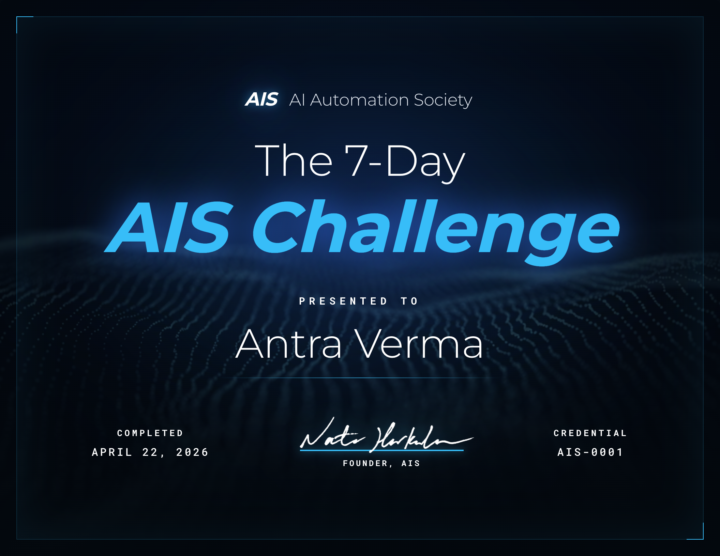
🎉 We have our FIRST graduate of the 7-Day Challenge!
Huge congrats to @Antra Verma for being the first to cross the finish line 👏 To celebrate, we're hooking her up with a FREE AIS shirt, and her official completion certificate is attached below 🏆 Let's give her a massive round of applause in the comments, she set the bar! Can't wait to see more of you submit your projects and join the graduate club. 👉 Want to take on the challenge? Head to the Classroom section or jump in HERE 👕 And if you want to grab some AIS merch for yourself, check it out HERE Cheers everyone! - Nate
Pinned

🔥
4d •
🏆 Weekly Wins Recap | Apr 18 – Apr 24
From high-ticket deals and agency SaaS launches to client systems, websites, and real-world automations - this week inside AIS+ was packed with serious builder energy. 🚀 Standout Wins of the Week 👉 Michael Wacht closed a $10K AI Readiness Assessment deal, sponsored by finance with training and system-integration readiness included. 👉 @Uros Pesic signed a £9K UK agency client for a 3-month ops audit and used multi-agent Claude Code to prep 20+ interviews in parallel. 👉 @Fernando Gómez turned a corporate social-media automation system into an agency SaaS with €2.5K setup + €100/month per client. 👉 @George Mbajiaku closed his first $1,300 client by shifting his pitch from “n8n builder” to “problem solver.” 👉 @Josh Holladay wrapped a 30-day client sprint and earned a retainer offer for ongoing strategy, builds, and AI education. 🎥 Super Win Spotlight | Balaji Iyer Balaji joined AIS+ knowing he could build something useful - but he needed structure, clarity, and confidence. Since joining, he has: • Set up his own cloud instance, Docker, Postgres, and self-hosted n8n • Built a real backend workflow from scratch • Created an app he now improves daily • Moved from “Can I really do this?” to “How can I make this better?” His biggest shift? Going from sitting on the sidelines → to finally building something he’s proud of. Balaji’s journey is proof that once you take the first step, momentum starts to build. 🎥 Watch Balaji’s story 👇 ✨ Want to see wins like this every week? Step inside AI Automation Society Plus and start building assets that compound 🚀


1d •
Cold email pipeline
I feel like I am at the point now where I’m ready to start looking for clients. My goal to begin with is to target tradespeople in my area with a simple speed to lead build. So today I started by making a cold email pipeline, it has a variety of different techniques which is constantly being tracked to figure out which methods work best. It is set up to be constantly looking for new clients( building up a crm), whilst sending 50 emails per day changing techniques after 200 emails. I have got it following up aswell. Any advice on other ways I can bring in clients

Jan 9 •
AI Content Creator
Has anyone ever created a creative brain? Something that has brand assets, winning hooks, angles, and is able to write more clean copy? Its something I have thought about doing.
1-30 of 16,099
skool.com/ai-automation-society
Learn to get paid for AI solutions, regardless of your background.
Leaderboard (30-day)
1

+5539
2

🔥
+3945
3

+3579
4

+2221
5

+1085
Powered by