

Dec '25 •
Deceleration training
Deceleration training matters because football isn’t just sprinting—it’s stopping, cutting, and re-accelerating hundreds of times. - Performance: The fastest players aren’t only quick… they can slam on the brakes under control and change direction without losing balance. Better decel = sharper cuts, quicker transitions, cleaner first step after the stop. - Injury reduction: Most non-contact injuries happen during hard stops and direction changes. Strong deceleration (especially eccentric strength) helps protect the knee, groin, hamstring, and ankle when forces spike. - Efficiency & endurance: If you brake well, you waste less energy “slipping” and can repeat high-intensity actions longer. Simple way to say it: Speed is the gas—deceleration is the brakes. Great footballers have both.

Dec '25 •
Don't just do a couple of laps and a few stretches to warm-up
Don’t just jog a couple laps and do random stretches. A real pre-pitch routine is intentional: you raise your temperature, activate the right muscles, and progressively build to game speed—so your first hard sprint, cut, or tackle isn’t your warm-up.

Dec '25 •
The importance of Pre-Pitch routines
Pre-pitch routines matter because they prepare your body and brain for match-speed before the first sprint, cut, or contact. - Injury prevention: They raise body temperature, “wake up” key stabilizers (ankles, hips, trunk), and expose tissues to gradual intensity—so you’re not going from cold → max speed in one play. - Performance optimization: You switch on the nervous system for faster reactions, sharper first steps, better coordination, and cleaner mechanics in sprinting, jumping, and changing direction. - Consistency: A repeatable routine creates rhythm and confidence—so you start games ready, not searching for the feeling. Simple line: The warm-up is your insurance policy and your performance switch.
0
0

Sep '25 •
Explosive Acceleration: Win Every Duel in the First 10 Meters
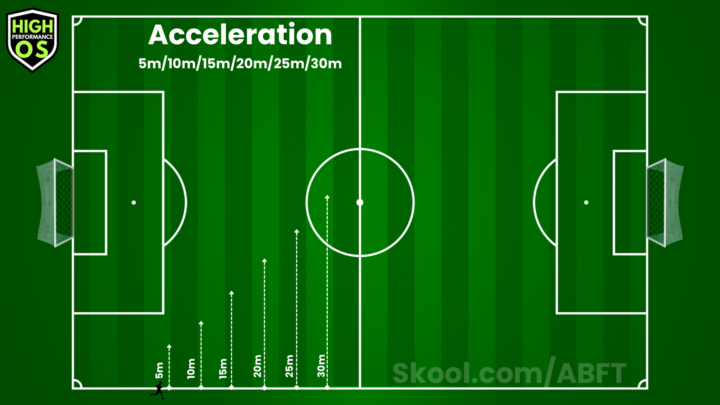
⚡ Acceleration Training for Footballers Football is not track — you rarely sprint 100m in a straight line. But you accelerate constantly: chasing a ball, pressing, breaking into space. That first 5–10 meters often decides whether you win or lose the duel. 🚀 Why Acceleration Training is Crucial - Game-deciding moments: Most sprints in football are under 20m. - Power & explosiveness: Builds the ability to hit top speed quicker. - Position-specific: Defenders react, strikers explode, midfielders cover gaps — all need quick starts. - Injury resilience: Stronger, sharper acceleration mechanics reduce hamstring and groin risks. 📏 Progressive Distances to Train Work in short zones and expand gradually as athletes adapt: - Phase 1 – Micro Accels (5–10m) Focus: Technique, first step power. Dosage: 4–6 reps × 2–3 sets, full walk-back rest. - - Phase 2 – Short Sprints (10–20m) Focus: Driving mechanics, explosiveness. Dosage: 4–6 reps × 2–3 sets, 1–2 min rest. - - Phase 3 – Extended Accels (20–30m) Focus: Transition from accel → near max velocity. Dosage: 3–5 reps × 2 sets, 2–3 min rest. ⚽ When to Use in Football - Speed Days: Main sprint work (after warm-up, before heavy legs). - Match Prep: Short accels in activation to fire the nervous system. - Top-Ups: Add 2–3 sprints post-training to keep sharpness and maintain weekly sprint exposure. ✅ Bottom line: Acceleration is the foundation of football speed. Train it progressively — from 5m bursts to 30m sprints — and you’ll dominate the first step that wins space, duels, and goals.
Sep '25 •
🌀 Why Curved Runs Matter in Football
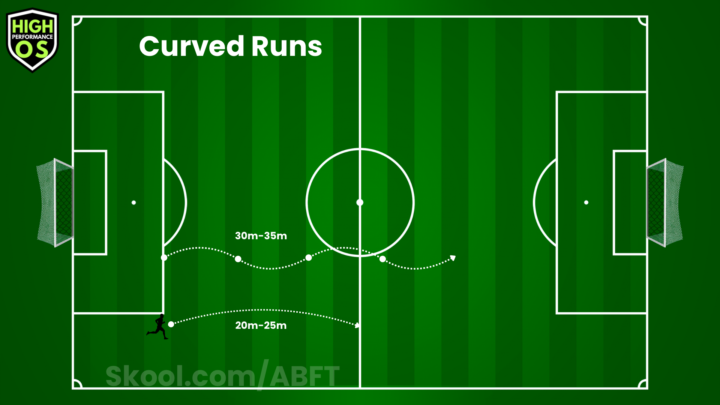
Most sprints in football are not straight lines — they’re curved: overlapping runs, chasing back, or adjusting your line to the ball. Training only straight-line sprints leaves a gap between gym speed and game speed. ⚽ Why Use Curved Runs - Game specificity: Mimics the natural angles and arcs players use in matches. - Hamstring protection: Curved sprinting slightly reduces peak hamstring load compared to straight sprints, which can help with injury prevention. - Change of direction prep: Builds strength in hips, groin, and trunk for stabilizing at angles. - Positional relevance: Wingers, fullbacks, and midfielders especially perform lots of curved high-speed runs. 📏 Distances & Dosages Setup: Use cones to mark a 20–30m arc (half-moon shape). - Youth / Developing players: 4–6 runs of 20m curved sprints // Rest: 60–90s between efforts - Elite / Senior players: 6–8 runs of 25–30m curves // Rest: 90s–2 min between efforts - Top-ups after training: 2–3 reps at 90% speed to accumulate HSR without overloading. 🔑 When to Use Them - Speed sessions: Mix straight and curved flying sprints (e.g., 4×20m straight, 4×25m curved). - Post-training top-ups: Ensure you hit both HSR and match-specific angles. - Return-to-play: Progress from straight runs → curved runs → match drills for safe reintegration. ✅ Bottom line: Football isn’t track & field. Adding curved runs makes your sprint training more realistic, protects against injury, and prepares you for the exact demands of the game.
0
0
1-10 of 10

skool.com/abft
The Greatest Footballer Movement for Next-Level Elite Performance
Powered by