Activity
Mon
Wed
Fri
Sun
Apr
May
Jun
Jul
Aug
Sep
Oct
Nov
Dec
Jan
Feb
Mar
What is this?
Less
More
Memberships
Energising Futures
27 members • Free
Career Connecting
61 members • Free
Career AI Academy
367 members • Free
Scholar Career Network
281 members • Free
Your Career & Life Transitions
11 members • Free
Career Operating System
59 members • Free
Career Professionals Network
89 members • Free
Career Boost
51 members • Free
EJ
Education, Jobs & Money
2k members • Free
20 contributions to Energy Data Scientist

21d •
Interview with Chevron: Challenges & trends
Recent interview question in Chevron. Happy to have some inputs. Thanks . - Department: Corporate Strategic Planning, interviewing jointly with Chevron New Energies (the division responsible for lower-carbon investments like hydrogen and carbon capture). - Target Role: Senior Quantitative Energy Economist - Interview Stage: Final Round / Executive Panel Presentation. You would likely be standing at a whiteboard in front of 3 to 4 senior directors. - 2 February 2026. - Format: the recruitment coordinator takes your mobile phone, laptop, and smartwatch. There is no AI, no internet, and no Python to run your simulations. You are led into a quiet focus room. On the desk is a printed piece of paper containing "The Carbon vs. Capital Conundrum" prompt, a basic scientific calculator, a notepad, and a pen. You are given exactly 45 minutes to digest the prompt, formulate your economic models from memory, and structure your recommendation.After 45 minutes, you are escorted into the boardroom to face the senior directors. You have nothing but your handwritten notes, a whiteboard, and a marker. Interview Question: " You are presenting to our executive investment committee. We have a strict capital expenditure (CapEx) limit for the upcoming fiscal year and can only fully fund one of two mega-projects. You must recommend which one we choose: Project Alpha (Deepwater Oil & Gas) - Location: Offshore West Africa - Financials: Spectacular projected Internal Rate of Return (IRR) of 20% with a very fast payback period. - Risks & Downsides: The host country is experiencing growing political instability. Furthermore, the project has a massive carbon footprint that will push our corporate emissions well over our stated public reduction targets for the decade. Project Beta (Carbon Capture & Hydrogen Hub) - Location: US Gulf Coast - Financials: The economics are extremely tight. The baseline IRR is only 7%, which barely clears our corporate hurdle rate (minimum acceptable return). - Benefits: It operates in a highly stable geopolitical region, secures massive government tax credits, and practically guarantees we hit our corporate net-zero pledges.
Feb 9 •
Trick interview question for energy consultancy role!
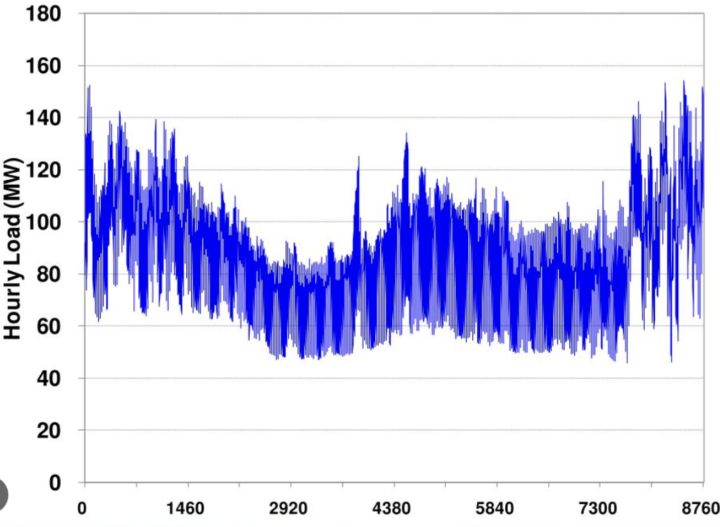
Speaking of interview rounds, I am sharing a very classic 'tricky' and frequently occurring question asked to those applying for consultancy roles in energy for entry roles . By 'entry roles' I do not mean internship. You need to have a BSc for sure, and you aim for a salary around $120k gross annual revenue - speaking of the United States , for 0-1 years of experience , i.e. fresh graduates. But this question is also asked to intermediate experience candidates e.g. 2-5 years experience (salary around. $180k / year in the USA. This is gross ie pre-tax, and annual). Below you see the plot of an electricity demand profile i.e. shows the electricity demand over a day. First, the question is to explain what we see. What do we understand in this plot. To explain the ups and downs. They may point with their finger e.g. 'why here it is low ' , 'why there it is high', speaking of this blue line. And then explain what happens to the price of electricity. Can we infer the wholesale electricity price from this plot? Because this plot doesn't show the price. It shows the demand . And this is the total demand in that region. Electricity demand. This question is asked because when you' re a consultant, your client often asks such questions. And you have to reply fast and accurately, or you may risk your reputation. If you try to evade e.g. by changing topic, then your client isn't stupid.. they will understand... and sometimes they will ask again... So such questions are asked. So this is a classic "gotcha" interview question. The interviewer is testing two things: your technical knowledge of energy markets and, more importantly, your attention to data validation.
0 likes • Feb 10
We are looking at an annual profile where the grid is under the most stress during the beginning and end of the year.

Feb 7 •
Energy Storage Arbitrage: 2 common Interview Questions
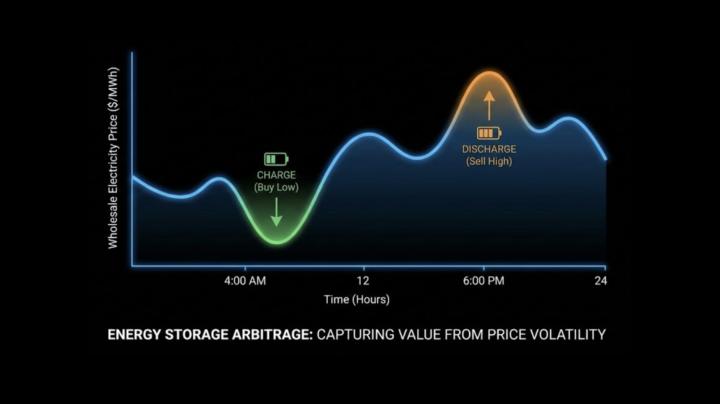
A new online course is being prepared about Energy Storage Trading using optimisation, machine learning (including reinforcement learning) , beginner-friendly ( no prerequisites ). This course will explain what energy storage trading is, what energy storage arbitrage is, etc - also all developed in Python. This is a topic that all energy companies are interested in, so there is very high probability that a relevant interview question will be asked . Even if you're not looking for jobs at the moment, you may look soon, so it is definitely useful to know this terminology. Here are two common interview questions: Interview Question1: What do we mean by Energy Storage Arbitrage? Interview Question2: What is the difference between Financial Arbitrage and Energy Storage Arbitrage? ================== Answer to Question1: It is when an Energy Storage unit buys electricity when the electricity price is low, and sells it when the electricity price is high. This operation generates economic profit by exploiting this price volatility over the course of a day, as shown in the attached slide. Answer to Question 2: The main difference is between space and time. Financial arbitrage exploits price differences between two different locations (e.g. New York and London) at the same moment (i.e. we buy a financial asset in New York and immediately we sell the same asset in London at a slightly higher price e.g. $100 versus $100.1 ). While Energy Storage arbitrage exploits price differences at different times within the same location (electricity market) e.g. the same storage unit (same location) buys electricity when its price is low, and sells it when the price is high. VIDEOS: Also, in the Classroom/6.3 I have uploaded 2 videos, each for these two questions (they provide some extra analysis). These two videos will also be part of the new course (in a few days).
1 like • Feb 7
Thanks. in terms of risk , id say the biggest risk is that the price at t2 might not spike as predicted when you decided to buy at t1.
Feb 4 •
New Report on Hydrogen
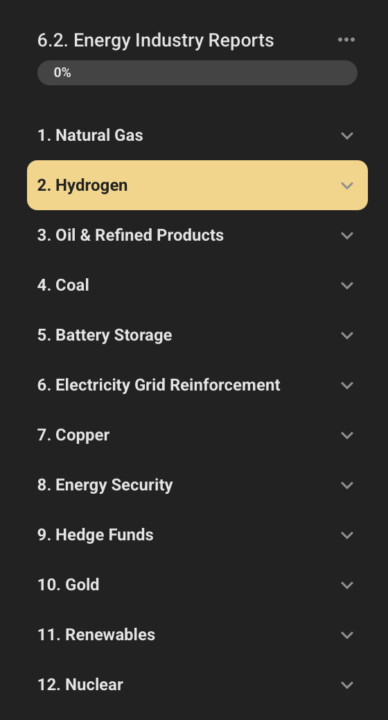
A new report on energy trends has been published and can be found by clicking on ‘Classroom’ and navigating to Section 6.2 (see the attached screenshot). You can use this report and the visualisations it includes, in your own projects, work, or studies, without limits. This report explains the progress for the UK’s hydrogen rollout. The report includes diagrams and flowcharts that provide context, and also a list of relevant sources that were used to complete this report. These sources are from the Financial Times, Wall Street Journal, the Economist and Investors Chronicle (all sources are available inside the report). Your subscription in this Skool community gives you access to paywalled energy-economics articles from these publications (Financial Times etc) indirectly through these reports. I have also included some explanations and additional text that explains some details. The text is written in beginner-friendly, easy-to-understand language. Reading these reports can help with interviews, meetings, presentations, networking, and public speaking. Strongly recommended.
0 likes • Feb 4
@Arben Kola , PhD The current price of £241/MWh is steep. However, this mirrors early offshore wind costs. Economies of scale should drive this price down significantly over time.
0 likes • Feb 4
@Arben Kola , PhD Input electricity costs are a major component of OPEX. removing taxes improves the business case. It incentivizes the use of renewable power for electrolysis.

Jan 19 •
Energy is a business as any other
Thank you for allowing me here, in your group. It is a pleasure to be here. I might be a bit away from the scientists. However, energy is a business as any other, and therefore, we can´t hide behind the "better future" phrases. The main interest of the market players is either to earn or save money. And that´s exactly where my mission starts.
1 like • Jan 19
I agree that energy is fundamentally an economic system: incentives drive behavior. If we ignore that, we misread why projects succeed or fail.
1-10 of 20

Active 21d ago
Joined Oct 14, 2025
ESFP
HK