Activity
Mon
Wed
Fri
Sun
Apr
May
Jun
Jul
Aug
Sep
Oct
Nov
Dec
Jan
Feb
Mar
What is this?
Less
More
Memberships
Energy Data Scientist 2026
464 members • Free
Solar Operations Excellence
279 members • Free
5 contributions to Energy Data Scientist 2026

27d •
New Online Course: Energy Storage Trading & Arbitrage in Python
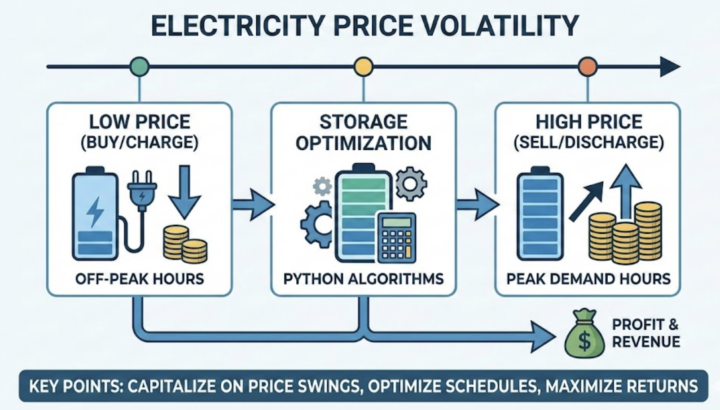
The course (available in Classroom) teaches how to develop a profit-maximizing arbitrage strategy for energy storage using mathematical optimization (Linear and Mixed-Integer programming) in Python. Full Python code available to download and fully explained in the video (1 hour and 15 minutes). No prerequisites (beginner-friendly). Energy storage can make money through various ways, one of which is energy storage trading (arbitrage). See the attached figure summarising the energy storage arbitrage strategy. The algorithms and strategies taught in this course are the industry standard for the following roles: - Quantitative Analysts (Quants) in energy firms - Energy Traders - Data Scientists (Energy) - Asset Managers Where is this code used? This specific type of optimization (Arbitrage & Dispatch) is used in firms across the energy and financial sectors: - Hedge Funds & Prop Trading - Investment Banks - Commodity Trading Houses - Energy Majors & Tech Energy Storage : - Utilities (e.g., Duke Energy, NextEra, Enel) own batteries (energy storage) to help stabilise the electricity grid. - Independent Power Producers (IPPs) (e.g., Vistra, AES, Neoen) are companies that build and own power plants (solar, wind, batteries) specifically to sell electricity for profit. They are very active users of arbitrage strategies. - Investment Funds (e.g., Gresham House, Gore Street Capital) are specialized funds that buy batteries as financial assets, similar to how a real estate fund buys apartment buildings to collect rent. - Hedge funds (like Citadel, D.E. Shaw, or Millennium) thrive on volatility. In energy markets, prices can jump from $20 to $2,000 in minutes.

1 like • 18d
@Manuel S OK, seems like you try to encourage me. Once I realize that my business development skills and negotiation skills are not secure my income anymore, I will think of Python as a possible way, how to expand my expertise. 😎😉
1 like • 18d
@Mateo Flores, Msc You make it sounding like it is a simple thing to do. Let me to check on this, once I have some days off. Thank you for the hint.
Feb 7 •
Energy Storage Arbitrage: 2 common Interview Questions
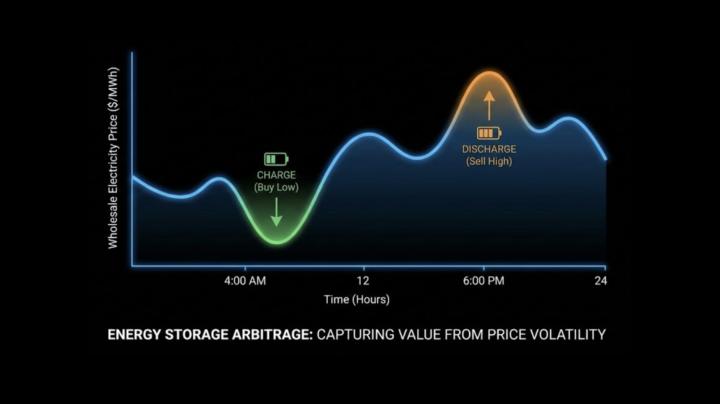
A new online course is being prepared about Energy Storage Trading using optimisation, machine learning (including reinforcement learning) , beginner-friendly ( no prerequisites ). This course will explain what energy storage trading is, what energy storage arbitrage is, etc - also all developed in Python. This is a topic that all energy companies are interested in, so there is very high probability that a relevant interview question will be asked . Even if you're not looking for jobs at the moment, you may look soon, so it is definitely useful to know this terminology. Here are two common interview questions: Interview Question1: What do we mean by Energy Storage Arbitrage? Interview Question2: What is the difference between Financial Arbitrage and Energy Storage Arbitrage? ================== Answer to Question1: It is when an Energy Storage unit buys electricity when the electricity price is low, and sells it when the electricity price is high. This operation generates economic profit by exploiting this price volatility over the course of a day, as shown in the attached slide. Answer to Question 2: The main difference is between space and time. Financial arbitrage exploits price differences between two different locations (e.g. New York and London) at the same moment (i.e. we buy a financial asset in New York and immediately we sell the same asset in London at a slightly higher price e.g. $100 versus $100.1 ). While Energy Storage arbitrage exploits price differences at different times within the same location (electricity market) e.g. the same storage unit (same location) buys electricity when its price is low, and sells it when the price is high. VIDEOS: Also, in the Classroom/6.3 I have uploaded 2 videos, each for these two questions (they provide some extra analysis). These two videos will also be part of the new course (in a few days).
3 likes • 27d
This is really interesting wrap-up. When people ask me, why they shall invest into BESS, I keep telling them that PV is generating power in the times when it is the least needed. Therefore BESS serves as a "revenue accelerator" for PV.
Feb 4 •
Interview Questions (Since October 2025)
The goal of this community is to help you secure jobs across the wider energy sector. That includes: - Major Energy Firms (Trading houses, Utilities, Oil & Gas). - Non-Energy Firms that manage their own energy assets or investments. - Academia (PhD applications and research roles). I have compiled a list of recent questions that candidates have faced in interview stages mostly between October 2025 and January 2026 ( retrieved from student databases ). You can also see below the company they were applying to. When reading these questions we need to ask ourselves: "Could I answer this question under pressure (with maybe 1 minute of thinking)"? Also, my answers to each question are in Classroom 6.3 compiled in the form of a PDF file. This PDF file has 5 more questions included as well (and answers). 1. Energy Quant (Power/Gas) - BP: “Walk me through a forward-curve model you would use for power or gas. How do you handle seasonality, mean reversion, and spikes?” - Shell Energy Trading: “Design a risk framework for an options book on power. Which metrics would you report daily, and how would you stress test extreme events?” 2. Energy Trader - TotalEnergies: “Explain the spark spread and how it links fuel prices, heat rate, and power prices. When does a plant dispatch?” - Trafigura: “You have a short physical position for next month. How would you hedge it with futures, swaps, and optionality, and what basis risks remain?” 3. Electricity Market Analyst (ISO/Utility) - National Grid ESO: “Explain Locational Marginal Pricing (LMP): what are its components, and what data does the market-clearing optimization need?” - EPRI: “How would you build a day-ahead load forecast and quantify uncertainty? Which error metrics matter most for operations?” 4. Project Finance Analyst - Macquarie: “Define DSCR and explain how it drives debt sizing. What DSCR range would you expect for a contracted wind or solar project?”
5 likes • Feb 5
Amazing. This is a very, very challenging task.
Feb 2 •
New Report on Small Nuclear Reactors
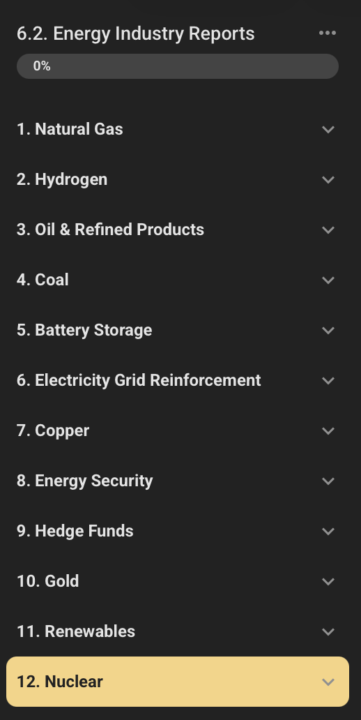
A new report on energy trends has been published and can be found by clicking on 'Classroom' and navigating to Section 6.2 (See the attached screenshot). You can use this report and the visualisations it includes, in your own projects, work, or studies, without limits. This report is about Small Nuclear Reactors and current trends by February 2026. Big technology companies like Amazon and Google are racing to find reliable electricity to meet the massive energy demands of new AI data centers. Their primary long-term solution is investing in Small Modular Reactors (SMRs) which are smaller nuclear plants that provide steady "zero-emission" electricity. However, because SMRs take about 8 years to build, these companies are also restarting and upgrading existing nuclear plants to bridge the gap. The report includes lots of diagrams and flowcharts that provide context, and also a list of relevant sources that were used to complete this report. These sources are from the Financial Times, Wall Street Journal, the Economist and Investors Chronicle (all sources are available inside the report). Your subscription in this Skool community gives you access to paywalled energy-economics articles from these publications (Financial Times etc) indirectly through these reports. I have also included some explanations and additional text that explains some details. The text is written in beginner-friendly, easy-to-understand language. Reading these reports is helpful for interviews, panel discussions , presentations, networking, and public speaking. Strongly recommended.
1 like • Feb 3
Mass use of e-mobility (not only private cars) + datacenters will cause a huge demand for electricity. Funny years are ahead!
Jan 19 •
Energy is a business as any other
Thank you for allowing me here, in your group. It is a pleasure to be here. I might be a bit away from the scientists. However, energy is a business as any other, and therefore, we can´t hide behind the "better future" phrases. The main interest of the market players is either to earn or save money. And that´s exactly where my mission starts.
3 likes • Jan 20
@Kahu Ngata Thank you for the comment. You are right. Everyone can familiarize himself with tangible results. "Greener future" is too generic and over-used phrase, which is difficult for people to associate with.
1 like • Jan 20
@Babette Pascal Thank you for your comment. Talking about money appears to be inappropriate. However, that´s the main motivation where all the effort start. No matter which industry we speak about. It´s a survival mode.
1-5 of 5

@jan-mastny-6885
Delivering growth & partnerships | Negotiating wins | Renewable business accelerator | Business development with excellence | Public speaker
Active 7h ago
Joined Jan 19, 2026