Activity
Mon
Wed
Fri
Sun
Apr
May
Jun
Jul
Aug
Sep
Oct
Nov
Dec
Jan
Feb
Mar
What is this?
Less
More
Memberships
For The Love Of Bodybuilding
28 members • $20/month
The Iron Forge Brotherhood
17.3k members • Free
Ultimate Human Diet
910 members • Free
DDT Method
133 members • $10/m
Real Primal Human
85 members • Free
Project Biohacked
10.8k members • Free
Castore: Built to Adapt
823 members • Free
Team Anabolic Bodybuilding
187 members • $29/m
17 contributions to Castore: Built to Adapt

Jan 5 •
New Year Check In 👇🏼
Quick check in for the new year Did everyone start working on their fitness goals yet? If so, what are you focused on this year fat loss, muscle gain, strength, conditioning, consistency, or overall health? Drop your goals below. Accountability matters, and it’s always motivating to see what everyone’s pushing toward. For me: I’m finishing my cut over the next 4–6 weeks, then taking advantage of improved insulin sensitivity with a 6 week lean mass rebound, followed by a dedicated health phase to solidify progress. I already started. That old “I’ll wait until Monday” mindset is gone at that point it’s just procrastination. The best time to start was yesterday. The next best time is today!
Poll
8 members have voted
0 likes • Jan 6
@Joaquin Rodriguez Nice! I rember doing DC training over a decade ago !
0 likes • Jan 6
@R K Awesome all Solid goals
Dec '25 •
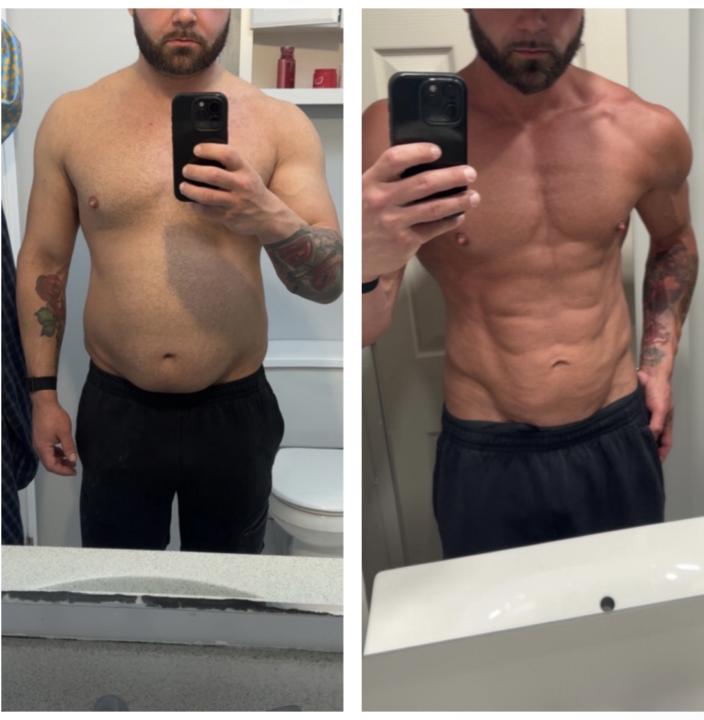
2025 Recomp: Progress, Setbacks, and What’s Next
As the year comes to an end, I wanted to share some progress with the community. From February 2025 to June 2025, I focused on doing things the right way carb cycling, a consistent Push / Pull / Legs split, hormone optimization, and strategically applied peptide protocols. Over that time, I went from 215 lbs to 188 lbs, recomping throughout the process while improving overall conditioning and muscle definition. In July, I unfortunately had to undergo back surgery, which cost me some momentum and a bit of size but it didn’t take away the foundation that was built. I’m already not far off from where I was, and more importantly, I’m back to pushing forward. This is just a pause, not a setback. 2026 is the real target and it’s going to be even better. Appreciate the knowledge, support, and accountability this community brings. Any questions don’t hesitate to ask!
0 likes • Dec '25
@R K Thank you!
0 likes • Jan 2
@Brady Nielson thank you!
Dec '25 •
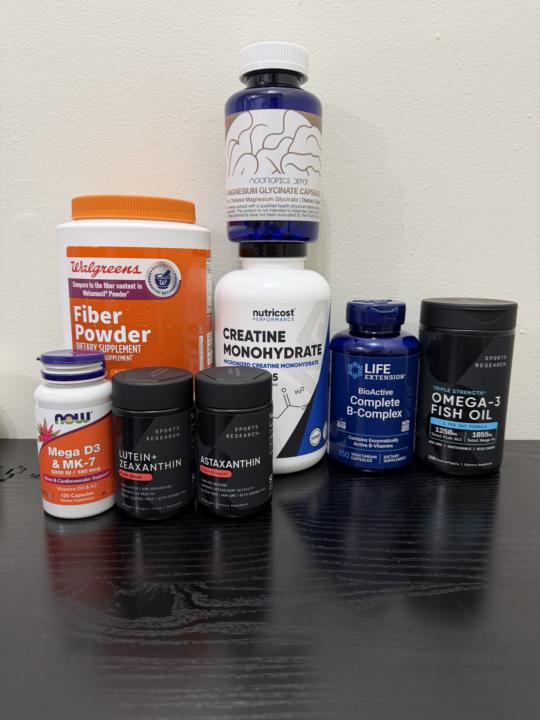
My Daily Evidence Based Supplement Stack
This is my baseline, year round supplement stack focused on general health, longevity, and performance. I figure I’d share with the community. I also run a separate sleep stack, Gut health and a PED support stack when applicable, but everything below is what I consider foundational and evidence backed. 1.Creatine Monohydrate Benefits: • Strength and power output • Cognitive support • ATP buffering • Neuroprotection Dosage: 6 g daily 2. Fiber Powder (Psyllium Seed) Benefits: • Gut health and motility • LDL cholesterol reduction • Improved glucose control Dosage: 6 g daily 3. Omega-3 Fish Oil Benefits: • Anti-inflammatory support • Lipid profile optimization • Brain and cardiovascular health Dosage: • EPA: 2,760 mg • DHA: 1,240 mg 4. Vitamin D3 + K2 (MK-7) Benefits: • Bone health • Immune function • Proper calcium handling and cardiovascular support Dosage: Vitamin D3: 5,000 IU Vitamin K2 (MK-7): 180 mcg 5. BioActive B-Complex Benefits: • Energy metabolism • Methylation support • Homocysteine regulation • Cognitive and nervous system function Dosage: ½ serving (1 capsule) 6. Lutein + Zeaxanthin Benefits: • Eye and retinal health • Blue-light protection • Reduced oxidative stress • Long-term visual longevity Dosage: Lutein: 20 mg Zeaxanthin: 4 mg 7. Astaxanthin Benefits: • Mitochondrial and membrane level antioxidant • Supports skin, eyes, joints, heart, and brain Dosage: 12 mg daily 8. Magnesium Glycinate Benefits: • Improved sleep quality • Parasympathetic nervous system support • Muscle relaxation and recovery Dosage: 400 mg nightly Any questions drop them below and if anyone is interested in my sleep stack, PED stack or gut health stack lmk and I can make a post about them!
0 likes • Jan 1
@Dena Schmid I bring all my supplements in supplement organizer split into AM/MID/PM and pack into my carry on typically. Going to LA next month I’ll have all this with me!
1 like • Jan 1
@Dena Schmid

Dec '25 •
Your Mitochondria Aren’t “Low Energy” — They’re Structurally Broken (And Pushing Them Harder Is Making It Worse)
Most conversations about mitochondria start in the wrong place. They start with energy production, ATP output, or how to “boost” mitochondria. That framing misses the real problem. Mitochondria don’t usually fail because they can’t make energy. They fail because the physical structure that allows energy to be made cleanly and efficiently becomes unstable. Once structure is compromised, every attempt to push energy production creates more noise, more oxidative stress, and more dysfunction. This is why people can have “normal” labs yet feel exhausted, wired, inflamed, or unable to recover. The issue isn’t fuel. It’s architecture. To understand this, we need to zoom in to the level of mitochondrial structure. Inside every mitochondrion is an inner membrane that folds inward into structures called cristae. These folds are not random. They are precisely shaped, tightly regulated, and essential for efficient energy production. Cristae dramatically increase surface area, but more importantly, they organize the electron transport chain into coherent, functional units. The electron transport chain is not just a series of enzymes floating in space. It is a spatially organized system embedded in the inner membrane. Distance between complexes, membrane curvature, lipid composition, and membrane tension all matter. A helpful analogy is an accordion. When the folds are evenly spaced, elastic, and well aligned, air flows smoothly and predictably. When the folds become stiff, warped, or collapsed, airflow becomes turbulent and inefficient. The same thing happens with electrons inside mitochondria. Electrons enter the electron transport chain and move through complexes I, II, III, and IV. As they move, they pump protons across the inner membrane, creating a proton gradient called membrane potential. ATP synthase then uses that gradient to produce ATP. When cristae structure is intact, electrons flow smoothly, protons are distributed evenly, ATP is produced efficiently, and reactive oxygen species remain low. When cristae structure is compromised, electrons leak, protons accumulate unevenly, membrane potential becomes excessive or unstable, and reactive oxygen species rise.
5 likes • Dec '25
This is one of my favorite posts you’ve written so far. You articulated the mitochondria problem exactly as it plays out clinically structure before signaling and I agree with every point you made. If you’re open to it, I’d be very interested in seeing how you typically structure an SS-31 protocol specifically how you dose and sequence it as a stabilization phase before any mitochondrial acceleration.
0 likes • Dec '25
@Anthony Castore I understand and makes perfect sense. We spoke through DMs awhile back. I will be in touch after the new year! Thanks Anthony

Dec '25 •
Mitochondria
I am going to be starting a mitochondrial stack starting with SS 31 then Mots-c than 5amino1MQ 6weeks with all 3 Has anyone done something similar? Any suggestions on how I should run it?
3 likes • Dec '25
I’ve ran MOTS-C 5mg EOD NAD+ 100mg EOD SLU-PP-322 300mg daily 5 amino 1mq 150 oral daily
1-10 of 17

@vincent-santangelo-2775
Biohacker optimizing performance, longevity, and metabolic health through data driven protocols. TRT Clinic | ER Registered Nurse
Active 1d ago
Joined Aug 1, 2025
New York
Powered by