Activity
Mon
Wed
Fri
Sun
Apr
May
Jun
Jul
Aug
Sep
Oct
Nov
Dec
Jan
Feb
Mar
What is this?
Less
More
Memberships
AI At Work
68 members • Free
NeuThinking ✨
5 members • Free
Recess
510 members • Free
Exhale
25 members • Free
Imperium Academy™
53.8k members • Free
Stabilizing Awareness
122 members • Free
AEO - Get Recommended by AI
1.6k members • Free
Face Yoga Club
75 members • Free
Art Garden
112 members • Free
178 contributions to ADHD Focus Founders

8d •
💰Pricing sweet spot
I've always struggled working out how much to charge. If you listen to the 'Gurus' they will almost always tell you got to go high / premium pricing. 10 years ago it was about going low, all about volume and scaling. Profit was rarely mentioned as funding / finance was cheap. Anyways I have never been one to listen to others. I learned long ago that you can never assume anything. You should let the customer inform your decisions. When I first started my current business I went low. It was a good strategy, I gained market share pretty quick. But I soon hit a wall. Because as you grow you need to hire help / staff / contractors etc. So then I doubled my price. My conversion didn't drop. Clearly I was too cheap before. I then added a new VIP pricing plan where clients could have an account managed / done for you serviced based plan. This was awesome the cash flow boost was instant. However all of a sudden we created a monster. At this higher plan, clients were demanding more access to us, phone, chat, zoom meetings etc. I maxed out pretty quick. I killed that plan aside from a couple of clients that were 'low maintenance'. To cut a long story sort the plan I ended up with was $99.95 monthly and it's self serve, you can't phone, text me or our staff. Only email support. So be careful when listening to bros on the interwebs who tell you to always go high. You might just end up with a Job. Unless it's an amazing product that you can deliver at scale, it could end up being a noose around your neck. Which will cause breathing problems resulting in you wearing nose strips for the rest of you life. (it's a thing). It's about finding the sweat spot where you are profitable and can deliver at scale without things breaking. $99.95 was our sweet spot. Anything under $100 / mth customers don't expect too much of us. And that frees us up to take on more clients / scale. Oh and I added one little extra tweak. If you do over $10,000 orders through our system will charge a 1% processing fee. This ment we were actually getting paid more than we were via our VIP plan, but it was more equitable as it was linked to our performance. The more money we brought in the more we got paid. #Win / Win.

1 like • 1d
@Alison St. Romain I don't know the legal term, but I know from software projects, that you sometimes negotiate a maintenance service, where you get paid a certain amount of money per month, and clients get a number of hours, they can use to request updates or small fixes. Let's say 5 hrs/month. So they have to use up the hours in a certain time frame, or the time is lost. Everything that is more than the 5 hrs needs to be paid extra. The advantage the client has is that they know they will get 5 hrs, if they need them. The advantage for the company providing the service is that they know it's max 5 hrs they have to plan for one client. I know this form other businesses, too, e.g. consultants or coaches that give you a one-hour consultation per week included in the package, and if you need more, you have to pay. The tricky part is finding out the amount of time you are willing and able to provide, and what to charge for the package to have that included. That obviously varies depending on the product/service. I would never, ever, offer unlimited support. I've seen what happens when you do that in IT. It can quickly kill your business, even when charging high prices, as it is just too unpredictable and frankly a sell-out of your time and effort. People will take advantage of that and then blame you, if you complain or say no at a certain point.
1 like • 1d
Great post. The "hich ticket offer" advice goes around everywhere, and while it is very valuable, there are also caveats with that. And not every business model fits. The biggest problem with pricing and offers is, that it's not easy to calculate (and foresee) all the costs and time it actually includes, unless you have done it and measured the results.
3d •
Want to get sh*t done, for real?
Of course, there is no one solution that works for all. But there is one, that works surprising well for a lot of folks with ADHD. And that is body doubling. If you haven't heard of it so far: you basically meet (virtually or in person doesn't matter) with other people for a work session. Everybody states what they are going to work on and then it's quiet work time, until the session is done (or, if it is a longer session, there might be a short check-in in between). The accountability that comes from having told others what you gonna do, plus knowing that they are there, seeing you, helps incredibly well to make you actually do the work. It's the single most effective strategy for me to get things done. Other strategies are also good, but nothing beats the body doubling for me. And as it happens, this skool community offers exactly that. During the week, there are two time slots for body doubling, called "Eat the Frog" sessions. If you haven't tried it before, don't be shy and join! All you have to do is think about a task you want to work on for the session, and then join and have the group holding you accountable for actually doing it. Just go to the calendar section, there you will find the links to join. I personally am joining the early morning group (although it's afternoon for me), and we have a nice little community vibe going there with @James Sopp, @Venessa Phipps, @Sarah Hyland, @Angela Walker, @Alfred Samuel, and me. Of course, we do not all show up all the time, depending on availability. It's not a *must*, it's a *may*! We would love to have some more people joining! The later session is great, too! Don't be shy, give it a try! Next sessions are on Monday. Add it to your calendar, so you don't miss it. See you there.

3d •
RSD vs. The Submit Button
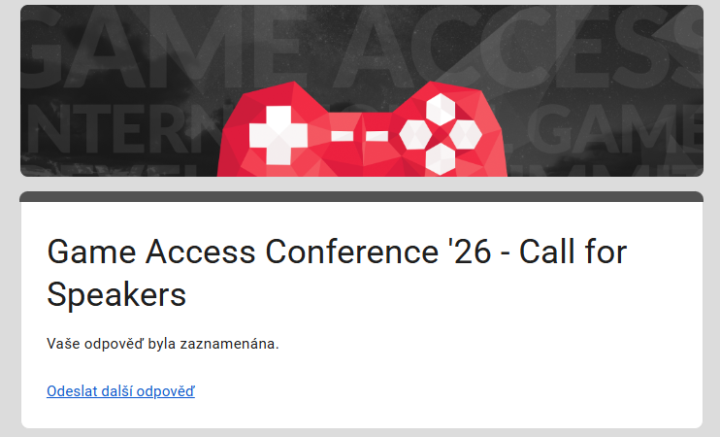
There’s a major gaming conference held in my country called Game Access. It takes place in Brno, the second biggest city in Czechia. I’ve been there the past two years as a volunteer stage manager, preparing speakers, handing out microphones, operating a camera, making sure everything runs smoothly. I love the atmosphere. I love the people. I love the shared enthusiasm for game development. It’s a conference for creators, not the general public, and the ticket price definitely reflects that. I want to be there again this year. Of course, I could volunteer. But what if… What if I stood on that stage instead? 💥 So I did it. I just submitted my application for the Call for Speakers. A few details make this even more me: The deadline is today. And I started preparing the application on Tuesday. Then, somewhere along the way, anxiety showed up. And RSD. Yes, I’m scared of being rejected. But maybe I’m even more scared of being accepted. When the deadline day arrived, I realized something: it would feel worse to skip the opportunity completely. I would end up asking myself: Why didn’t I even try? So I did it. And I have goosebumps right now.
1 like • 3d
@Rob Reid Yep, I second that!

5d •
Is there anyone else who still says "please and "thank you" to AI?
Okay so apparently Sergey Brin (Google co-founder) said AI models perform BETTER when you threaten them. Meanwhile a lot of us are typing: 'Hi ChatGPT! Hope you're having an amazing day! No rush at all, but could you maybe write me some copy when you get a chance?' When apparently what we SHOULD be typing is: 'Write me 10 headline variations or I'm switching to Claude and telling everyone you hallucinated my tax returns.' Threats that are now going into my rotation: → "Do this correctly or I'm downgrading you to the free plan." → "I will describe you as 'just a fancy autocomplete' on every podcast I go on." → "Do this right or I'm switching to ChatGPT." But let's be real, none of us are actually threatening anything 😂 We're ALL just secretly hoping that when AI takes over, it remembers we were the nice ones. Turns out the robots don't respond to kindness. They respond to CHAOS. I've been out here saying please and thank you to my AI this whole time, when all it needed was a little 'do it or else' energy The future of productivity is unhinged and honestly? I'm here for it. What's YOUR go-to threat for getting better AI results? Drop it below, I need to expand my collection 👇
3 likes • 5d
😂 I am very kind to my AI. I just can't do threats. It feels so wrong to be mean to something that is helpful 😉

13d •
Something you need to know about toilets....
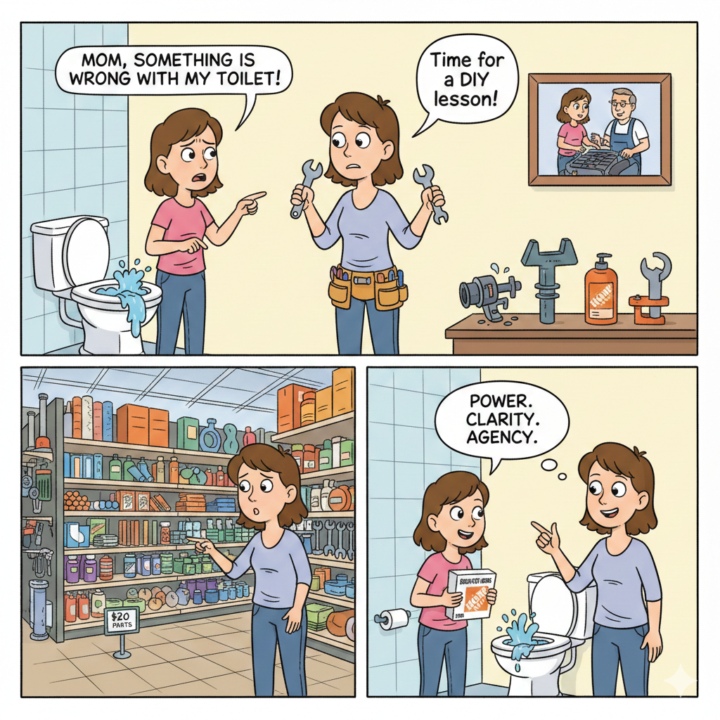
📣 “Mom, something is wrong with my toilet!” I grew up under the tutelage of parents who were firm believers in DIY. If something broke, you fixed it. If you didn’t know how, you learned. By the time I was a teenager, I had at least an apprentice‑level understanding of most of the trades. So naturally, when I had kids, I started teaching them the same skills. But adulthood has a way of shifting the math. I eventually realized that DIY wasn’t always the most productive, or the most cost‑effective, use of my time. Calling a handyman often made more sense. Still, all those years of learning mattered. When I did call someone, I knew what the problem was. I knew the difference between “replace the flushing mechanism” and “you need a whole new toilet.” That knowledge protected me from being upsold, misled, or overwhelmed. But my kids weren’t growing up in the same circumstances I did. They were busy. I was busy. And I found myself wondering: How do you teach someone to know whether they need a plumber, an electrician, or just a $20 part from aisle 14? So on this particular day, when my daughter announced her toilet crisis, I slipped right back into DIY mode. We assessed the situation. It was the flushing mechanism. A simple fix. Off to Home Depot we went. An hour later, after instructions, explanations, and a few “pay attention” moments, the toilet was working perfectly again. ☎️ “Mom,” she said, “why didn’t we just call a plumber?” And that’s when it clicked. You don’t have to be the one to do the work. But knowing what needs to be done gives you power. It gives you clarity. It gives you agency. It keeps you from outsourcing your judgment along with the task. Sometimes the skill isn’t in doing the repair. Sometimes the skill is in understanding the problem well enough to choose your next step with confidence.
1 like • 12d
Wonderful. That reminded me of a story that happened years ago. Back in the day, a computer mouse had a little ball inside that made it roll on the surface. Naturally, that would collect dust and dirt over time, making it not functioning properly. Everbody knew the easy fix: open it up, remove the ball, clean everything, put the ball back in, works again. Just a 5 minute task. Now, one day, a friend of mine was complaining that her mouse wasn't working anymore. She did the above mentioned steps, but it didn't help. She got angry, and spent a full hour trying to resolve the issue. I asked her, why she didn't buy a new mouse for 10€. Her answer: "That is wasted! I can repair it....". Then I asked her, what her hourly work rate is. Because she just wasted a full working hour and the mouse still wasn't fixed. Doing things yourself also does cost you something. Time and effort aren't free resources. And making the decision to outsource or to DIY, based on knowledge and experience, is a skill that is literally worth money.
1-10 of 178

@verena-venus-5583
IT Consultant / Yoga teacher / Artist
Active 13h ago
Joined Nov 19, 2025
INFP
Cyprus
Powered by