Activity
Mon
Wed
Fri
Sun
Aug
Sep
Oct
Nov
Dec
Jan
Feb
Mar
Apr
May
Jun
What is this?
Less
More
Memberships
Rebel Economist (Free)
1.4k members • Free
Rebel Economist Institute
1.1k members • $10,000/year
260 contributions to Rebel Economist (Free)

Aug '25 •
Quick review - WEA book featuring interview with Steve
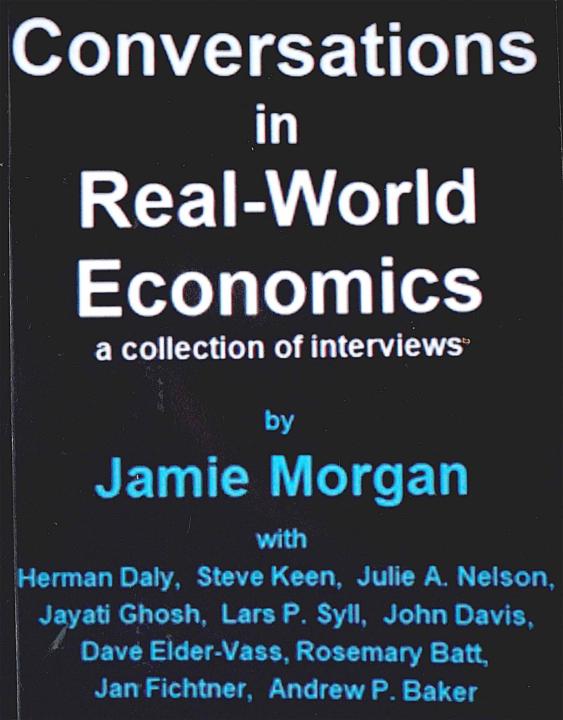
'Conversations in real-world economics' by Jamie Morgan of the World Economics Association has just been published. It features interviews with various heterodox economists of somewhat varying persuasions. I'd say it's useful for how it illustrates the breadth of the field and its vitality. I found the first two interviews especially interesting - 1) a view of ecological economics from Herman Daly 2) a view from finance to climate crisis from Steve Keen. ISBN 9798282878806 paperback Photos of the front and rear are attached.
0 likes • Aug '25
Kindle version is £6.01 - https://www.amazon.co.uk/Conversations-Real-World-Economics-collection-interviews-ebook/dp/B0FL3DKD6F/ref=sr_1_1?s=books

Aug '25 •
Now Richard Murphy goes Multi-Capital
Highly recommended I comment his efforts on my Patreon Blog. Too much of policy is steered by economics thinking, which is glaringly not fit for purpose. I realised this whilst on Steve Keen’s Rebels course (highly recommended). The problem is, the way economists talk and act, it sounds like they are the best equipped to advise policy. Scientists have a way of presenting things in a non-actionable way. It seems I am not alone. Bringing Real Capital into accounting and the narrative, I hope a new breed of advisors emerges to provide better decision and policy bases. For my part I have worked out ways of valuing and quantifying real capital (I call it the Real Capital Framework). I am collecting all info I can on the multi-capitals, and adding my view. Some comments from my research on his video: a) A pile of money should never be called capital. Calling it financial capital is a misnomer. True capital is as said in the video: something used but not used up (like resources) but worn down without a flow of maintenance and spare parts. b) He did not mention metals (or stone) – I call them Natural Capital, and like the atoms used as the basis of life (C,H,N,P,Ca,O etc) they could be recycled if our production system was set up that way. They are finite too. c) social capital includes our institutions, and this is where accounting could come in more. We need our institutions to be financially stable and capable of delivering.. (Caring for our institutions). And we need them to possess the built capital that has the capability to be circular (that is caring for the Earth). d) I am really sensing a productive overlap between caring for people, planet and the concrete, measurable, rational demand for the minimum state of the capitals for that to be the case. e) When national budgets are made, there is an expectation expenditure will be balanced via taxes etc returning. There is an implied claim on the multi-capitals – often a drawing down of natural, social and human – to make that budget work. That is the link to MMT
1 like • Aug '25
@Stephen Hinton UN calls it System of Environmental Economic Accounting. Lot of work undertaken. Companies enthusiastic until it showed they were broke if they had to pay for/repair their pollution and waste! - https://seea.un.org/
0 likes • Aug '25
@Stephen Hinton I nthink that is where Carbon Credits come in, as supported by Steve - ecocore.org -
Aug '25 •
Question about the velocity of money
I have a question for Dr. Keen. If the velocity of the US dollar is less than 2, and the average person using the currency is living paycheck to paycheck, spending all of their income every 2 weeks, wouldn't that mean that the volume of the money supply must be inordinately high to sustain the average citizen? This seems very puzzling to me, and I'd be curious to hear some discussion about that. Thank you.
1 like • Aug '25
The velocity/turnover of money is not due to any one individual spending but to how the accumulated respend progresses through society as it goes from my pocket to, for example, the supermarket, then their employees and so on. Individuals living paycheck to paycheck spend all their money, so it circulates as it is spent. The wealthy do not spend all their income so a significant proportion does not circulate. And spending already issued/created money does not increase the money supply, it simply redistributes it. Spending on a credit card does create money, but it also accrues the need to pay interest and those interest payments can be very debilitating, especially when a downturn hits.
Nov '24 •
A liveable future, or will civilisation disappear ?
I’ve said before that, even though I sometimes find intricate details fascinating, I tend to be more fascinated by a ‘big picture’. I doubt there could be a much bigger view than the one described by Richard Heinberg, in his Resilience post at - https://www.resilience.org/stories/2024-11-21/envisioning-a-livable-future/ (Link now OK, following Tony's correction of it, below) His Post asks three questions about the potential for a liveable future - 1) What would have to change? 2) What would a sustainable society look like? 3) How do we get there? It opens with a quote from Sir David King, former chief scientific advisor to the UK Government, who says “On our present psth, civilisation as we know it will disappear.” Heinberg continues, saying “Sadly, most people fail to understand the seriousness of our predicament.”. And a predicament it surely is, as Heinberg briefly summarises. He uses the I = P A T model, developed by Paul Ehrlich in the early 1970s, where - Impact = Population x Affluence x Technology The words ‘affluence’ and ‘technology’ sound descriptive and neutral enough, yet I’m disturbed by what they don’t say, by what those words seem to let slip. I’d modify them as - Affluence - a range of circumstances from comfort in moderation to material and behavioural rapacity. Technology - a range from to ingenious thrift to exploitative rapacity. I think Heinberg says much the same, in his detailed dissection, but without using the word ‘rapacity’. His worst-case outcome could hardly be worse - "…we will arrive at a post-industrial future via catastrophe and suffering. Nature will break down to the point where it can no longer support the existing human population. Human social systems will implode amid a mad scramble for power and survival. Our species may not outlive this unraveling.". Of the many alternative outcomes, he describes just one, that he calls 'a gentler path'. He has little hope of it being reached, saying "If humanity were going to take the gentler path, it would have had to start decades ago.". Instead, in both politics, finance and big business he sees what he calls 'the rejection of moderation'.
0 likes • Nov '24
@Alwyn Lewis it's .org, not .ord in your link Alwyn. Richard is very good and is saying what needs to be understood much more widely.
Nov '24 •
I do not have the new link to the Legacy lectures on Thursdays. A number of members have complained for some time.
I still haven't found the challenge link for legacy members. The calendar is of no use. It takes you to a marketing link.
1 like • Nov '24
https://us06web.zoom.us/j/3366324240?pwd=YjdLaENqem9oRjZTRzgrV0dwQVBnQT09 This is the link from the Challenge calendar for Thu session. It is the same as the one from 6 days ago so it would appear that the Zoom links are the same for all sessions
1 like • Nov '24
@Phil Carmody It may well be that you need to be paying the monthly fee for the Challenge session on Wed to enable the link to work. Adam - @Adam Maio (https://www.skool.com/@adam-maio-5784?g=debunking-economics-7964) may be able to clarify.
1-10 of 260
@tony-fenn-7679
Retired.
Been following Steve for years now and want to be given the tools to get across how fabtastical mainstream economics actually is.
Online now
Joined Jan 19, 2023
Powered by