Activity
Mon
Wed
Fri
Sun
Aug
Sep
Oct
Nov
Dec
Jan
Feb
Mar
Apr
May
Jun
Jul
What is this?
Less
More
Memberships
The MAGDALENE Network
723 members • Free
12 contributions to The MAGDALENE Network
2d •
🌹FOR ALL MAGDALENE'S: TODAY IS OUR DAY TO STAND UP🌹
The Magdalene Awakening Is the Hero’s Journey of Our Time On her feast day, perhaps the most sacred thing we can do is stop hiding the stories that brought us back to life. Every day, I encounter another one. Someone who survived an illness that rearranged everything they believed. Someone whose marriage collapsed and took her identity with it. Someone who lost the job, the house, the parent, the plan, the future they thought they were building. Someone who hit rock bottom face-first, paid an unspeakable price, and somehow crawled out carrying wisdom. They are young. They are old. They are religious, atheist, wealthy, broke, educated, ordinary, skeptical, and occasionally the last human being on earth you would expect to start talking about spiritual awakening. But they are talking. About synchronicities. Intuition. Trauma. Purpose. Energy. God. The soul. The strange sense that the worst thing that ever happened to them was also the event that finally cracked their life open. This shit is happening everywhere.😬 And I have begun to wonder whether we are watching millions of private catastrophes, or whether humanity itself has entered the Hero’s Journey. The pattern is ancient. First comes the call. Sometimes it arrives as longing. Sometimes as restlessness. Sometimes as a quiet knowing that the life you are living is no longer the life you came here to live. More often, we ignore it. So the call becomes louder. The body breaks down. The marriage ends. The career disappears. The belief system cracks. The identity we spent decades constructing begins to collapse under the weight of everything it can no longer contain. We call this failure. We call it bad luck. We call it illness, divorce, grief, burnout, betrayal, rock bottom. But our ancestors may have called it initiation. The Hero’s Journey begins when the old world can no longer hold the person we are becoming. It leads us away from the familiar, down into the underworld, through fear, loss, confusion, and confrontation with everything we have avoided.


3 likes • 2d
Happy Feast Day! Thank you for all your work and efforts. It’s truly amazing .
Jun 23 •
What You Don’t Bring Forth Will Destroy You
I thought I was researching Mary Magdalene. Then I realized she had been explaining what had already happened to me. ✨📚If you'd rather read this in my Substack: The Magdalene Heresies “If you bring forth what is within you, what you bring forth will save you. If you do not bring forth what is within you, what you do not bring forth will destroy you.” I’ve read that passage from the Gospel of Thomas for years. I’ve quoted it. I’ve taught it. I’ve highlighted it in books and nodded knowingly whenever it appeared in discussions about Gnosticism, consciousness, and spiritual awakening. And then recently I had one of those strange moments where a familiar idea suddenly revealed an entirely different meaning. Not because the words changed. Because I did. Have you ever had that happen? A phrase you’ve heard a hundred times suddenly lands in a completely new way. You don’t learn something new as much as realize you’ve been looking at the same thing from the wrong angle, and all at once, something becomes obvious. That happened to me while I was thinking about the Magdalene Method. For years, I assumed this passage was talking about hidden gifts, spiritual purpose, or some untapped divine potential waiting to emerge. Now I think it is talking about something much more immediate, much more personal, and honestly, much more uncomfortable. I think it is talking about the things we refuse to see. The fears we inherited. The beliefs we absorbed. The wounds we buried. The stories we keep repeating because they have become so familiar that we mistake them for reality. The parts of ourselves that quietly shape every decision we make while remaining largely invisible to us. And as I sat with that realization, another one arrived right behind it. The entire Magdalene Method grew out of this exact process.
1 like • Jun 23
Amazing. I can relate. Have you seen Disclosure Day? It’s ends with “LISTEN”. For those who have ears to hear. Thank you for all your work - inner and outer.🙏🏼
Jun 16 •
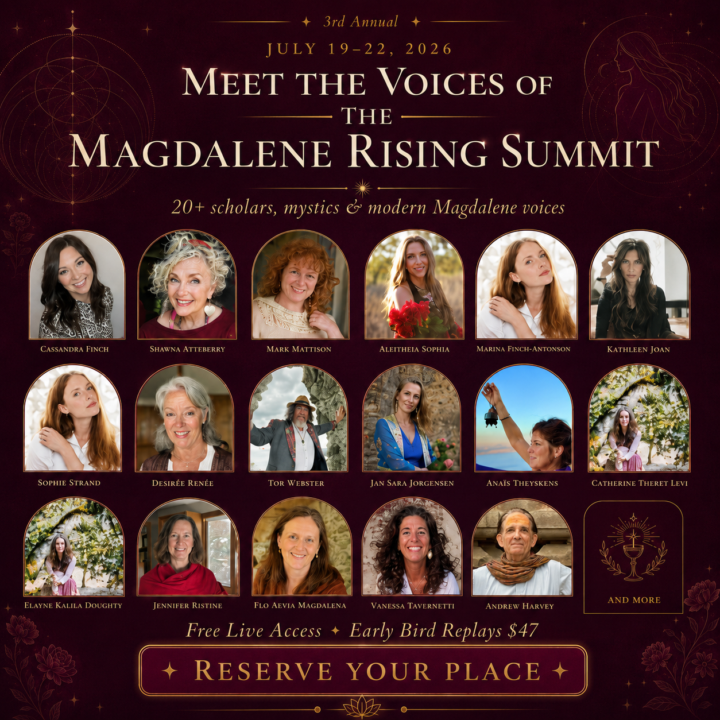
✨ Speaker Lineup for Magdalene Rising Summit 2026 is HERE ✨
July 19–22 | Free to Attend Live | All Access Pass $99 or $27 membership 🌹4 Epic Days, Immerse Yourself in Magdalene🌹 Friends, we are so close — and I am finally ready to share not just who is joining us, but what they are bringing. This panel is extraordinary and Magdalene Rising is known for our exceptional summit offers. 🙌Mystics, scholars, priestesses, and authors from across the globe — gathering in Mary Magdalene's name, on her feast day. And the 🎁bonuses they're offering? Meditations, digital books, programs, sacred guides — generously given to you as All Access Pass holders. Here's your full lineup 👇 🌹 Andrew Harvey — Mystical Scholar, Poet & Author of 30+ Books Presenting: The Sacred Marriage and Mary Magdalene — the alchemical marriage of soul and spirit, and what Magdalene and Jesus demonstrated for our awakening today. 🌹 Cassandra Finch — Soul Guide, Vancouver Island Presenting: The Magdalene Field: A Journey Into Truth and Devotion — a live guided meditation to restore inner clarity and dissolve patterns of self-abandonment. BONUS🎁 Soul Realignment session bonus 🌹 Shawna Atteberry & Mark Mattison — Co-Editors, The Divine Feminine Version of the New Testament Presenting: The Divine Feminine Version of the New Testament — the revolutionary translation using feminine pronouns for God and the Holy Spirit, including the Gospels of Mary and Thomas. 🌹 Aletheia Sophia — Sacred Mysteries Keeper, Southern France Presenting: Rite of the Five Seals: Magdalene Baptism — the ancient ceremonial initiation into the Christ Mysteries as Magdalene performed it in France. 🌹 Marin Bach-Antonson — Magdalene Rose Priestess Presenting: Becoming the Temple of Love — a ceremonial activation using rose oil anointing, Magdalene chanting, and sacred toning to embody divine love. 🌹 Kathleen Joan — Priestess of Brigid & Channeler, Maryland Presenting: Magdalene as Mystic & Medium — including a LIVE channeled message from Mary Magdalene. BONUS🎁 Free guide: 5 Ways to Connect with the Sacred Feminine Daily
3 likes • Jun 17
Wow. Amazing!
Mar 23 •
What is your favorite "Mary Magdalene" book? And why?
We'd love to know what everyone is reading these days. Is it more educational, channeled stories or fiction? And what is it that draws you to these type of books? For me, and my co-creators, we really dive into more educational and factual accounts so that we can build a clear understanding of Mary's path before, during and after Jesus. However, we have enjoyed some channeled books as well.
2 likes • Mar 23
I’m currently reading this book and really enjoying it!
0 likes • Mar 23
@Carrie Schulze oh yes! This book is finally getting to the depth I’ve been looking for. A book circle to share and discuss would be very powerful!
Feb 21 •
Question
Is anyone experiencing profound internal changes? My whole life I e had a career in accounting/finance which obviously requires a strong left brain to handle the details. That ability in me is gone. It feels like I have a whole brain that has a very wide aperture and my body and brain are now in knowing vs the chatter I used to have in my brain. I’ve been struggling because I can no longer hold a job in accounting. It feels like I’m not who I was and I’m in the liminal space of not knowing who I’m becoming. I’m tired of feeling alone with this.
1 like • Feb 26
@Alexandra Hilberth wow your words provide a great description of the journey after corporate accounting life. I’m more myself now than ever. I had an interview and was telling myself I need to go earn money. I can do this. The interview was uncomfortable and my body sent me in to an anxiety close to panic attack that took me a couple of days to recover from. It’s incredible how far we travel from our true selves in order to earn a paycheck. I have to trust the plan that I will be provided for and so far I have for 3 years! I am same with you - that world feels so far away. Thank you for your beautiful words and sharing your journey. It helps me so much to hear of others on the same journey.🙏🏼
0 likes • Mar 6
@Kelly Keith thank you! It’s so good to hear others stories!
1-10 of 12
Active 4h ago
Joined Dec 31, 2025
Powered by