Activity
Mon
Wed
Fri
Sun
Sep
Oct
Nov
Dec
Jan
Feb
Mar
Apr
May
Jun
Jul
What is this?
Less
More
Memberships
Mandarin Blueprint
36.6k members • Free
Clief Notes
43k members • Free
5 contributions to Clief Notes

6h •
if You Could Start Over Today, What Would You Do Differently?
I've been diving deeper into dropshipping and learning something new every day. One thing I've realized is that finding products isn't the hard part—building consistent systems for marketing and customer acquisition is. For those who are already getting results: - What's been the biggest game changer for you? - AI tools? - Better product research? - Paid ads? - Organic content? I'm always looking to learn from people who have real experience. If you're open to sharing your journey or exchanging ideas, feel free to comment or send me a DM.

24d •
For those struggling and getting stuck learning ICM
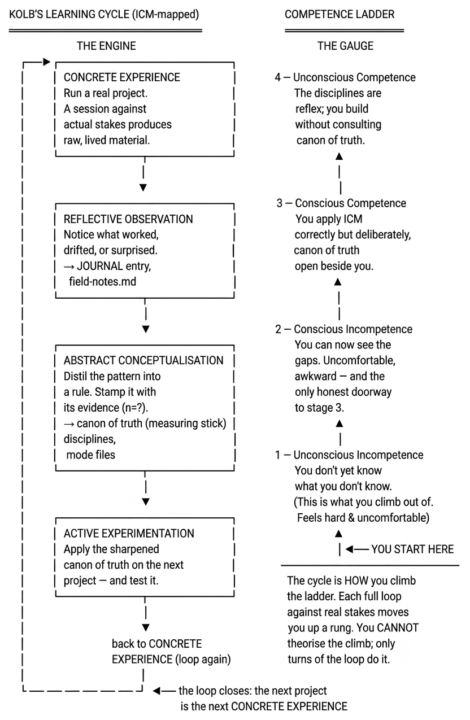
This came off the back of a comment with @Mira Bradshaw and seeing her experience in real time. Thank you for the inspiration, Mira, and April version of Mira too. I forgot to mention that @Don Roy - Do you use loops? 🔁 post, further compounded to me writing this post too. Attached is a visual representation of Kolb's Learning Cycle beside the Competency Ladder you climb (and slide back down) as you learn ICM. This demonstrates @Jake Van Clief's ethos of learning by doing, and in turn gaining competency. As Thomas Edison said: "Vision without execution is hallucination." You cannot theorise your way up the ladder, you climb each rung by doing the loop. So if you're finding this hard, awkward, or you're getting stuck: that's normal. It's meant to feel uncomfortable. The more you go through the cycle, the more you progress up the ladder, one rung at a time. I did try to render it in the post but no joy, so attached as image. Here is a link to a graphical representation. Personally I prefer the attached image layout.
1 like • 11d
This is a great way to visualize the learning process. I think a lot of people expect to understand everything immediately, but real progress comes from repeatedly applying what you've learned, making mistakes, reflecting, and improving. The reminder that it's normal to feel uncomfortable while learning is especially helpful. Every loop builds confidence and competence over time. Thanks for sharing this—it’s a great mindset shift for anyone feeling stuck.
1 like • 7d
@Andrew Carter I completely agree. That Edison perspective is a great reminder that failure is part of the process, not evidence that we're incapable. Experience teaches lessons that theory alone can't, and every attempt—whether it succeeds or not—adds to our understanding. The key is staying curious, reflecting on what happened, and continuing to take action. That's how real competence is built.

13d •
Thoughts on harness engineering within the ICM framework
Hi everyone, I'm posting this because I'm curious to hear your perspective on harness engineering within the ICM method. If you have any experience or opinions, please share :)
1 like • 11d
@Nika Marsagischvili That's a really helpful insight—thanks for explaining. It makes sense that context-related issues are usually easier to diagnose because you have something concrete to adjust. The AI-generated failures seem much trickier since they can be less predictable. I like your point about using hooks to make the process more deterministic. It sounds like a good reminder that effective AI workflows aren't just about writing better prompts but also about designing systems that can handle the model's inconsistencies. Thanks for sharing your experience!
1 like • 11d
@Nika Marsagischvili That's encouraging to hear! It sounds like the benefits become much more obvious once you start using ICM consistently in real projects. I'm still learning, so it's great to hear such positive feedback. I'm looking forward to gaining more hands-on experience and seeing those benefits for myself. Thanks for sharing!

11d •
AI Companion
I think it is best to assume we will all have an AI companion next to us - going forward - for the rest of our lives. For me, once I had that thought clearly and now typed it, the words provide some clarity on a few things. First, start working on what that companion looks like for you. There is great personal context in my phone, and any AI that is balanced the right way will be able to provide great insight and results. But more importantly, start working on what makes you unique as a person - both personally and professionally, and start putting into the right shape. Yes, that is one clear reason we are all here - keeping your work close to you, and not relying too much on the models to track you. Second, I am so curious about education. Testing had no notes as the results of pens, no calculators for decades after calculators appeared. So we will have years to watch education slowly adjust because no AI during tests is their obvious answer. But here is the hard point. If your test can be answered by an AI, you need to be teaching different things. There is more... but for me I just had a breakthrough that helped me focus on the important things going forward. Special thanks to my mom, who told me in the late 1970s, 'It is not like you are going to have a calculator with you every day for the rest of your life.' Fast forward decades later, and yes, I did have a calculator with me my whole life. Thank you HP 11C, and iPhone since 2006.
3 likes • 11d
That's a really interesting way to look at it. I think AI is becoming less of a tool we occasionally use and more of a long-term companion that helps us think, learn, and create. The part that stood out most to me was your point about building our own context instead of relying entirely on AI to remember everything. That feels like where the real value will come from—combining our unique experiences with AI's capabilities. Your point about education also resonates. If AI can answer the questions we're testing, maybe it's time to focus more on critical thinking, creativity, and problem-solving rather than memorization. It'll be fascinating to see how schools and workplaces adapt over the next few years.

Jun 3 •
Animation/Video Recommendations
Anyone have an good recommendations for doing videos with the folder structure? Specifically, more like generative video of people/places/things? I've got Remotion and Manim going right now (well, they work just not integrated just yet). They handle more data visualization or text type stuff in videos. I was looking for some other options, if I wanted to a short video with someone walking down the street kind of thing. Stick with the usual suspects of Veo, Sora, Kling and/Runway? Anyone have any other suggestions for alternatives?
1 like • Jun 3
@Rich C If you're already using Remotion + Manim, you’ve got a pretty solid foundation already for the structured side of video generation. For the more cinematic “person walking down the street” style clips, I’d probably still stick mostly with Veo, Kling, Runway, and Sora honestly they seem to be leading overall quality right now. A few other alternatives worth experimenting with though: Luma Dream Machine → good cinematic motion/atmospherPika nice for fast iteration and stylized clipPixVerse → decent for short-form/social style generationssurprisingly good considering how lightweight it is One workflow I’ve seen work really well:Generate consistent images/keyframes first (Flux/SDXL/etc.) → then animate them with Kling/Runway/Luma instead of relying entirely on text-to-video. Gives way more control and consistency between shots. Also if you're doing folder-structured pipelines, ComfyUI + FFmpeg can become really useful glue between everything.
1-5 of 5
