Activity
Mon
Wed
Fri
Sun
Aug
Sep
Oct
Nov
Dec
Jan
Feb
Mar
Apr
May
Jun
Jul
What is this?
Less
More
Memberships
Brand with Sina
12.2k members • Free
Make $1k-$10k in 30 days
19.6k members • Free
370 contributions to Make $1k-$10k in 30 days

⭐
Jun 14 •
🚀Last 24 hours of Admission: $1000 in 30 day Challenge
90 Slots are filled Till now - We do not believe in creating fomo and selling - islie jisko join krna ho aram se krlo nh to koi bat nh agey aur bh challenges aenge ye last challenge nh hai 🔴Classes are starting on Monday 8AM-10AM Morning - then Discord office hours execution - then night class at 8PM - 10PM ( hamari niiat hai k apko mukammal support mile and uske lie hum har mumkin koshish krenge ) 🤝Topics we are covering ( ye sirf oper oper k topics hain iske ilawa bht topics hain jo cover honge ) : 1. Client selection ICP ( break down of 170k earning on upwork, client by client industry and niche breakdown) 2. OFFER creation, winning cover letters and dm scripts 3. Multi channel outreach( warm cold ) upwork, insta, facebook, x, LinkedIn, skool, email, cold call, partnerships, B2B agencies, local clients , lead generation ka every method jo exist krta hai wo sikhaenge apko 4. Client communication 5. Project management 6. Team building 7. Finance Tracking and management 🤩Extras: - Profile Optimization ( Upwork and social media ) - Personal brand building - Alex hormozi ki 3 books ki knowledge milegi apko with AI assistant trained on Alex Hormozi Knowledge - AI skills milengi jinse aap sab kam krwa skte ho, jese client replies, portfolio nikalwana, project management etc 🔴 90% hamara time, energy, focus Outreach pe hoga ( lead nikal kr unko msg krna ) Jinhone join krlia unko whatsapp group, paid community, discord ka access mil gaya hoga ( jinko access nh mila wo skool pe dm kren mjhe ) jo challenge join krna chahte hen wo ye post parhen, comment kren , form fill kren and onboarding krwalen apni aaj https://www.skool.com/make-1k-5k-in-30-days-8449/life-changing-30-day-1000-challenge-is-coming-next-week-drop-your-answers-below-to-get-in?p=0e5af0a8

0 likes • 29d
Count Mr in Sir @Haroon Khalil

May 14 •
Daily journal|day58|date14-05-2026
• Notes 📝 ✨ 30-Day Challenge – Commitment in Action Today, I reaffirmed my intention to step into the reality of earning $200/month by learning Lead Generation. For the next 30 days, my focus remains clear: ✔️ Strengthening dummy bidding ✔️ Slowly and confidently moving toward live bidding ✔️focous video 📷 📷 editing 🏡 This income is not just a number—it’s for my children and husband, to uplift our family life. 💖 My biggest dream is to fulfill the wishes of my children, InshaAllah. 🌙 Sleep & Morning Routin 🕑 Slept at 1:00 Wake up 6:00 Wake up 5 hours Nmazee fajer✔️ Gas bahut problem kar rahi hai subah 6:00 baje se 8:00 baje tak gas aati hai. Or phr all day gaib.😩😩😩 7:00 -9:00 🕰️ Daily Activitie Made breakfast + Listen tafseer Quran.today i listen surhaa Al momin Is surya may mominin Ki safai ke bare mein bataya gaya hai. Yah sura use waqt nazil hova jab makke mein tamam musalman bahut mushkil or pareshani mein the. 🧹 Cleaned kitchen+house work 9:00-10:00am Watch classroom video 📷 📷 comunity building 🏢 26 -Aug -2025. 11:00 to 12:00 Check community msg Community me reply kia Up work pr job search ke Cover letter likhee Goggle drive me paste ke 👇🏼👇🏼👇🏼👇🏼 https://docs.google.com/document/d/1xktSRI9BCIKK5TUSDd54vhbMLbJteTocSuZVcvpoD7Y/edit?usp=drivesdk 12:00 to 01:00 Video editing ke. Raima ne new assignment di thi video editing ke bus usi per kam kar rahi hun abhi video ko complete ke phr review folder me upload kia.takee aj discord pe session hoga to @Raima Zainab review karengi. 👇🏼👇🏼👇🏼👇🏼👇🏼 https://drive.google.com/drive/folders/1iJ3mYSlhXep0N0L97TXEGjl2KDQgvsus 1:00 to 2:00 I prayed nmaze zoher. Prepared lunch boil chawal,raitta, salad,salan me toraee or chhana dall bnaya.🍅🌶️🧄🧄🧄🍲🍲🍲 3:00 to 4:00 Take lunch with family.wash clothes🎽🎽🎽🎽of mu son. 4:00 to 7:00 Nmazee asser ada kia 🧕🏼🧕🏼🧕🏼🧕🏼
0 likes • May 15
Congrats Rukhsana finally ap ny apny goals ka ak step complt kr lia by buying laptop ma sha Allah ma sha Allah Allah pak brkat dy apki mhnat m zindgi m wqt m ameen actually you're consistent so keep it up 🌱
May 8 •
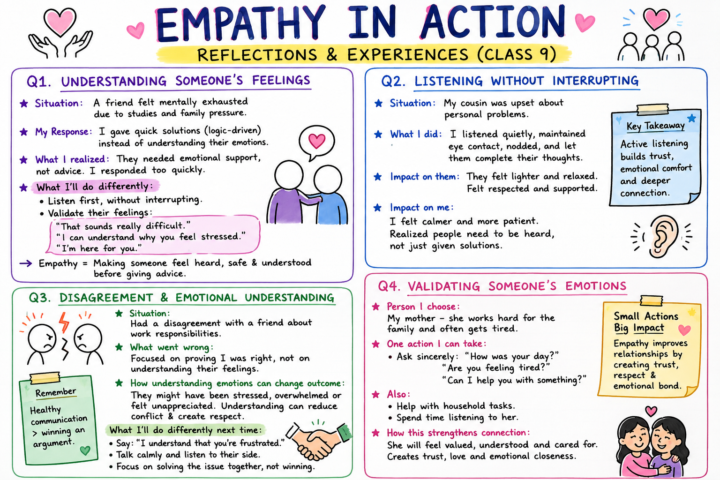
What is empathy?|notes|07-05-2026
What is empathy and why it matter? Q1. Understanding Someone’s Feelings with Empathy Recently, one of my friends shared that they were feeling mentally exhausted because of studies and family pressure. At first, I responded quickly by giving solutions like “Just take rest,” “Manage your time,” and “Don’t overthink.” I realized later that I was focusing more on fixing the problem instead of understanding their emotions. I did not fully pause to feel what they were going through. My response was logical, but not deeply empathetic. The person probably needed emotional support more than advice. Now, with high empathy, I would respond differently. I would first listen carefully and say things like: “That sounds really difficult.” “I can understand why you feel stressed.” “I’m here for you.” Instead of rushing to solve the issue, I would allow them to express themselves freely. Empathy means making someone feel heard, safe, and understood before giving advice. --- Q2. Listening Without Interrupting? One time, my cousin was upset about problems in their personal life. Instead of interrupting or giving advice immediately, I listened quietly and gave them full attention. I maintained eye contact, nodded, and let them complete their thoughts without judgment. After talking, they said they felt lighter and relaxed because someone genuinely listened to them. It made our relationship stronger because they felt respected and emotionally supported. While listening, I noticed that I became calmer and more patient. I realized that sometimes people do not need solutions; they only need someone who truly listens. Active listening creates trust, emotional comfort, and deeper connection between people. --- Q3. Disagreement and Emotional Understanding? I once had a disagreement with a friend about work responsibilities. During the argument, I focused more on proving that I was right instead of understanding why they were upset. Because of this, the conversation became tense and emotionally distant.
0 likes • May 11
Real empathy, according to me, is being a safe space for someone Yess listening without interrupting being kind and soft speaking is a quality of high value that humans always carry
May 8 •
Daily journal|day57|date 07-05-2026
• Notes 📝 ✨ 30-Day Challenge – Commitment in Action Today, I reaffirmed my intention to step into the reality of earning $200/month by learning Lead Generation. For the next 30 days, my focus remains clear: ✔️ Strengthening dummy bidding ✔️ Slowly and confidently moving toward live bidding ✔️focous video 📷 📷 editing 🏡 This income is not just a number—it’s for my children and husband, to uplift our family life. 💖 My biggest dream is to fulfill the wishes of my children, InshaAllah. Purchase lapetop because now i have a crome book for video editing i need?? 🌙 Sleep & Morning Routin 🕑 Slept at 1:00 Wake up 6:00 Wake up 5 hours Nmazee fajer✔️ Gas bahut problem kar rahi hai subah 6:00 baje se 8:00 baje tak gas aati hai. Or phr all day gaib.😩😩😩 Cooking ka zyada tar kam me 1st time he karti hu or jo baqi reh jatta he phr cylinder me pakati hu.kuch smjh nahe atta Pakistan me kia ho raha he basic koe bh cheez available nahe na gas,bijli,pani or na he good governece. Dova go hu Allha behter karee. 7:00 -9:00 🕰️ Daily Activitie Made breakfast + Listen tafseer Quran.today i listen surhaa Muhammad. Is surya ke najul hijrat ke bad hua. Yah sura use waqt na jalva jab makke mein tamam musalman bahut mushkil aata pareshani mein the. 🧹 Cleaned kitchen+house work 9:00-10:00am and other work. 11:00 to 12:00 Check community msg Community me reply kia Up work pr job search ke Cover letter likhee Goggle drive me paste ke 👇🏼👇🏼👇🏼👇🏼 https://docs.google.com/document/d/1xktSRI9BCIKK5TUSDd54vhbMLbJteTocSuZVcvpoD7Y/edit?usp=drivesdk 12:00 to 01:00 Video editing ke. Raima ne new assignment di thi video editing ke bus usi per kam kar rahi hun abhi video ko complete ke phr review folder me upload kia.takee aj discord pe session hoga to @Raima Zainab review karengi 👇🏼👇🏼👇🏼👇🏼👇🏼 https://drive.google.com/drive/folders/1iJ3mYSlhXep0N0L97TXEGjl2KDQgvsus
1 like • May 8
Yess lazmi lyna chahy yh one time investment apko bht comfort dy gi ap jb apna kam kro gi ya fr clients ka. Baqi gd h ma sha Allah keep doing it acha lead generation k ly kya process follow kr ri hn ks playeform pr ks k ly kr ri o ya fr apny ly

Apr 22 •
🚨 Attention All Social Media Managers
A few weeks ago, we completed our Social Media Management course I wanted to check in: 👉 How’s your progress going? 👉 Have you started working with clients yet? I also want to share something important. I’m currently onboarding a few serious SMMs for personalized mentorship. In this, I’ll guide you step by step on: • How to get your first client • How to generate quality leads • How to close deals • How to scale your skills within a few months ⚠️ This is NOT a job ⚠️ This is NOT a paid program This is purely to mentor you personally and help you grow in your career and start earning properly. If you’re serious about your journey and want guidance: 📩 Reach out via: • Skool DM • Instagram • LinkedIn I’ll try my best to respond to everyone so no one is left behind 🤝 Let’s grow together 💪
1 like • Apr 23
Jzak Allah Shayan bhai ready for the right thing application for your another great step 🙌
0 likes • Apr 28
@Haleema Nadeem check your iG girl i replied u
1-10 of 370

@sobia-nazik-1884
I help Personal Brands and Coaches.
My services cover Branding, Storytelling Marketing, Design Expertise, Strategic Audits, and Lead Generation.
Active 6d ago
Joined Dec 7, 2025
Lodhran