Activity
Mon
Wed
Fri
Sun
May
Jun
Jul
Aug
Sep
Oct
Nov
Dec
Jan
Feb
Mar
Apr
What is this?
Less
More
Memberships
Pre-Vet Skool
6 members • $5/month
7 contributions to Pre-Vet Skool

6d •
Happy Sabbath! Prayer Requests & Sabbath Skool Animal Trivia 🙏
Good morning and Happy Sabbath, everyone! I pray you all had a smooth week, whether you were studying for exams, shadowing at a clinic, volunteering, or working on those veterinary school applications. Pre-vet life is no joke, and I see you putting in the work! Wherever you are, I hope you take a moment today to rest, recharge, and step outside for some fresh air and sunshine. 🌿 If you have any specific prayer requests, drop them in the comments below. Unspoken requests are welcome too, because God knows what they are. 🙏 Introducing Sabbath Skool Animal Trivia! I’m starting a fun new series just for this community! Each Sabbath, I’ll post a question about an animal mentioned in the Bible. As future veterinarians, you already have a love for animals, so let’s put that passion to work in a fun way! I’ll point you in the right direction and you’ll have all day to answer. Drop your answer in the comments and let’s see who knows their Bible animals! 😊 This Week’s Question: I don’t know what the weather looked like where you are, but we had some wild weather this week, so our very first question comes straight from the flood story! As animal lovers and future vets, you might have some thoughts on this one. What animal is sent out of the ark first? Hint: Start in chapter 6 of Genesis. Fun Extra: After naming the animal, share a fun trivia fact about it! 😊


1 like • 3d
A raven. Ravens are excelents mimics able to copy everyday sounds,other animal sounds,and even human speech.
9d •
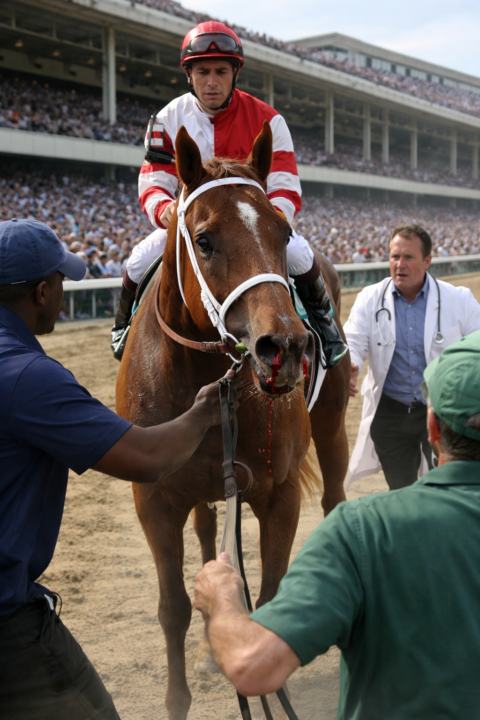
🐴 Case Study: What Is Wrong With Blaze After the Race?
Meet Blaze, a 5-year-old Thoroughbred racehorse who crosses the finish line and pulls up sluggishly. His jockey notices something alarming: blood streaming from both nostrils. His trainer assumes a nosebleed. You know better. Bilateral epistaxis after maximal exertion points directly to exercise-induced pulmonary hemorrhage (EIPH). During Blaze’s full gallop, his pulmonary capillary pressure surged to nearly 100 mmHg, physically rupturing the thinnest membrane in his body. Blood flooded his alveoli, migrated through his airways, and exited through both nostrils. You perform post-exercise endoscopy at 45 minutes and find continuous blood streams covering over one-third of his trachea. That is a Grade 4. Blaze needs 30 days rest, a full upper airway evaluation, and furosemide before his next race. 💡 The takeaway: Bilateral epistaxis after exercise is EIPH until proven otherwise. One nostril tells a different story entirely.
0 likes • 3d
I would actually love that! Could i post my results?
0 likes • 3d
@Nisana Miller i have already found new information a lot actually 😅 however I'm going to research more tommorrow then write a small research paper and post it sometime whether it be tomorrow or later this week
7d •
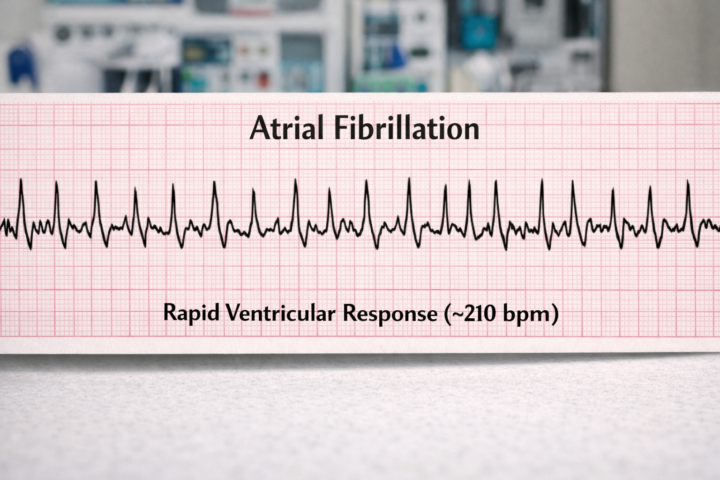
🐾 Case Study: Why Did Duke Collapse at the Dog Park?
Meet Duke, a 6-year-old Doberman Pinscher who collapsed mid-run at the dog park. His owner describes two prior episodes of sudden weakness that resolved within seconds. Today he made it to the clinic. On exam, his heart rate is 210 bpm. The rhythm is chaotic and impossible to count consistently. You notice multiple pulse deficits when you simultaneously auscultate and palpate his femoral pulse. The ECG tells the story: no P waves anywhere, a wildly irregular baseline of fibrillation waves, and narrow QRS complexes firing in no predictable pattern. Atrial fibrillation with a rapid ventricular response. Chest radiographs confirm what you suspected: a severely enlarged heart with early pulmonary edema. Duke’s dilated cardiomyopathy has progressed. Your first move? Diltiazem 0.15 mg/kg IV slowly to rein in that ventricular rate. Then furosemide for the fluid. You cannot convert Duke back to sinus rhythm. The goal now is control. 💡 The takeaway: In atrial fibrillation, rate control is the mission. Conversion is not the goal.
0 likes • 3d
WOW thats super cool i wouldve thought something was wrong with the horse if i examined its heart and realized it was skipping. Also i saw you said ranges like for the horse you said 140 to 220 is that saying anything inbetween is okay? Im assuming it depends on breed,size,and genetics correct?
0 likes • 3d
My mistake 😅 we were talking about horses in another post aswell so my brain was stuck on horses my apologies. Also that makes perfect sense when contributing stress and identfiers the patient already has especially sinse every patient is different assessing the whole patient and not just one part is how to get the proper diagnosis correct?
5d •
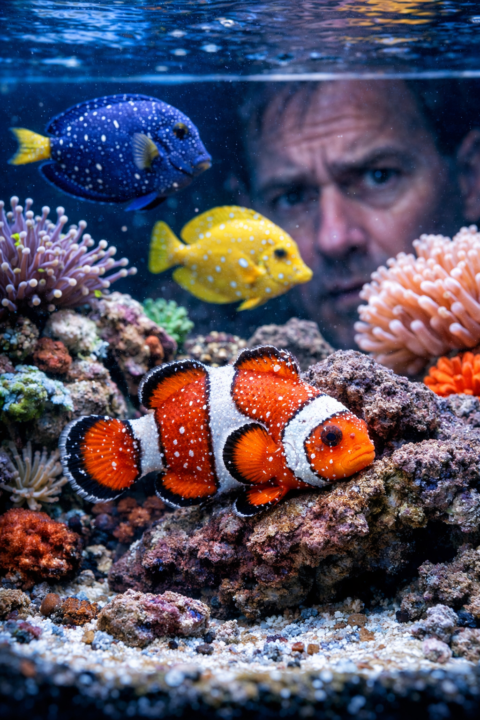
🐠 Case Study: Why Is Finn Covered in Salt?
Meet Finn, a 4-year-old clownfish in a 90-gallon reef tank. His owner rushes in after noticing a dusting of white spots across his body and fins overnight. Finn is scratching frantically against the live rock. The owner just added two new tangs three weeks ago. No quarantine. You recognize this immediately: Cryptocaryon irritans, marine ich. A ciliate parasite that burrows under the epithelium, feeds on host tissue, and explodes in population when a naive fish enters the system. Here is the problem. This is a reef tank. Copper sulfate, your gold standard treatment, would wipe out every invertebrate and coral in the system. Your plan: move Finn and the tangs to a bare hospital tank, begin copper treatment at 0.20 mg/L free copper for 28 days, and leave the display tank completely fishless for eight weeks. Without a host, every theront that hatches will die. The reef survives. Finn survives. But only because of patience. 💡 The takeaway: In reef tanks, the fallow period is your most powerful treatment tool.
1 like • 3d
Wow that makes perfect sense! How would you properly collect a sample without hurting the fish?
1 like • 3d
Thats really helpful im always scared of accidents happening when trying to collect samples or when handling animals especially with how small some animals are so this is a great fact to know for future reference
4d •
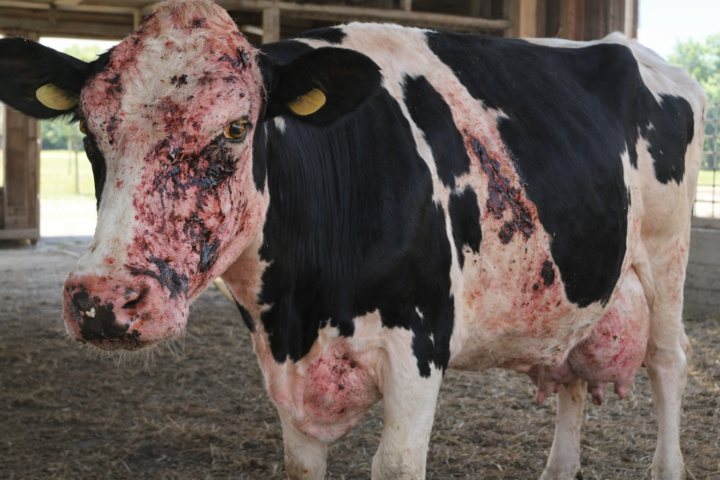
🐄 Case Study: Why Is Bella’s White Skin Falling Off?
Meet Bella, a Holstein dairy cow on an Oregon farm. Her owner calls in a panic after three days of bright summer sun. Bella’s white facial markings, teats, and udder are swollen and weeping. Her black patches look completely normal. That sharp line where damaged white skin meets untouched black skin tells you everything. This is photosensitization. But your next question matters enormously: is this primary or hepatogenous? You check Bella’s eyes. Yellow sclera. You check her herd mates grazing a weedy, overgrazed pasture and notice ragwort scattered throughout. You pull blood. GGT comes back at 480 U/L. Bilirubin at 9 mg/dL. Bella’s liver is failing. This is hepatogenous photosensitization from pyrrolizidine alkaloid toxicity. Senecio has been quietly destroying her liver for weeks. The sunny weather just revealed it. Bella goes indoors immediately. The prognosis is guarded. 💡 The takeaway: When white skin burns and the eyes are yellow, the problem is never just the skin. Drop your questions below! No question is too basic. You are here to learn and I love hearing from you. 👇
0 likes • 3d
That makes sense! I forgot yellow eyes alone usually indicate liver issues even in human patients with yellowing eyes. Also this may be a dumb question but why are the lesions only on the white parts of the skin and nowhere else?
0 likes • 3d
Okay 👍🏼 that actually helps a lot now i believe i can identify that from now on plus thats a really cool fact to know incase somone comes acorss a cow or any animal with this issue correct?
1-7 of 7

@rosalie-kirkpatrick-1738
My name is rosalie and im a aspiring wildlife rehabilitator. My goal is to get a degree in biology,rehabilitation,and conservation at OSU.
Active 7h ago
Joined Apr 20, 2026
Oklahoma