Activity
Mon
Wed
Fri
Sun
Nov
Dec
Jan
Feb
Mar
Apr
May
Jun
Jul
Aug
Sep
Oct
What is this?
Less
More
Ruth Performance Lab
364
Free
5 contributions to Ruth Performance Lab
Aug 18 •
10sec peak power
Anyone up for capturing 3 attempts to establish a 10sec peak power (wattage) on the C2 bike? I messed with it today, damper 10 and got 1113, 1155, 1355 (200# on the dot this morning) Interested in male / female scores - even better if you include BW so I can get a watts/kg read. I’ll report all the data back here.
1 like • Aug 19
👋
1 like • Aug 19
@Kyle Ruth see you in Monday 🤝
Mar 4 •
Case Discussion: Athlete With Multiple Injuries – SI Joint Pain Limiting Unilateral Work
Hi everyone, I’d appreciate some input on a case I’m about to start working with. I’m beginning with a new athlete. I completed the TTT Movement Course, so I plan to apply principles from the Fives model, but I’d also like to open this up for discussion and hear additional perspectives on approach and progressions. She is 45 years old, previously competed in CrossFit, and her goal for the coming year is simply to return to consistent, enjoyable training without pain. Current issues: • SI Joint inflammation (Sacroiliac Joint) – at one point there was even concern about possible arthritis• Partial labrum tear in the shoulder – no pain in internal rotation, but external rotation is painful Movement observations so far: • She can perform most bilateral lower-body movements until the load becomes painful• Unilateral lower-body work is currently not possible (split squats, lunges, SL RDL, SL hip thrusts)• Running is not currently an option due to pelvic pain During the initial assessment I tried to identify a pelvic imbalance, but didn’t see any major asymmetry in the 90/90 testing. The pain during unilateral work appears to be immediate during execution, rather than delayed soreness. Programming-wise, I’m fairly confident in the overall direction. The template will likely emphasize: • Freedom / Variability / Self-Mastery• Isometrics and tempo work• Extensive hip and ankle mobility• Very controlled, foundational strength work I still need to complete my full movement assessment battery, including the additional tests I incorporated after the TTT movement course. My main questions: 1. Why do you think unilateral work might currently be such a major limitation here? 2. How would you approach progressing it back in? 3. Is there anything else you would consider prioritizing in this situation? I already have a general structure in mind, but I’d really appreciate hearing how others might approach a case like this.
0 likes • Mar 5
Yes, that’s exactly what I was thinking of doing 🙂 And then later adding RNT work. Since there are a lot of variables here, this is kind of the default way I approach the process — building the progression from the bottom up rather than from the top down.
Dec '25 •
Quad Strain Rehab: first 24hrs
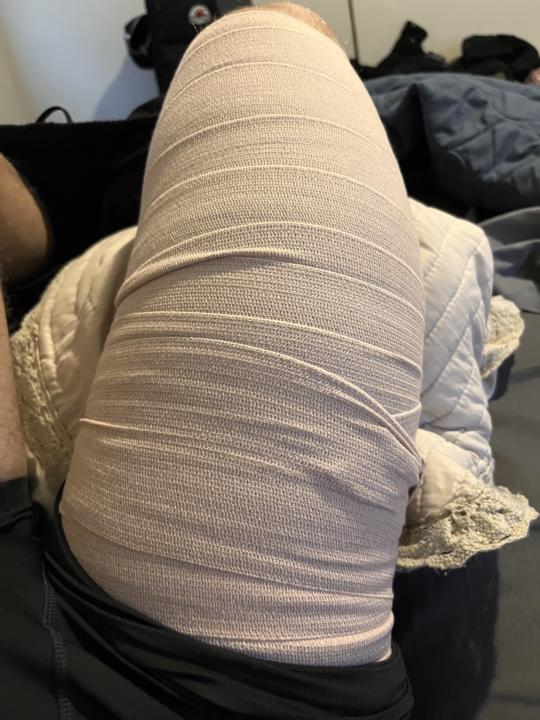
This weekend was a win and a reminder at the same time. Three USAMWL American records in my age group and weight class, along with a grade-2 rectus femoris strain near the insertion. I’m sharing this as a snapshot of my initial rehab process. Basically how I think through the first 24 hours as both an athlete and a coach. This isn’t a template or advice, just context for discussion. (1) Starting framework Initially my goal was to minimize bleeding - with a grade-2 strain, limiting the bleed means limiting the size of the scar tissue that develops. So as soon as it happened I had medical wrap it tightly with a compression bandage. I avoided the ice and NSAIDS that were offered sing both can potentially delay the healing process. (2) The first night After I got back to the hotel and a took a shower, the priority shifted to calming the area and setting myself up to sleep. I used my red light therapy pad for 30min, then wrapped the leg lightly to create some compression for sleep. Hip extension wasn’t tolerable at all, so I had to try to find a sleep position that worked around that. (3) Current modality and supplement checklist: ✅ Red / near-infrared light ✅ Compression (tight during the day / loose at night) ✅ Phytosome Curcumin (moderate dose) ✅ Pro-resolving mediators (a form of fish oil that helps the body shift from inflammation -> healing) ✅ PEA (Palmitoylethanolamide - reduces inflammation and modulates pain without delaying healing) ✅ Collagen (double my normal dose) ✅ Positioning that avoids aggravating the injury. (4) What I’m avoiding right now ❌ Aggressive stretching ❌ Soft-tissue work near the insertion ❌ Repeated icing ❌ Testing ranges to “check” on pain ❌ NSAIDs I’ll post another update in 2 days once I start BFR / isometrics. If you’ve found certain approaches helpful, or problematic, in the first 24-72 hours, I’d love to hear how you think through it.
0 likes • Dec '25
Oh no🥲 Fast recovery!
Dec '25 •
Making Sense of Heart Rate Training - Office Hours Recording Up
Today we finally unpacked a topic that confuses a lot of athletes: how heart rate zones, lactate thresholds, and V̇O₂ training actually fit into CrossFit and hybrid conditioning. We covered the differences between Zone 2, Threshold, and V̇O₂ work, why HR is reliable on machines but not under load, and how to use readiness data without overthinking it. Thank you to everyone who joined and contributed. The questions, examples, and back-and-forth made the session fly by, and I’m really enjoying how easy it was to get this posted and how organized everything feels inside this platform (thanks @Haley Ruth for getting these up so fast!!). The full episode is ready for you in the Office Hours archive. @Brandon Smith @Christian Laws @Eamon Coyne @Reshef Gold
0 likes • Dec '25
@Kyle Ruth might not be saying it with the exact terminology, but I remember that in Evan’s course and in his book he talked about his system as the DRU model meaning: Delivery training Respiratory training Utilisation training
0 likes • Dec '25
@Kyle Ruth tnx for the clarification! Super interesting
Dec '25 •
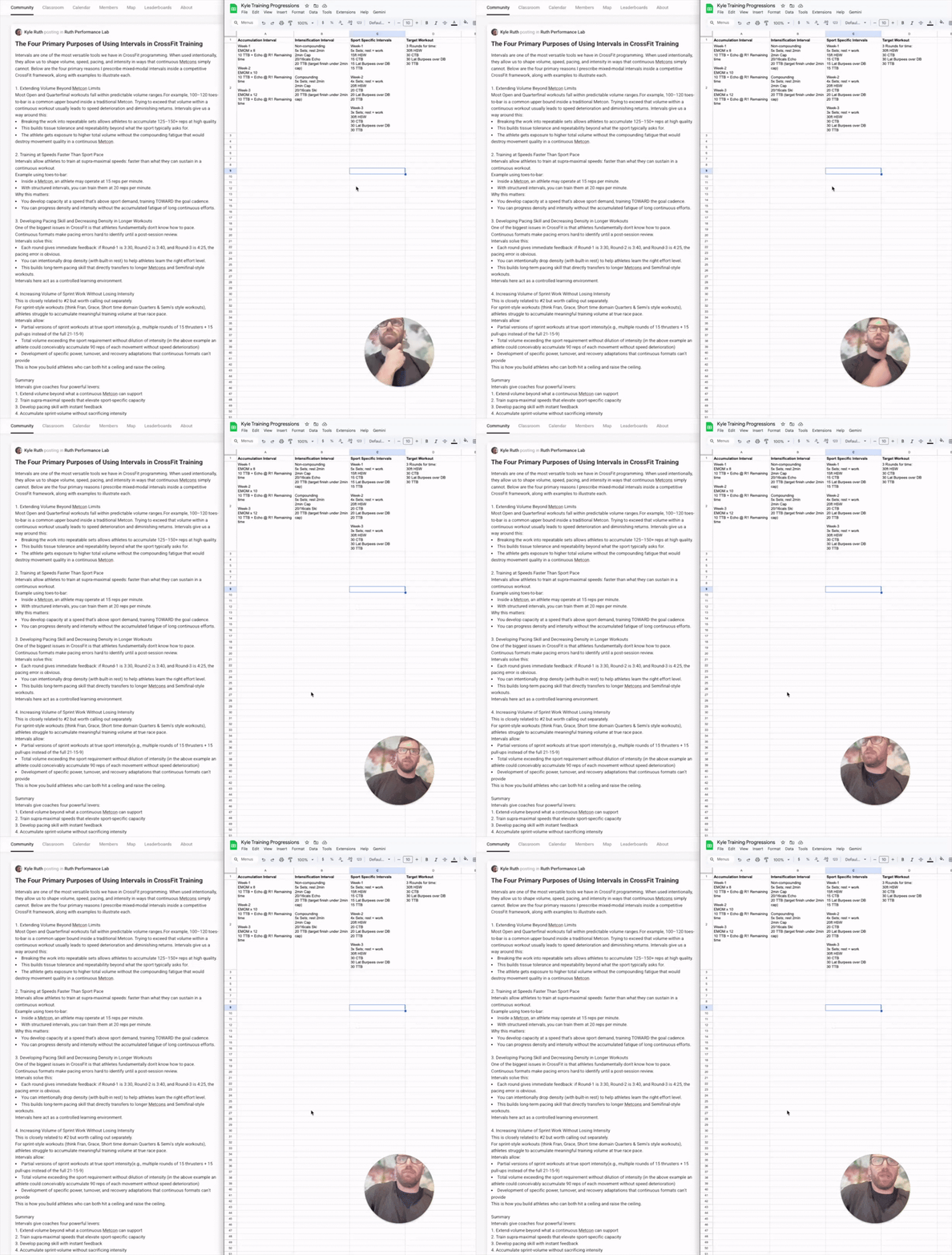
The Four Primary Purposes of Using Intervals in CrossFit Training
Intervals are one of the most versatile tools we have in CrossFit programming. When used intentionally, they allow us to shape volume, speed, pacing, and intensity in ways that continuous Metcons simply cannot. Below are the four primary reasons I prescribe mixed-modal intervals inside a competitive CrossFit framework, along with examples to illustrate each. 1. Extending Volume Beyond Metcon Limits Most Open and Quarterfinal workouts fall within predictable volume ranges.For example, 100–120 toes-to-bar is a common upper bound inside a traditional Metcon. Trying to exceed that volume within a continuous workout usually leads to speed deterioration and diminishing returns. Intervals give us a way around this: - Breaking the work into repeatable sets allows athletes to accumulate 125–150+ reps at high quality. - This builds tissue tolerance and repeatability beyond what the sport typically asks for. - The athlete gets exposure to higher total volume without the compounding fatigue that would destroy movement quality in a continuous Metcon. 2. Training at Speeds Faster Than Sport Pace Intervals allow athletes to train at supra-maximal speeds: faster than what they can sustain in a continuous workout. Example using toes-to-bar: - Inside a Metcon, an athlete may operate at 15 reps per minute. - With structured intervals, you can train them at 20 reps per minute. Why this matters: - You develop capacity at a speed that’s above sport demand, training TOWARD the goal cadence. - You can progress density and intensity without the accumulated fatigue of long continuous efforts. 3. Developing Pacing Skill and Decreasing Density in Longer Workouts One of the biggest issues in CrossFit is that athletes fundamentally don't know how to pace. Continuous formats make pacing errors hard to identify until a post-session review. Intervals solve this: - Each round gives immediate feedback: if Round-1 is 3:30, Round-2 is 3:40, and Round-3 is 4:25, the pacing error is obvious. - You can intentionally drop density (with built-in rest) to help athletes learn the right effort level. - This builds long-term pacing skill that directly transfers to longer Metcons and Semifinal-style workouts.
0 likes • Dec '25
Does it make sense that in this style of progression will be an A week and a B week? For example week A would focus on T2B and B week in other movement or mix of movements?
1 like • Dec '25
@Kyle Ruth Understood, thanks!
1-5 of 5
Active 14h ago
Joined Nov 24, 2025
Powered by