Activity
Mon
Wed
Fri
Sun
May
Jun
Jul
Aug
Sep
Oct
Nov
Dec
Jan
Feb
Mar
Apr
What is this?
Less
More
Owned by Pat
Creatives for the Common Good (partnership of Moulin des Arts Vivants in France & TEACHumanity.org in US)
Memberships
Global Creatives United
65 members • Free
Compelling Communicators
75 members • Free
3 contributions to Compelling Communicators

Feb 4 •
I've coached over 100 TEDx speakers since 2014.
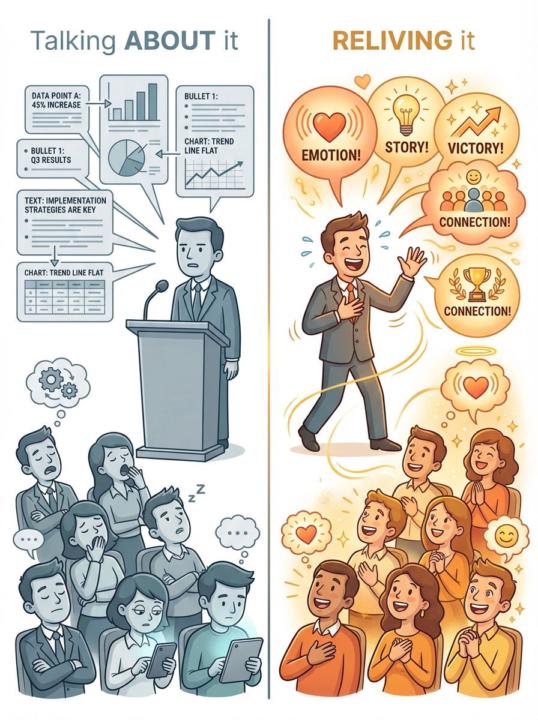
Some talks went viral. Some didn't. But after a decade of watching speakers succeed and fail, the patterns are remarkably consistent. And the #1 mistake I see? 𝗦𝗽𝗲𝗮𝗸𝗲𝗿𝘀 𝘁𝗮𝗹𝗸 '𝗮𝗯𝗼𝘂𝘁' 𝘁𝗵𝗲𝗶𝗿 𝘁𝗼𝗽𝗶𝗰 𝗶𝗻𝘀𝘁𝗲𝗮𝗱 𝗼𝗳 𝗿𝗲𝗹𝗶𝘃𝗶𝗻𝗴 𝗶𝘁 𝘄𝗶𝘁𝗵 𝘁𝗵𝗲𝗶𝗿 𝗮𝘂𝗱𝗶𝗲𝗻𝗰𝗲. They explain. They summarise. They give information. But they don't take the audience on a journey. They don't make them feel what it was like to be there, to experience the moment, to wrestle with the problem. The best talks don't describe an experience — they recreate it. When a speaker shares a pivotal moment, I don't want them to tell me what happened. I want to see it. I want to feel the tension, the doubt, the breakthrough. That's the difference between a forgettable talk and one that changes how people think. If you're preparing a talk or pitch, ask yourself: Am I explaining my topic? Or am I bringing my audience into the experience of it? One informs. The other transforms. Which are you doing? 😉

1 like • Feb 5
This is the difference between "talking" and "teaching ". I love the illustration.
Jan 11 •
The most common Founder mistake...
Most founders are so focused on where they want to go, they forget the audience isn't on the trip with them yet. They talk about their grand vision, their brilliant strategy, and how they're going to change the world. They're vocalising their own narrative. And they wonder why they get polite nods instead of real buy-in. The most powerful shift you can make in your communication is to stop talking about your destination and meet the audience where they are. Start with their reality. Voice their concerns, their frustrations. - "I know you're frustrated with..." - "These are the concerns I had at this point too..." Show them you understand their starting point 𝘣𝘦𝘧𝘰𝘳𝘦 you ask them to imagine a new destination. Only then can you map out the journey. You guide them from "I hear what your frustration is" to "This is what a new transformation could look like." This is a process I take every speaker through. We build two maps: the Audience Logical Journey and the Audience Emotional Journey. You're not dragging them to your finish line. You're taking them on a journey they actually want to be on.

1 like • Jan 13
Great advice! Thank you
Aug '25 •
Introduce yourself...
Let everyone know who you are and where you are. And tell us of the most memorable live presentation you saw or gave. 😃
0 likes • Jan 13
Hiya! I am PatCruz born and raised in Baltimore, Maryland. My husband and I immigrated to France in 2022 where we have a retreat center called Moulin Sage. Here I have a nonprofit called TEACHumanity.org We connect teachers with artists in order to ignite lessons with creativity, critical thinking, and empathy. My fave TEDed talk by one of the best teaching artists I have had the honor to work with is a great example: https://youtu.be/9f8VcV8v2LE?si=MdJUCy_NYmaxq0In
1 like • Jan 13
@Chris Hanlon what a great slam poet! Thanks for sharing her video - I am always looking for kindred spirits to join our collaborative.
1-3 of 3

@pat-cruz-2448
Teacher who teaches TEACHING, Arts Integrationist, Community Organizer, Rebel Rouser
Active 4h ago
Joined Jan 12, 2026
Treignac, France
Powered by