Activity
Mon
Wed
Fri
Sun
Apr
May
Jun
Jul
Aug
Sep
Oct
Nov
Dec
Jan
Feb
Mar
What is this?
Less
More
Owned by Nick
a casual, no-fluff online room for owners and serious starters who want to get unstuck, bounce ideas around, and turn small business into real income.
“Learn how to use tax strategy and cost segregation to turn commercial real estate deals into more after‑tax cash flow.”
Memberships
The Relationship Chef
70 members • Free
Skool Owners Network
83 members • Free
AI Workshop Lite
15.7k members • Free
AI Bits and Pieces
547 members • Free
Legal Launchpad for AIpreneurs
252 members • Free
Skool Speedrun
12k members • Free
Growth Gap Destiny Builders
63 members • Free
AI Automation Agency Hub
300.4k members • Free
The Real Estate Academy
3.7k members • Free
10 contributions to AI Bits and Pieces

17h •
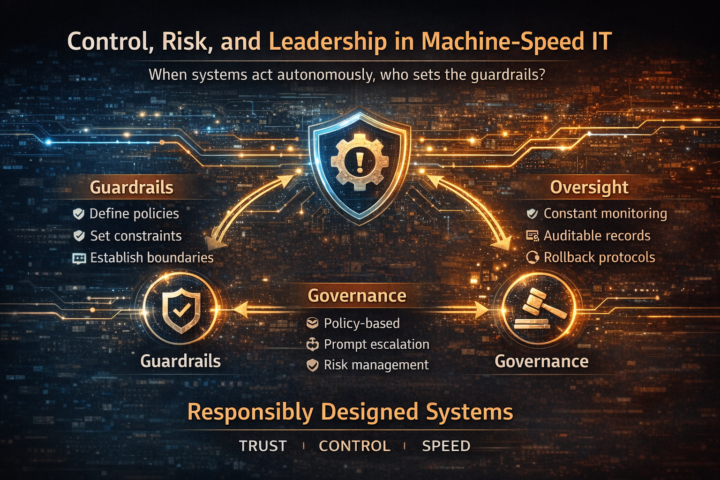
🔐 How AI will Transform Enterprise IT: Part 3 — Control, Risk, and Reluctance
The technical shift to machine-speed IT is already underway. The real challenge will not be computing power, infrastructure, or even AI capability. The challenge will be trust. As systems begin to operate autonomously — coordinating with other systems, making operational decisions, and executing tasks — organizations must answer a fundamental question: How much control are we willing to delegate to machines? 🔐 The Control Question For decades, enterprise processes have relied on human checkpoints. Approvals. Reviews. Manual overrides. Exception handling. These checkpoints exist not only for accuracy, but for accountability. Autonomous systems challenge that model. When decisions occur at machine speed, the traditional approach of reviewing every step becomes impossible. Instead, organizations must shift from transaction oversight to policy oversight. Executives will increasingly define: - What systems are allowed to do - What constraints must never be violated - What thresholds trigger human intervention In other words, leadership moves from approving actions to designing guardrails. 🔐 The New Risk Model Autonomous systems introduce a different kind of risk. Not necessarily worse risk — but faster risk. When machines coordinate decisions across infrastructure, finance, security, and operations, errors can propagate quickly if governance is poorly designed. This makes several capabilities essential: - Clear operational policies - Strong monitoring and audit trails - Immediate rollback mechanisms - Transparent system behavior Trust will not come from removing oversight. It will come from redefining oversight. 🔐 Where Leaders Will Hesitate Despite the advantages, organizations will naturally resist autonomy in several areas. Financial transactions. Regulatory compliance. Customer-facing decisions. Strategic reporting. These domains carry reputational, legal, and financial consequences. Leaders are conditioned to maintain direct involvement.

1 like • 13h
Michael — that’s a great observation. Compliance often slows adoption in the early stages of any major technology shift. But interestingly, once the architecture stabilizes, compliance often becomes the accelerator rather than the barrier. Clear governance frameworks, audit trails, and standardized controls actually make it easier for organizations to trust automated systems. We saw the same pattern with cloud adoption. At first the concerns were security, compliance, and regulatory exposure. But once guardrails and standards matured, the cloud became the default infrastructure layer. AI governance may follow a similar path. The companies that figure out how to design those guardrails early will probably move much faster than those waiting for regulators to define them. Curious if you’re starting to see any industries moving past that “paralyzed” stage yet.
1 like • 12h
Michael — that makes a lot of sense. Historically new technologies almost always enter organizations through non-core systems first. Email before core communications. Cloud before mission-critical infrastructure. Automation before financial controls. AI voice, support tools, and internal assistants feel like the same pattern — clearly bounded environments where the risk surface is limited. What’s interesting is that once reliability becomes visible in those edge systems, the trust boundary slowly expands toward more critical workflows. The technology rarely starts in the core. It earns its way there over time.
2d •
Why Some LinkedIn Posts Keep Growing While Others Disappear
Most LinkedIn posts disappear within minutes. A few likes.Maybe a comment. Then they fade from the feed. But some posts behave very differently. They keep resurfacing.The comment thread grows. In many cases the difference is the first few lines of the post. I broke down the hook structure here: https://taxlogiccre.com/linkedin-hook-structure/ Curious how others approach writing the opening lines of LinkedIn posts.
4d •
🎯 Naming Your AI Agency Part 5 of 5: Taglines - The Hidden Multiplier
You don’t need to have the company name do all the work. That’s rarely necessary. In many cases, the name carries identity — and the tagline carries clarity. Together, they do far more than either one alone. Think of it this way. The name is the container. The tagline explains what’s inside. A strong tagline answers the question people almost always ask when they hear a company name: “What exactly do you do?” It clarifies your positioning. It reduces confusion. It strengthens your market signal. For example: AI & Data Strategies LLC Adopt AI with confidence. The name signals the lane. The tagline signals the outcome. Or take AI Bits & Pieces. The name carries story and identity. The tagline clarifies the tone and focus. AI Bits & Pieces Quick quips, quirks, and insights on people + AI Used together, they create signal. 🎯 What a Good Tagline Should Do A strong tagline usually clarifies at least one of three things: What you do Who you help What outcome you create For example: AI Education for Operators Agent Systems for Founders Adopt AI with confidence Short. Clear. Memorable. It shouldn’t feel like a paragraph. It should feel like positioning. 🎯 The Simple Test Look at your name and tagline together. If someone reads both and still asks, “So what exactly do you do?” It needs tightening. The goal isn’t cleverness. The goal is signal. 🎯 The Strategic Advantage A well-constructed name and tagline together give you: - Clarity - Story - Positioning - Flexibility - Longevity The name anchors identity. The tagline carries explanation. And explanation is where positioning lives. 🎯 Final Thought for the Series Naming isn’t about sounding innovative. It’s about signaling the kind of company you’re building. Some names carry story. Some names carry clarity. Some names optimize for search. Some names are built for longevity. The key is choosing intentionally. And then supporting that name with positioning that makes the signal clear. For example:
2 likes • 4d
One thing I’ve noticed after watching hundreds of businesses and deals over the years: The name creates curiosity. The tagline creates understanding. If the name opens the door but the tagline doesn’t quickly explain the value, people hesitate. The strongest brands usually do three things with their tagline: • Clarify the problem they solve • Signal the outcome they create • Position the type of people they help In other words: Name = Identity Tagline = Signal When both are aligned, people instantly understand what you do. And when people understand quickly, trust forms faster. Curious how others here think about this: Do you prefer outcome-driven taglines or positioning-driven taglines?
Jan 20 •
💍Weekend Wedding🍾🥂🎉
I was at a wedding this past weekend, so I was a little quiet on posting. Spent a few days in Dallas, Texas celebrating some really great friends. It was a nice reminder to slow down, be present, and enjoy the moment. Back at it this week.

2 likes • Jan 20
Nice one, Michael — love the photos and the energy. That reminder to slow down, be present, and then get back after it really lands.

Jan 17 •
🚀 AI Just Got a Major Upgrade: Meet "Skills" in Claude
I've been exploring one of the most significant developments in AI assistance technology, and I need to share this with my network. Anthropic has introduced Skills in Claude a modular system that transforms a general-purpose AI into a specialized expert on demand. Think of it as giving your AI assistant the ability to load exactly the right expertise, workflows, and tools for any specific task. Why This Changes Everything: Traditional AI assistants are generalists. They know a bit about everything, but lack the procedural depth for specialized work. Skills solve this elegantly by providing Claude with: → Specialized workflows for multi-step domain-specific processes → Tool integrations for specific file formats, APIs, and systems → Domain expertise including company-specific knowledge and business logic → Bundled resources like scripts, templates, and reference materials What's Available Out of the Box: The current skill library is impressive. Professional document creation (Word, PowerPoint, Excel, PDF), production-grade frontend design that avoids generic "AI slop" aesthetics, algorithmic art generation, MCP server building, and sophisticated theme systems—all with best practices built in. The Real Game-Changer: Custom Skills Here's where it gets exciting for businesses. You can create your own skills that encode your company's brand guidelines, internal processes, database schemas, and proprietary workflows. I've implemented custom skills for Plexaris that automatically apply our brand identity—colors, typography, visual standards—to any deliverable Claude creates. Imagine asking Claude to create a pitch deck, and it automatically knows your exact brand colors, your preferred fonts , and your glass morphism card styling. That's not a template that's institutional knowledge embedded in your AI assistant. The Technical Elegance: What impressed me most is the progressive disclosure architecture. Skills use a three-level loading system: metadata always present (~100 words), the skill body loaded only when triggered (<5k words), and bundled resources pulled only as needed. This means efficiency without sacrificing capability.
1 like • Jan 17
I'm an old man, the word's out you can't teach an old dog new tricks!
0 likes • Jan 17
“I’m busy, back on the grind” https://pie.yt/?v=https://youtu.be/cMOKamtpUA8?si=ya-DZJifZLsgcTDn&pieshare=1
1-10 of 10

@nick-coppola-9225
45+ years in businesses & CRE, Tax Logic™ was born—putting tax incentives upfront in the proforma to make CRE deals clearer & stronger. ULI Member.
Active 8m ago
Joined Jan 11, 2026
Charlotte, NC
Powered by