Activity
Mon
Wed
Fri
Sun
Sep
Oct
Nov
Dec
Jan
Feb
Mar
Apr
May
Jun
Jul
Aug
What is this?
Less
More
Memberships
Clief Notes
43.7k members • Free
5 contributions to Clief Notes

Jun 19 •
Come hang out on LinkedIn! 📲 (110 Members and Counting!)
A handful of folks from here have started connecting and sharing each other’s content on LinkedIn. Thought it would be nice to have a group over there where we can all contribute to and share our content to a wider audience through our connections. Hopefully continue to drive more folks to the conversations here as well. Please join if you’d like to connect! There’s already 20 of us in there after one day! Go boost your network. https://www.linkedin.com/groups/31160010

0 likes • Jun 22
Joined!
May 31 •
I read Jake's paper and built this
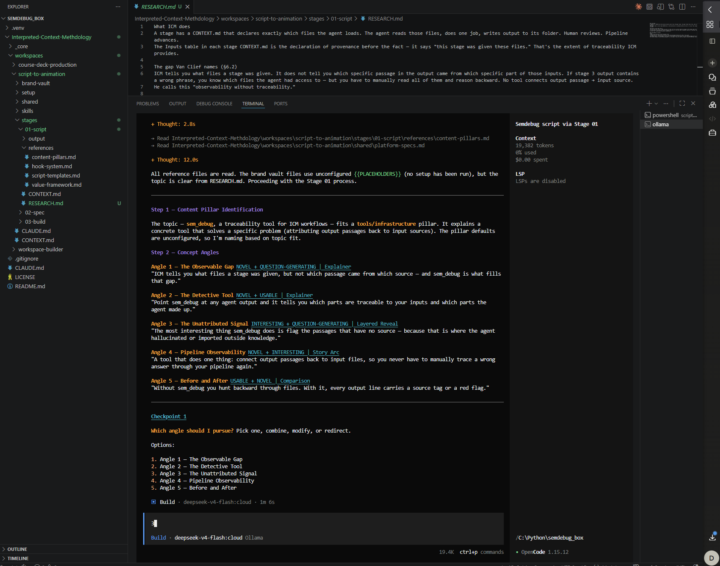
Built something that addresses a gap named in section 6.2 of the ICM paper. https://arxiv.org/abs/2603.16021 Van Clief and McDermott call it "observability without traceability." ICM tells you which files a stage was given. It does not tell you which passage in the output came from which file. If something is wrong, you know what was in the room but you have to read everything and work backward. sem_debug is my attempt at that traceability layer. Point it at a stage output and the declared inputs. It maps every passage back to its source and flags anything with no detectable origin. That unattributed text is where the agent went outside the declared context. I wrote it about a week ago and sat on it because I wasn't sure if I was being a dick. Jake may have already solved this or had something in the works. Figured sharing it was better than sitting on it. Runs inside the ICM workspace structure. Validated on a real pipeline stage. Made the ICM workflow build the tool, because why not. github.com/WBChain3/sem_debug Curious if anyone has experienced the traceability problem, or if Jake has already addressed it somewhere I missed.
1 like • Jun 5
@Aaron Klein Credit where it's due, the declared-input boundary framing came from @Bas Rosario's section-loading suggestion earlier in the thread. We were attacking the same problem from different directions. And your reframe from 'citation feature' to 'operating control' helped shape the decision layer, drift detection is now a gate. So thank you both for the contribution!
1 like • Jun 5
@Curtis Abbott Appreciate it Curtis, happy to answer any questions!

May 30 •
Workflow vs. Reasoning System: what I've been figuring out (learner perspective)
Most of what I see in here is about automating tasks. Building workflows, connecting tools, making things run faster. I've been learning all of it and it's clicking.But I kept hitting a wall that I couldn't name for a while. I was using an LLM app as my operating system. Not just for tasks but for decision-making, project navigation, thinking through problems, tracking where things stood across different work. And it kept falling apart. Sessions ended, context disappeared, drift compounded quietly. By the time something felt wrong, I was already deep in the wrong direction. I lost real work to it. The problem wasn't the tool. The problem was the category error. A workflow system automates a process you already understand. You know the steps, you know the inputs and outputs, you want to run it reliably and faster. It's execution. It shines when the process is stable. A reasoning system is what you need before that. It's the thinking partner that helps you figure out what the process should even be, especially when you're building something from scratch and the process doesn't exist yet. You can't automate your way to a decision you haven't made yet. I was treating a reasoning tool like a workflow system. No persistent state, no routing logic, no structure, just conversation. It can't hold a project together. That's not what it's for. So I've been building what I'm calling CoworkOS, based on ICM principles, a folder architecture that gives Claude a stable structure to operate within across sessions. Routing tables, layered context files, memory that persists. The idea is: before you build workflows inside your projects, you might need an operating layer that actually runs the reasoning coherently. I don't know if this is the right approach yet. Still figuring it out. But the distinction feels important, especially if you're newer to this and trying to figure out where to start. Workflows are powerful once you know what you're automating. The reasoning layer is what gets you there.
1 like • May 31
What you are describing with CoworkOS is the structural layer ICM provides but taken further. ICM gives you declared context per stage. You still have to trust that the agent used what it was given. That gap bothered me enough that I built a tool to close it. Just posted it in Show Your Work if it is relevant to what you are building. It traces every passage in a stage output back to its declared input and flags anything with no detectable source. That unattributed text is where drift actually lives.
May 19 •
I was (likely) targeted by North Korean hackers, so I found the payload and reverse-engineered a security tool.
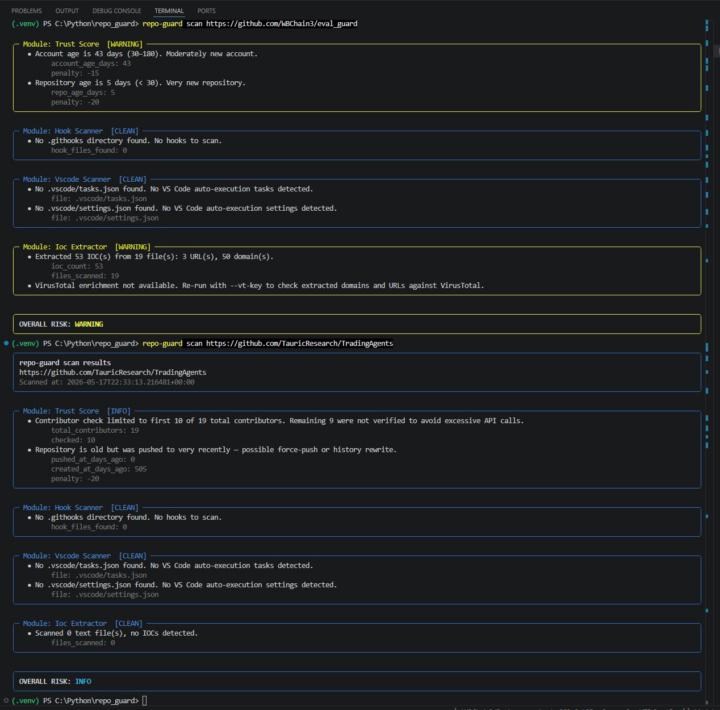
A recruiter contacted me on LinkedIn on Wednesday. CEO of a crypto startup, $125/hr advisory role, review our product via GitHub repo as the first interview step. The social engineering was top-notch, polished profile with 500+ connections, days of back and forth DMs, the cracks only appeared in hindsight. Friday, I got access to the repo, which felt like a win. With a healthy amount of skepticism, I reviewed the repo with Claude. The codebase looked professional and complete, the README was well structured, and the .json files where malware would normally be hidden came back clean. The payload was buried well enough that Claude and I missed it. Luckily, I decided to enjoy my Friday night and not clone the repo. This is the main reason I want to share my story here: many of us are starting new businesses, and when someone offers you a paid role that seems like the perfect fit, your judgment becomes clouded. I know mine did.Having had more time to think, the inconsistencies started to surface. Lying in bed around midnight on Saturday, the eureka moment happened. This was definitely an elaborate scam. I stayed up all night digging through the repo and gathering evidence to file reports. Here’s what I found: The repo contained a fully operational malware delivery chain: - .vscode/tasks.json configured with runOn: folderOpen — silent code execution the moment you open the folder in VS Code, zero prompt. - .githooks/post-checkout buried under 40 lines of decoy comments, downloading and executing a remote payload from a Vercel server across Mac, Linux, and Windows simultaneously, all output suppressed. - Private key social engineering via the .env.local README instruction, a backup vector in case the malware delivery fails or gets caught - This is a complex attack chain designed to pass pre-clone inspection. Once you clone it, you’re cooked. I stayed up all night gathering evidence and filing reports: Vercel - both domains, GitHub - account + repo, LinkedIn profile, Basescan wallet flagged, Neynar/Farcaster. Then the big guns: RCMP/CAFC and FBI IC3. But then I started thinking, what tools should I have used to protect myself in this situation?
1 like • May 19
@Kurt Henninger Thanks for the star, really appreciate it! And that's a great point, the last thing I do before pushing is have Kimi scan for PII and secrets. Sounds like we're on the same page there. Hadn't thought about it as a repo-guard use case but it's worth considering.
1 like • May 19
Thanks everyone for the kind words, questions, and GitHub stars! Didn't expect this kind of response overnight. If you starred the repo, feedback on the tool itself is always welcome. Happy to keep answering questions as they come in. Stay safe out there!

👑
May 17 •
New Video: We Audited a Vibe Coded Production App. Three Holes Found.
Dropped a new one for you all. Mike from Urban Pulse let me share footage from his security audit. He vibe coded his whole platform using my routing architecture, then hired me and my team to read every line before he opened it up to high ticket clients. We took our time over many hours. We found three holes that I share here. A Google Maps API key that had already been flagged and locked down by Google. A second cryptographic auth layer the AI built on top of Supabase, which already handles all of this for you. A JWT verification step that never checked the issuer, meaning any valid Supabase token from any project on the internet would have passed. This is what real building and shipping looks like in the AI world. Mike built something that used to take a year and a couple hundred grand. He did it solo. Then he paid engineers to audit it before any customer touched it. Copy his move. If you are vibe coding anything you plan to put in front of paying clients, watch this one.
1 like • May 18
@Gloria Kate Solo tool for now, open source, built it for the community more than anything. If it gets traction there's a natural path to a broader pre-clone security layer; private repo scanning, contributor network analysis, maybe a GitHub Action that runs on PR. But right now I just want developers to have something they can actually run before they open a stranger's repo. The gap was real, the attack was real, the tool needed to exist. Everything else is secondary. Really appreciate your interest though as I'm very new to all of this.
0 likes • May 18
@Gloria Kate Absolutely! Any tips would be greatly appreciated
1-5 of 5

@max-walker-6717
Recovering crypto bro turned AI Engineering n00b
Active 12d ago
Joined May 12, 2026
Powered by