Activity
Mon
Wed
Fri
Sun
Aug
Sep
Oct
Nov
Dec
Jan
Feb
Mar
Apr
May
Jun
Jul
What is this?
Less
More
Memberships
AI Workshop Lite
38.2k members • Free
AI Skool with Ken Kai
620 members • $69/m
AI Automation Society
425.1k members • Free
AndyNoCode
35.1k members • Free
30 contributions to AI Automation Society


0 likes • 1h
Man, your title is misleading. I was curious to see what Google had suddenly built. Hyperframes + ffmpeg can be used in any coding editor, so where did Antigravity come from? 😕

7d •
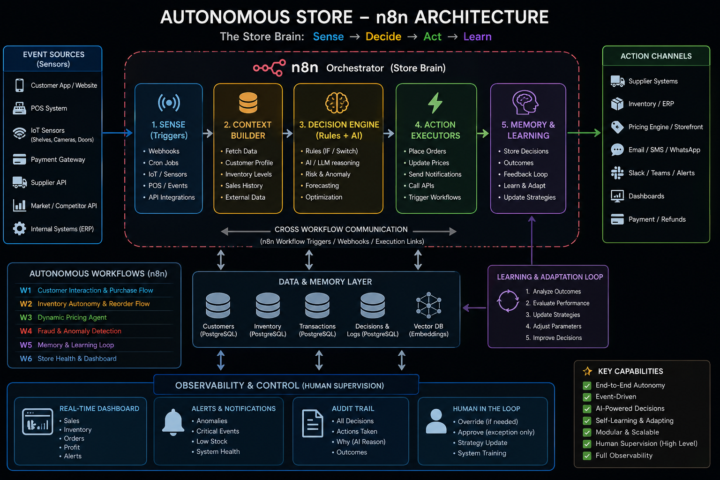
Can we simulate The Autonomous Store in n8n?
Example: Autonomous Store Workflows Customer purchases item → Webhook Inventory drops below threshold → IF node AI decides reorder quantity → LLM node Supplier API order placed → HTTP node Log decision + outcome → Database Notify manager only if abnormal → Slack That is true operational autonomy. Would you add something? Edit? Cannot work? What do you think?
2 likes • 7d
Genuinely impressive diagram, and the flow you wrote underneath is the right shape. Sense, decide, act, learn with a human only on exceptions is exactly how autonomous ops should look. A few things I would add or pressure test, from having watched where these break. The example is mostly deterministic, which is its strength, so I would tighten where the LLM actually sits. Reorder quantity is usually a formula, sales velocity, lead time, safety stock, not a judgment call, so an LLM there adds cost, latency and a chance of a confidently wrong number. Keep the AI for the genuinely fuzzy calls, anomaly reasoning, demand shifts, supplier issues, and let deterministic math own the reorder. That is the recurring lesson in this whole thread, an LLM belongs only where an IF statement cannot go. What I would add is the unhappy path, because that is what separates a demo from real autonomy. What happens when the supplier API times out or rejects the order. What stops a bad trigger reordering five times in a loop. Where is the idempotency key so a webhook firing twice does not double order. Where is the cap, a hard ceiling on spend or quantity that no AI decision can exceed without a human. Right now the diagram shows the flow when everything works. Production is mostly the handling of when it does not. Two smaller ones. Your notify only if abnormal is smart, but define abnormal explicitly or you get alert fatigue or silent failures. And the learning loop is the hardest piece to make real, updating strategies from outcomes needs labeled results and evaluation, otherwise it quietly drifts. Most systems that claim self learning are really just logging. So my honest take, the architecture is sound and the autonomy is real for the happy path. Make the reorder deterministic, put a hard spend cap and retry and idempotency logic around the action layer, and define your alert thresholds, and you move from an impressive diagram to something you would actually trust to run unattended. Nice work, this is a genuinely strong mental model.

7d •
Need Advice On making an Automation
I'm planning to build a white-label AI social media publishing system for my agency clients, and I'd love some advice from people who've already built something similar. The idea I already build websites and run Google Ads/Meta Ads for local businesses. Most of my clients also post daily on Instagram, Facebook, TikTok, and sometimes LinkedIn. Right now, they manually upload the same photos/videos and captions to every platform, which takes a lot of time. I want to build a simple web app where the client only needs to: - Upload photos or videos - Write a caption (or let AI improve/generate it) - Select the platforms - Click Publish Everything else should happen automatically in the background using n8n. Planned architecture Frontend (Lovable / Next.js / Replit) ↓ Webhook to n8n ↓ OpenAI (caption enhancement, hashtags, CTA) ↓ Publish to selected social platforms ↓ Save logs to database ↓ Return success to the frontend The client never sees n8n—they only interact with a clean dashboard. My biggest questions 1. What's the best way to let clients connect their social media accounts? - Instagram - Facebook - TikTok - LinkedIn - X - Google Business Profile - How does the OAuth flow usually work for a SaaS like this? - Where should I securely store access tokens and refresh tokens? - Does n8n handle token refresh automatically, or do I need to build that logic myself? - Would you recommend using n8n as the backend for production, or would you put another backend (Node.js, Supabase Edge Functions, etc.) between the frontend and n8n? - For agencies serving multiple clients, what's the best architecture for keeping each client's credentials and posts isolated? If you've built a similar social media publishing tool or SaaS, I'd really appreciate hearing how you structured it and any lessons you learned along the way. Thanks in advance!
1 like • 7d
Solid plan. The one thing to flag up front is that the hardest part here is not the automation, it is the social platform APIs. That is where projects like this quietly die, so weight your planning there. Most platforms require app review before you can post on a client's behalf. Meta covers Instagram and Facebook but demands business verification and review, and Instagram only publishes through a Business account linked to a Page. TikTok, LinkedIn and X each have their own hurdles. Budget weeks for approvals, not an afternoon. Your questions in order. OAuth flow, the client approves on the platform, then you exchange the code server side for tokens, never in the frontend since it uses your app secret. Storage, keep tokens encrypted in your database tied to client and platform, Supabase with row level security fits well. Refresh, do not rely on n8n for this in a multi client system, its credential model is built for your own accounts, so own the refresh logic yourself. That answers your backend question too. Put a real backend between the frontend and n8n. Let Supabase Edge Functions or a small Node service own auth, token storage, refresh and client isolation, and hand n8n a valid token at run time. Let n8n do what it is good at, the publish orchestration. Do not make it your whole production backend for a system holding many clients' credentials. For isolation, tag every token, post and log with a client id and filter at the database layer with row level security, so a code bug cannot leak one client's access to another. Biggest lesson, build one platform end to end first, usually Instagram via Meta, get the full approve, token, publish, refresh loop working for a single client, then clone the pattern. Launching six platforms at once means six review processes stalling you in parallel. Worth knowing as a plan B, not your foundation: middleman tools like Blotato give you one API key to publish across all major platforms, with OAuth, refresh and rate limits handled for you, plus official n8n nodes. It skips every app review queue, but you would be renting your core publishing layer and inheriting their pricing, limits and uptime, which for a white label agency system is exactly the part you want to own. Keep it in your back pocket if review timelines block you, but build to own the plumbing if you can.

21d •
Every n8n builder hits this problem. I just built the solution.
I just shipped my first n8n community node. I built it because workflows that ran perfectly on 10 items kept throwing API rate limit errors on 500. The only workaround most people know is the Wait node where you literally guess a delay and hope it's enough. So I built the Rate Limiter node to fix this properly. Here's how it works: 1️⃣ Check your API docs for the rate limit (Gemini 2.5 Flash = 10 req/min, Airtable = 5 req/sec) 2️⃣ Drop the Rate Limiter node before your API call or HTTP node 3️⃣ Set the exact number, requests per second or per minute 4️⃣ Run your workflow. The node automatically processes each item with the right delay in between, ensuring every single item goes through without hitting the API limit. No more guessing the delay time. Now live on n8n Cloud ✅ To install: Search "Rate Limiter" directly in your n8n canvas and drop it in. For more details, Here is the npm link 👇 https://www.npmjs.com/package/@divyanshu00

1 like • 21d
Solid first ship by the way, solving your own real pain is exactly how the best nodes get built.

23d •
Which is actually getting you hired right now, the new stuff or n8n?
Genuine question that's been bugging me. Everyone in here is moving fast with Claude Code and Cowork, and the n8n material got archived. But I still see a ton of clients and job posts asking specifically for n8n. So which is it actually worth going deep on right now if your goal is paying clients, not just cool personal builds? Are you betting on the newer stuff, or sticking with what businesses already recognize and ask for by name? Would love to hear what's actually getting you hired versus what's just fun to play with.
2 likes • 23d
Honest answer, n8n is what gets you hired right now, and it is not close. Businesses buy what they can name, scope and put a budget on, and n8n is a known quantity with a known deliverable. A Claude Code agent is harder for a non technical buyer to picture or trust, so it rarely shows up in the job post even when it would do the job better. But the either or is the trap. Sell what they ask for, deliver it with the newer stuff. n8n is the keyword that gets you in the door, Claude Code is the edge that lets you finish the same job in half the time and take on the ones other freelancers cannot. The client never asks how you built it, only that it works, so you get paid on the recognized name and win on the hidden capability. Keep in mind that asked for by name is a lagging indicator too, a tool lands in job posts long after it matured, so the people learning the new stuff now are the ones the market asks for by name later. One more thing, do not get pulled into shiny object syndrome. There is a fresh buzzword every week, AI OS being the latest, and honestly 90% of the people throwing that term around could not tell you what it actually is. Clients do not buy buzzwords, they buy a problem that stays solved. Think of it like commuting to work. You need a reliable car that starts every morning, not an F1 car. The F1 is faster and far more impressive, but it is useless for the commute, costs a fortune and needs a pit crew. Chase the trophy tech for fun on your own time, and get paid solving the boring commute, because that is what businesses are actually buying.
1-10 of 30

@leon-h-3441
Exploring the future through AI and emerging tech. Sharing insights and making innovation approachable for everyone.
Active 1h ago
Joined Feb 13, 2025
Canada
Powered by