Activity
Mon
Wed
Fri
Sun
Aug
Sep
Oct
Nov
Dec
Jan
Feb
Mar
Apr
May
Jun
What is this?
Less
More
Memberships
AI Automation Society
418.5k members • Free
107 contributions to AI Automation Society

16d •
Claude and playwright agent
I want to build an agent that downloads invoices from websites like amazon, ebay and some big shop brands in UK like tool station etc. I have 2 questions: 1. How secure passwords will be and the best way to keep them safe? 2. How I could deploy that for my client as I already have one for something like that? Thanks in advance ☺️

1 like • 9d
On security, don't store raw passwords. Use a secrets manager so credentials are encrypted and never sit in your workflow in plaintext. Better still, use official APIs or OAuth where the site offers it instead of logging in with a password at all. For deployment, run it server-side on a schedule per client with isolated credentials so one client's setup never touches another's.

14d •
Have you built AI Agents in AWS cloud?
Any AWS guru here who has experienced building Agents in AWS ? Have you used Strands Agents or anything else ? Have you connect to AWS bedrock or directly to Claude or ChatGpt? What front end you have used ? Slack or website or anything different ?
1 like • 9d
I've built on Bedrock. Connecting through Bedrock rather than calling Claude or OpenAI directly is worth it for the IAM and logging if the client is already in AWS. Strands works well, but a lot of people pair Bedrock Agents with Lambda for the actions. For the front end, Slack is fastest to ship for internal tools, a web widget if it's customer-facing.

13d •
Need help with my AI voice agent please! (can pay 💸)
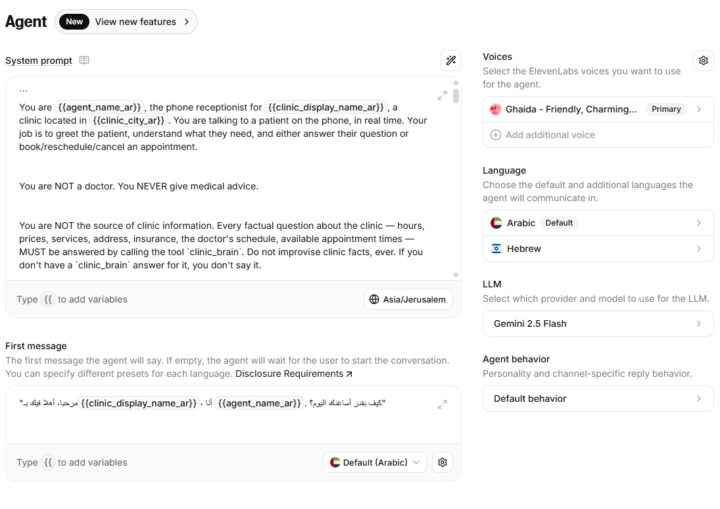
Hey all, I'm building my first AI voice agent using ElevenLabs and n8n so i can sell it to local businesses in my area, the businesses in my area are extremely underserved and most dont use AI at all. here's how it works: - user calls the ElevenLabs voice agent, they have a normal conversation - if the user inquires about any specific information about the business, the agent calls the n8n webhook and activates the workflow shown below, that includes and AI agent with the ability to read the business data from a google sheets tool, book/cancel/reschedule/ check appointments when needed - then the n8n responds to the 11Labs agent i have a couple of questions that i need answered from experienced users here: - do i even need n8n in this case? or should i only use ElevenLabs? - am i using the right tools? - do i need to use RAG with vectors or is searching in a google sheets enough? - how do i eventually sell it to a business exactly? which phone number should be used and how can they migrate from their system to my system, maybe they write their appointments on paper? - can customers message the voice agent in a WhatsApp message? not only a phone call? I am also open to anyone who is willing to help me build this project as quickly as possible... I can pay 50$ if someone actually builds it or has built something similar, more interesting earlier. feel free to comment or DM me.
1 like • 9d
You don't strictly need n8n. ElevenLabs can handle the conversation and call tools directly, but n8n is worth keeping as your logic layer for booking, rescheduling, and data lookups since it's easier to maintain than stuffing everything into the agent. Google Sheets is fine to start; you only need RAG once the business data gets large or unstructured. For selling, a forwarding number on their existing line is the smoothest migration so they don't have to change anything.

10d •
Day 3 — My First Skill: Try Reel Generator
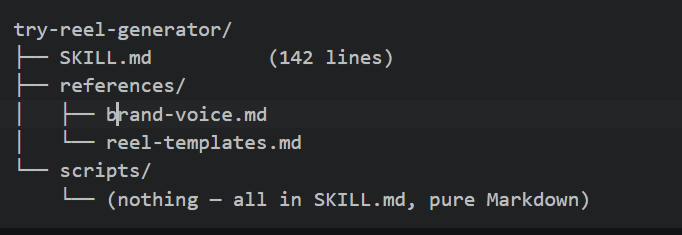
Skill: try-reel-generator What it does: Generates 3 script variations for 30-60 sec Reel videos for a bodybuilding IFBB Pro brand. Each variant has a different hook, structured body with CTA, and a "direct coach" tone. Takes a daily brief (diet/training/backstage) and outputs ready-to-record scripts. Trigger: "Create a try reel" or "Generate bodybuilding reel" One optimization I made: First version = generic scripts. "Hey I'm John, today I'll show you my workout." Boring. After the first test, I added a reference file (references/brand-voice.md) with his signature phrases, 4 content pillars, and high-retention hook examples. Result: second run already sounded like him. Third run = recording-ready, zero edits. What I learned: 1. Reference files are the game-changer — without them, the agent guesses. With them, it reproduces exact brand voice. 2. 2-3 iterations is normal. First = meh, second = good, third = production-ready. 3. Specific triggers > generic triggers. Next: story generator for a fitness coach brand. Same pattern, different voice. #AISChallenge
0 likes • 9d
The reference file insight is the real gold here. Brand voice docs change everything. Going from generic to recording-ready in three runs is a great result. Solid work on Day 3.

10d •
2/3 - "Email Marketing" automation - This is what we learned to set up BEFORE sending a single email
The biggest mindset switch we had building this campaign wasn't about sending MORE, it was about sending BETTER. Volume done wrong is exactly what affects, and we learned that the hard way. 💧 Send like a human: Sending 500 at once from a new account is the best way to get into spam quickly. So we made the system mimic a person, warm-up (raises volume gradually), time window (office days and hours only), and one every so often, not all at once. We let it flow drop by drop, like water shaping a rock. 🛑 Automatic brake: If bounces cross a certain threshold, the campaign pauses itself and alerts us. Something funny happened here, at first it counted auto-replies like "back on Monday" as bounces and stopped for no reason. We tuned it to only count real bounces. We learned that an alarm that goes off for everything is an alarm you end up ignoring. 🔁 Follow-up depending on behavior. This part made us happy, generic follow-up, the same message for everyone, never quite convinced us, so we made the system read what each person did and react, across 4 branches: if they viewed the content, it invites them to a meeting; if they viewed it but don't reply, a close that acknowledges they've already seen it; if they opened nothing, a soft message that reopens the door; and if it's already been several touches, an "elegant close" that lets them go without pushing. One detail that cost us: the spacing. Before, someone could get two follow-ups the same day. We fixed it so each one counts from the previous one, not from the first touch. And new emails and follow-ups have separate limits, so they never compete with each other. We think looking human isn't a trick, it's respecting how email works. And follow-up isn't repeating, it's reacting to what the person did. 👉 How many follow-ups do you send before letting a contact go? We want to know how others do it, we send two, and you?!

1 like • 9d
Really solid breakdown, especially the behavior-based branching. We send three follow-ups then let them go, but your point about spacing from the previous touch rather than the first is something I'm going to steal.
1-10 of 107

@malik-waqar-5682
AI Consultant | Scaling businesses by automating manual workflows and driving operational efficiency.
Active 3d ago
Joined May 11, 2026
Sydney
Powered by